
At first glance, the Royal Tombs of the Joseon Dynasty may look simple. You may see a grassy mound, pine trees, stone statues, and a quiet path. There are no colorful throne halls, no palace guards, and no dramatic city views.
But once you understand their meaning, these royal tombs become some of the most powerful historical places in Korea. They show how the Joseon Dynasty remembered its kings and queens, honored royal ancestors, and connected nature, ritual, and political authority. UNESCO lists the Royal Tombs of the Joseon Dynasty as a collection of 40 tombs across 18 locations, built over five centuries from 1408 to 1966.
This Royal Tombs of the Joseon Dynasty guide is written for travelers who want more than a quick photo stop. It will explain what these tombs are, why they matter, what to look for, and which tombs are easiest or most meaningful to visit. As a Korean local, I think these sites are among the best places to feel Korea’s royal past in a calm and natural setting.
Why the Royal Tombs of the Joseon Dynasty Matter
The Royal Tombs of the Joseon Dynasty matter because they are not just graves. They are carefully designed ritual landscapes where Joseon kings, queens, emperors, and empresses were remembered after death. The Korea Heritage Service’s Royal Palaces and Tombs Center explains that the UNESCO-listed tombs refer to 40 graves of monarchs and their consorts from Joseon and the Korean Empire.
Joseon was a Korean kingdom that lasted from 1392 to 1897. After 1897, Korea became the Korean Empire, which lasted until 1910. The royal tombs therefore connect the long Joseon period with the final years of Korea’s monarchy.
In Joseon society, Confucianism was very important. Confucianism, in simple terms, emphasized respect for ancestors, family order, moral leadership, and proper rituals. The royal tombs were built and managed according to these values, especially filial piety and ceremonial propriety.
Historical Background: Joseon Dynasty and Royal Memory
To understand the royal tombs, it helps to understand how Joseon kings thought about memory and duty. A king’s role did not end with ruling the living. He also had to honor the royal ancestors who came before him.
These tombs were places where the living royal court continued to show respect to deceased rulers. Memorial rites were performed, and the tombs were maintained as sacred spaces. According to UNESCO, the tombs honored ancestors, showed respect for royal achievements, asserted royal authority, and protected ancestral spirits.
This is why the royal tombs feel different from ordinary parks. They are peaceful, but they are not casual. They are natural, but they are also formal. Every path, gate, mound, stone figure, and ritual building has meaning.
What Makes Joseon Royal Tombs Different
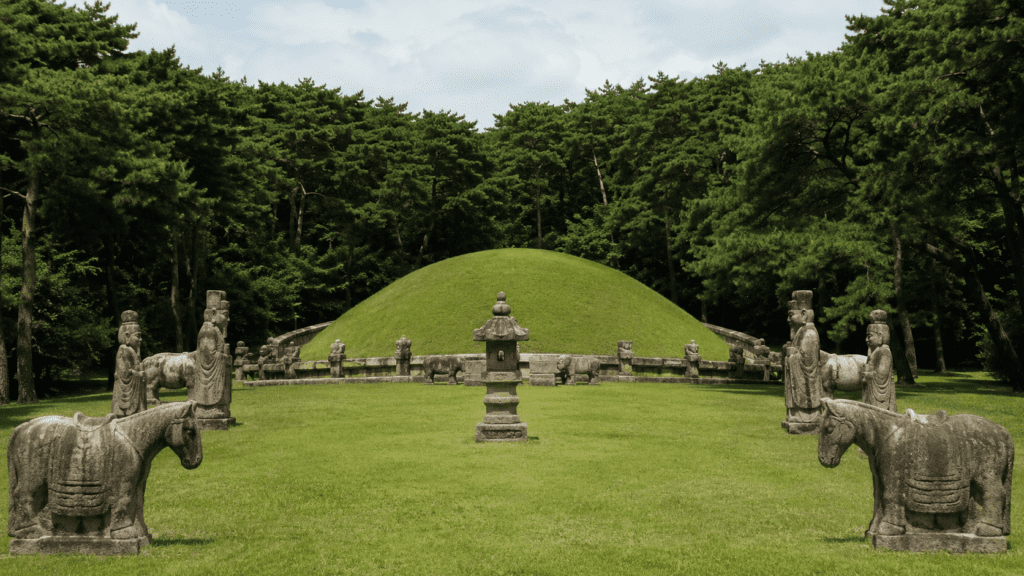
A Joseon royal tomb is not only a burial mound. It is a complete cultural landscape. The tomb usually includes an entrance area, a ceremonial area, and the sacred burial area where the king or queen was laid to rest.
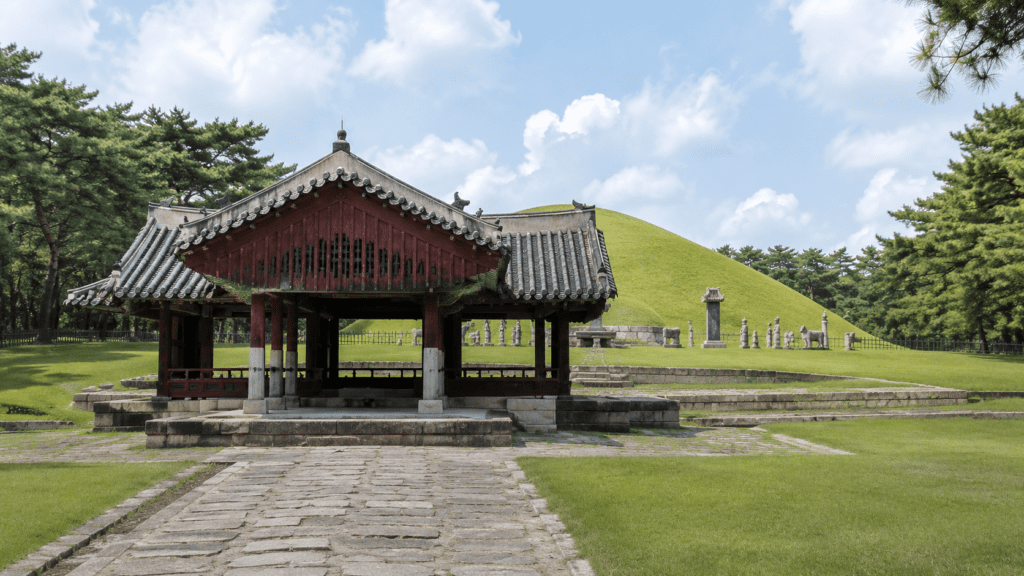
UNESCO notes that these tombs often include a T-shaped wooden shrine, a stele shed, a royal kitchen, a guards’ house, a red-spiked gate, and stone figures of people and animals. These features helped organize the site for royal ancestral rituals.
The tombs were also placed carefully in nature. Good sites were chosen according to pungsu, the Korean term for geomancy, similar to feng shui. Ideally, a tomb would have a protective hill behind it, face south toward water, and be surrounded by a harmonious landscape.
Key Features Travelers Should Notice
When you visit a Joseon royal tomb, start with the approach. Many tombs have a quiet path leading through trees toward the ritual area. This slow approach helps you leave the modern city behind and enter a more solemn space.
Look for the hongsalmun, a red-spiked gate that marks the sacred entrance. You may also see a stone path divided into different levels or lanes. In traditional interpretation, one path was connected to the spirit of the deceased ruler, while another was used by living ritual participants.
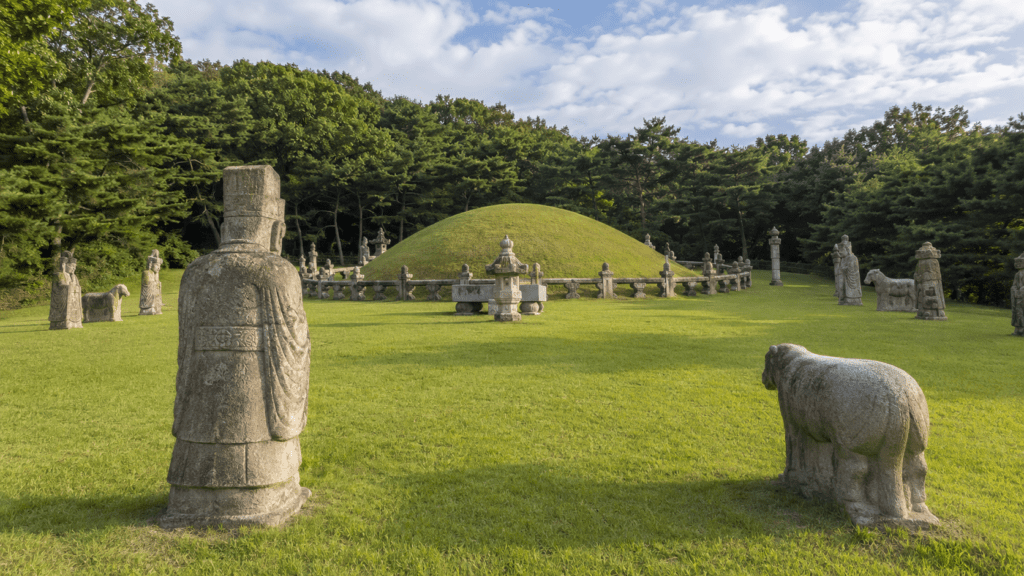
The jeongjagak, or T-shaped ritual pavilion, is one of the most important buildings. This was where memorial rites were performed. Behind it, usually higher on the hill, you will see the grassy burial mound. Around the mound, stone animals, stone lanterns, and statues of civil and military officials symbolically guard the royal resting place.
Confucianism, Pungsu, and the Landscape
The Royal Tombs of the Joseon Dynasty are meaningful because they combine Confucian ritual with Korean landscape ideas. Confucianism gave the tombs their moral and ceremonial purpose. Pungsu shaped their relationship with mountains, water, and direction.
This is why the tombs are usually calm and spacious. They were not built to show wealth in a loud way. They were built to show order, respect, and harmony between the royal family, ancestors, and nature.
UNESCO explains that the natural surroundings of the tombs, shaped by pungsu principles, create a setting for the living tradition of ancestral worship. It also notes that the tombs show a hierarchical movement from ordinary space to sacred space. For travelers, this means the best way to enjoy the tombs is to walk slowly and notice how the space changes.
Best Royal Tombs to Visit for Travelers
There are many Joseon royal tombs, so first-time visitors often wonder where to begin. The best choice depends on your route, your interest in history, and how much time you have. Some tombs are easy to visit in Seoul, while others are better for a half-day or full-day trip.
For most travelers, Seolleung and Jeongneung Royal Tombs in Gangnam are the easiest introduction. They are in central Seoul, near COEX and Bongeunsa Temple. VisitKorea explains that Seolleung holds King Seongjong and Queen Jeonghyeon, while Jeongneung holds King Jungjong, Seongjong’s son.
For a deeper historical experience, Donggureung, or the East Nine Royal Tombs, in Guri is one of the most impressive sites. Donggureung means “nine tombs in the eastern part of the capital,” and it includes the tomb of King Taejo, the founder of Joseon.
For travelers interested in King Sejong, Yeongneung in Yeoju is especially meaningful. Yeongneung is the tomb of King Sejong, the fourth ruler of Joseon, and Queen Soheon. VisitKorea describes it as the combined tomb of King Sejong, who created the Korean alphabet, and his wife.
Seolleung and Jeongneung: Best for First-Time Visitors in Seoul
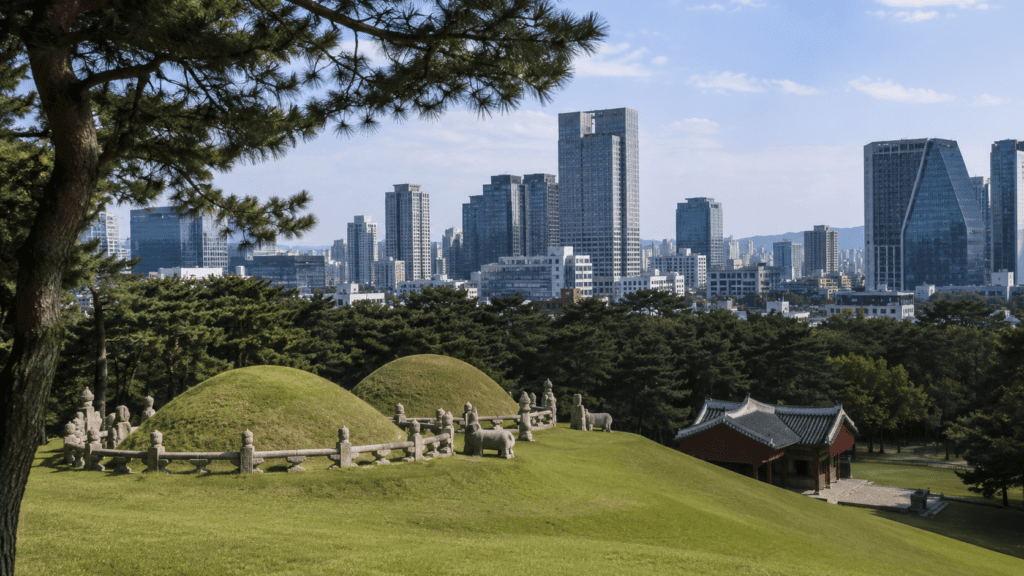
Seolleung and Jeongneung are the most convenient royal tombs for many Seoul travelers. They are located in Gangnam, one of the busiest and most modern districts in the city. This contrast makes the experience memorable: royal tombs from the Joseon Dynasty surrounded by today’s office towers, apartments, and traffic.
Seolleung is the tomb of King Seongjong, the ninth king of Joseon, and Queen Jeonghyeon. Jeongneung is the tomb of King Jungjong, the eleventh king of Joseon. The Royal Palaces and Tombs Center also lists these tombs as part of the Joseon royal tomb system in Seoul.
This site is a good choice if you do not have time to leave Seoul. You can visit in about one hour, walk through the trees, see the ritual pavilions, and understand the basic structure of a Joseon royal tomb. It also pairs well with Bongeunsa Temple or COEX.
Donggureung: The Largest Royal Tomb Cluster Near Seoul
Donggureung is one of the best choices if you want to feel the scale of Joseon royal memory. It is located in Guri, just east of Seoul. The name means “East Nine Royal Tombs,” and it contains several tombs connected to important Joseon rulers and queens.
The most symbolic tomb here is Geonwolleung, the tomb of King Taejo, the founder of the Joseon Dynasty. For travelers who have already visited Gyeongbokgung Palace or Jongmyo Shrine, this is a powerful next step. You move from the palace of royal rule and the shrine of royal ancestors to the tomb of the dynasty’s founder.
Donggureung is more spacious than Seolleung and Jeongneung. It is better for travelers who enjoy walking, forests, and quiet historical landscapes. The site also helps you understand that Joseon royal tombs were not isolated monuments but part of a larger system of dynastic memory.
Yeongneung: Visiting the Tomb of King Sejong
Yeongneung in Yeoju is one of the most meaningful royal tombs for foreign travelers because it is connected to King Sejong. King Sejong is widely remembered for supporting the creation of Hangul, the Korean writing system. Hangul made reading and writing more accessible to ordinary people, and it remains one of Korea’s most important cultural achievements.
Yeongneung is the tomb of King Sejong and Queen Soheon. The Royal Palaces and Tombs Center identifies Yeongneung as their double burial tomb, while nearby Nyeongneung is connected to King Hyojong and Queen Inseon.
A visit to Yeongneung is especially good for travelers who want to connect Korean language, science, and royal history. Yeoju is outside Seoul, so it works best as a half-day or day trip. If you are writing a Korea itinerary with deeper cultural meaning, this tomb deserves serious consideration.
Hongneung and Yureung: From Joseon to the Korean Empire
Hongneung and Yureung in Namyangju show a later chapter of Korea’s royal history. These are imperial tombs connected to the Korean Empire, not only the earlier Joseon kingdom. This makes them interesting for travelers who want to understand Korea’s transition from dynasty to empire in the late 19th and early 20th centuries.
Hongneung is the tomb of Emperor Gojong and Empress Myeongseong. Yureung is the tomb of Emperor Sunjong, Empress Sunmyeong, and Empress Sunjeong. The Korea Heritage Agency explains that Hongneung was created in a new form designed for the Korean emperor, different from conventional Joseon royal tombs.
This site is especially meaningful if you are interested in Korea’s modern history. It connects royal tradition with a period of political pressure, reform, empire, and colonial threat. The atmosphere is still quiet, but the historical emotions feel different from earlier Joseon tombs.
Cultural Meaning: A Place Between Life, Death, and State Ritual
The Royal Tombs of the Joseon Dynasty are places between life and death. They are burial sites, but they were also used by the living. Kings, officials, and ritual participants came here to honor past rulers and continue the relationship between the present court and royal ancestors.
This is why these tombs are both natural and ceremonial. The grass, trees, hills, and open sky create peace. The gates, stone paths, pavilions, and statues create ritual order.
Many travelers are surprised that the tombs are not more decorative. But that restraint is part of their meaning. Joseon royal culture often valued dignity, balance, and moral symbolism over excessive display.
Hidden Stories and Local Perspective
For many Koreans, royal tombs are not only history sites. They are also peaceful walking places. Families, students, and local residents sometimes visit them to enjoy trees, quiet paths, and seasonal changes.
This does not mean the tombs are ordinary parks. Visitors should still respect them as royal burial and ritual spaces. You should not climb the burial mounds, cross restricted areas, or treat the site like a picnic ground.
From a local perspective, the beauty of Joseon royal tombs is quiet. They do not explain themselves loudly. They ask you to slow down, read the signs, look at the landscape, and imagine the rituals that once took place there.
Travel Tips for Foreign Visitors
Before visiting any royal tomb, check current opening hours, closed days, ticket prices, and access rules. Information can change depending on season, restoration work, holidays, or special events. Official tourism and heritage websites are the best sources for the latest details.
Wear comfortable shoes because most royal tomb visits involve walking on paths, slopes, or stone surfaces. Spring and autumn are the best seasons for many visitors. Spring brings fresh green landscapes, while autumn gives the tombs a peaceful atmosphere with colorful leaves.
Choose the tomb based on your itinerary. For an easy Seoul visit, go to Seolleung and Jeongneung. For a larger royal tomb landscape, choose Donggureung. For King Sejong and Hangul history, visit Yeongneung in Yeoju. For late royal history and the Korean Empire, consider Hongneung and Yureung.
Nearby Places to Visit
If you visit Seolleung and Jeongneung, you can also visit Bongeunsa Temple, a major Buddhist temple near COEX. This combination is convenient because it lets you experience both royal Confucian heritage and Korean Buddhist culture in the same area. COEX is also nearby for shopping, food, and indoor attractions.
If you visit Donggureung in Guri, plan extra time for a slower historical walk. It is less about quick sightseeing and more about atmosphere. You can combine it with a local meal in Guri or return to Seoul for an afternoon palace visit.
If you visit Yeongneung in Yeoju, consider adding Yeoju Museum or Silleuksa Temple. This makes the trip more balanced because you can connect King Sejong’s tomb with local history, temple culture, and a quieter riverside city outside Seoul.
Frequently Asked Questions
Q. Are the Royal Tombs of the Joseon Dynasty worth visiting?
A. Yes, they are worth visiting if you are interested in Korean history, royal culture, UNESCO heritage, or quiet places in nature. They are less colorful than palaces, but they show a deeper side of Joseon culture through ritual, landscape, and memory.
Q. Which Joseon royal tomb is easiest to visit from Seoul?
A. Seolleung and Jeongneung Royal Tombs in Gangnam are usually the easiest for first-time visitors. They are located in central Seoul and can be combined with COEX or Bongeunsa Temple.
Q. What is the most famous Joseon royal tomb?
A. Yeongneung, the tomb of King Sejong and Queen Soheon, is one of the most meaningful for many travelers. King Sejong is closely connected with Hangul, the Korean alphabet, so the site has strong cultural importance.
Q. Can visitors enter the burial mound area?
A. In most cases, visitors cannot freely enter the sacred burial mound area. You can view the tombs from designated paths and viewing points, but restricted areas should be respected because these are royal burial sites.
Q. Why are the Royal Tombs of the Joseon Dynasty UNESCO World Heritage Sites?
A. They are UNESCO World Heritage Sites because they preserve a rare and complete royal tomb tradition from a long-lasting dynasty. They also show the connection between Confucian ritual, pungsu landscape principles, architecture, and ancestral worship.
Q. How long does it take to visit a Joseon royal tomb?
A. A smaller and convenient site like Seolleung and Jeongneung may take about one hour. Larger sites such as Donggureung can take longer, especially if you want to walk slowly and see several tomb areas.
Q. What is the difference between a palace and a royal tomb?
A. A palace was where kings lived, worked, held ceremonies, and managed the state. A royal tomb was where deceased kings and queens were buried and honored through memorial rituals.
Final Thoughts
The Royal Tombs of the Joseon Dynasty are among the most meaningful places to understand Korea’s royal past. They may not impress visitors in the same immediate way as Gyeongbokgung Palace or Changdeokgung Palace, but their power is different. They speak through silence, space, stone, trees, and carefully arranged ritual landscapes.
For foreign travelers, these tombs offer a chance to see how Korea remembered its kings and queens after death. They show that Joseon royal culture was not only about throne halls, palace politics, and royal ceremonies in the capital. It was also about honoring ancestors, protecting memory, and placing human life within a larger natural and moral order.
When you visit, do not rush. Look at the red-spiked gate, the stone path, the T-shaped ritual pavilion, the grassy mound, and the stone guardians. Notice how the tomb is placed against the hill and how the surrounding trees create a peaceful boundary from the modern world. These details help you understand why the Royal Tombs of the Joseon Dynasty are not just historical remains, but cultural landscapes filled with meaning.
For a first visit, Seolleung and Jeongneung are the easiest choice in Seoul. For a deeper royal history route, Donggureung is excellent. For travelers interested in King Sejong and Hangul, Yeongneung in Yeoju is especially rewarding. Together with Korea’s palaces and Jongmyo Shrine, the royal tombs complete the story of Joseon: how kings ruled, how ancestors were honored, and how history was remembered across generations.
Suggested Internal Links
- Gyeongbokgung Palace History for Travelers
- Changdeokgung Palace Guide for First-Time Visitors
- Jongmyo Shrine Guide: Seoul’s Quiet Royal Ancestral Shrine
- King Sejong and Hangul: A Traveler’s Guide to Korean History
- Best UNESCO World Heritage Sites to Visit in Korea