Sajikdan makes more sense when you first place it on a map of the Joseon capital. West of the main palace stood the altars for soil and grain. East stood Jongmyo, the royal ancestral shrine. Together, these sites expressed responsibilities that extended beyond the palace walls.
At Sajikdan (사직단), 89 Sajik-ro, Jongno-gu, start with the site plan, identify the two altars, then look at the buildings used to prepare ceremonies. It is a compact history stop for travellers interested in how a kingdom connected rule, agriculture and ritual.
Begin with the ruler’s view of the capital
The Royal Palaces and Tombs Center’s history of Sajikdan explains the arrangement often described as the ancestral shrine on the left and the soil-and-grain altars on the right. The reference point is a ruler facing south: left is east, and right is west.
This viewpoint resolves an apparent contradiction on a north-up map. Jongmyo appears to the map reader’s right, while Sajikdan appears to the left. Both descriptions fit once you establish whose direction is being used.
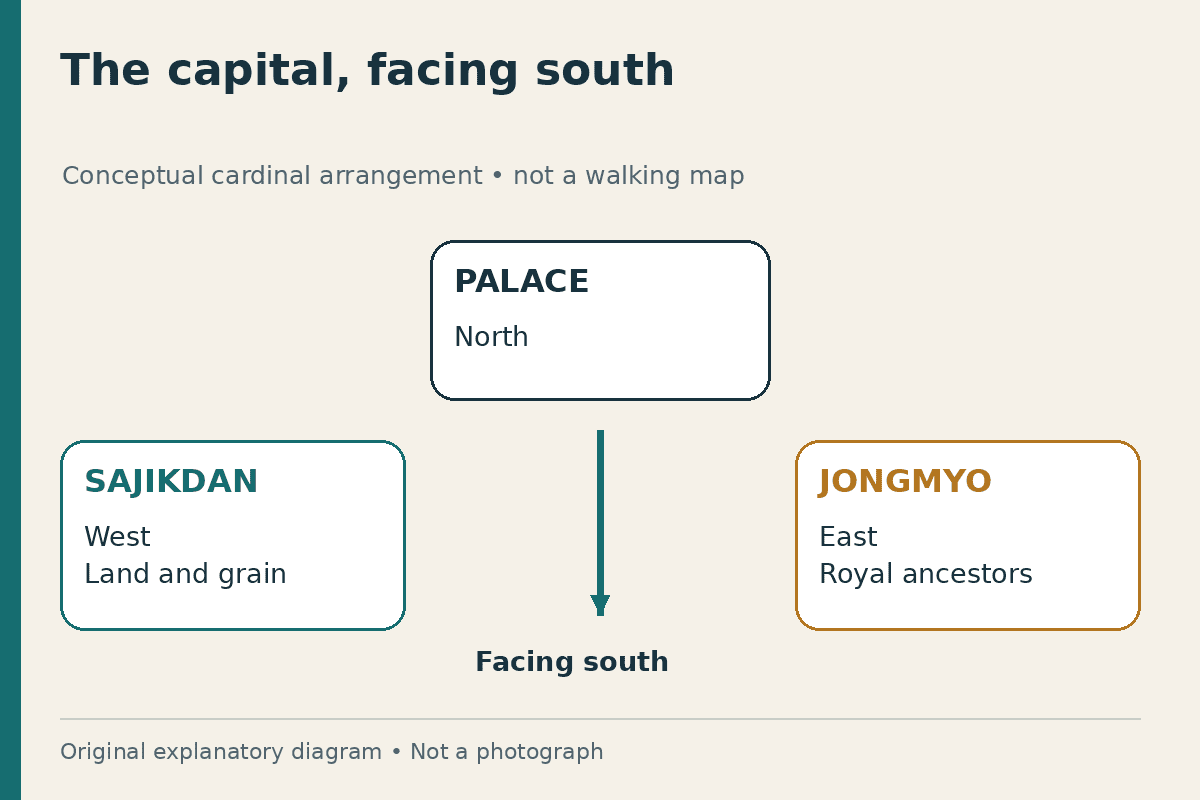
Use the diagram as a relationship sketch, not a walking map. It shows why the locations mattered to the capital’s organisation. It does not imply that visiting both sites forms a short, uninterrupted stroll.
The managing authority dates Sajikdan’s foundation to 1395. Its purpose was to honour the deities of soil and grain, concerns central to an agricultural state. The site thus offers a different historical question from a palace residence: what did rulers regard as essential to sustaining the country?
Find east and west before naming the altars
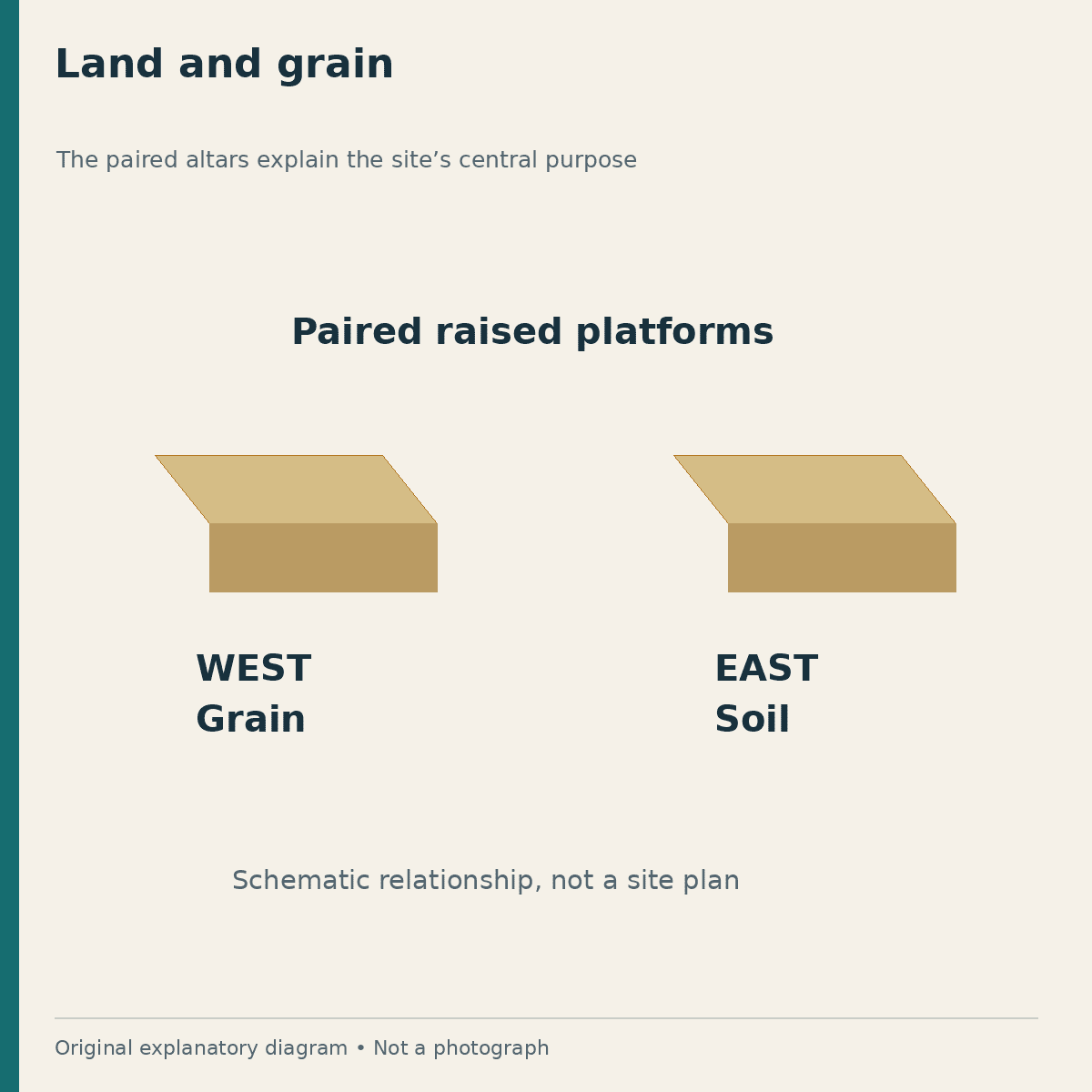
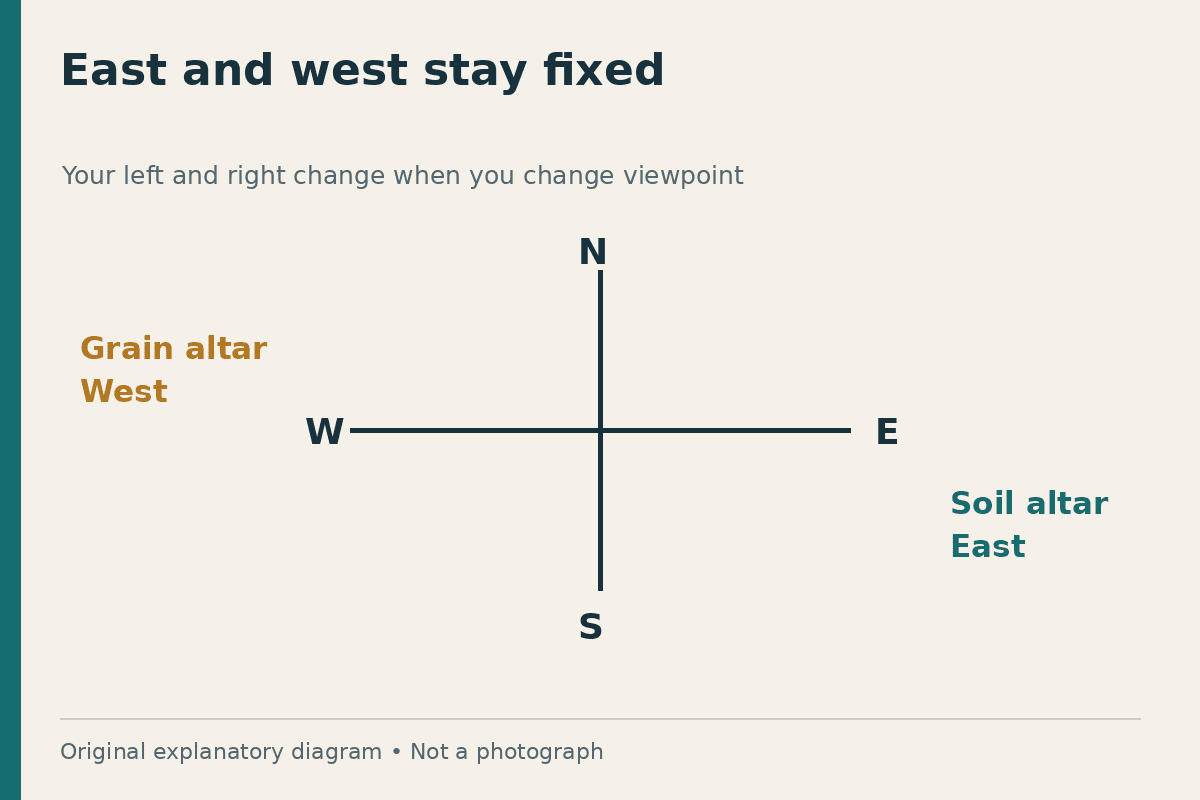
The two raised platforms have distinct roles. The official heritage description places the soil altar to the east and the grain altar to the west.
Locate the compass directions on the site plan before matching them to what you see. “The altar on my left” changes when you walk around the enclosure. East and west keep the identification stable.
Stay on the permitted visitor route while doing this. Seeing an altar through an enclosure does not mean visitors may step onto it or cross a barrier for a photograph. If a ceremony or site operation changes access, follow the current signs and staff directions.
For a short visit, focus on the distinction between the two altars: one honours soil, the other grain.
See where the ceremonies were prepared
The nearby buildings show how the ceremonies were prepared. The authority explains that Anhyangcheong held incense and ritual texts, while the Jeonsacheong area supported the preparation of ceremonial food. These functions connect the formal altar space with the practical work required to use it.
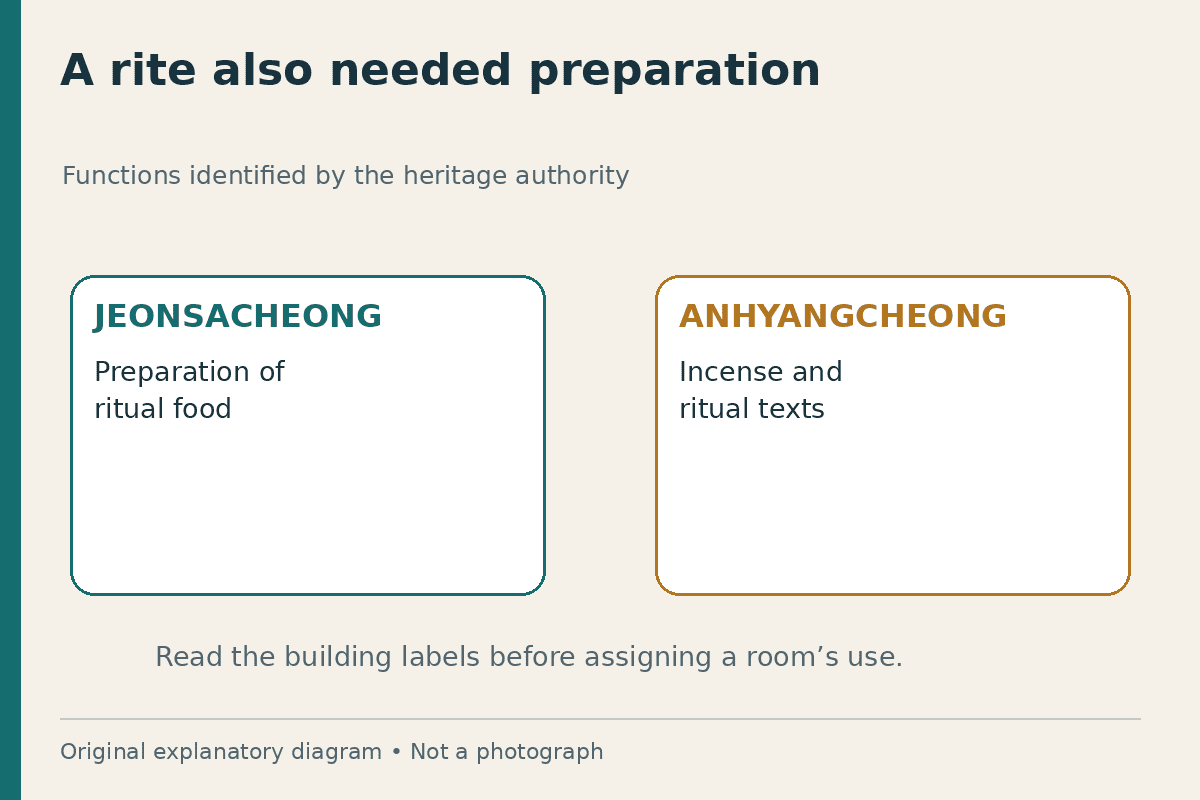
Read the site’s individual building labels as you move through the permitted area. A September 2026 visitor account notes how easily a general map label can be confused with the name of a specific building. The useful lesson is to use the on-site interpretation for identification, then ask what task each space supported.
For example, “What was prepared here?” and “What was stored here?” are more productive starting questions than treating every roofed building as another shrine. The answers explain how each building supported the ceremonies at the altars.
Keep the chronology in view. The current managing-authority history describes restoration of the preparation precinct in 2022. The 1395 foundation date concerns the historic establishment of the site; it does not date every structure visible today.
Arrive while the preparation precinct is open
The official visiting-hours table, checked on November 5, 2026, describes Sajikdan as generally open year-round but gives the Jeonsacheong precinct separate hours of 08:30–16:30. Use that earlier closing time if the preparation buildings are part of your reason for visiting.
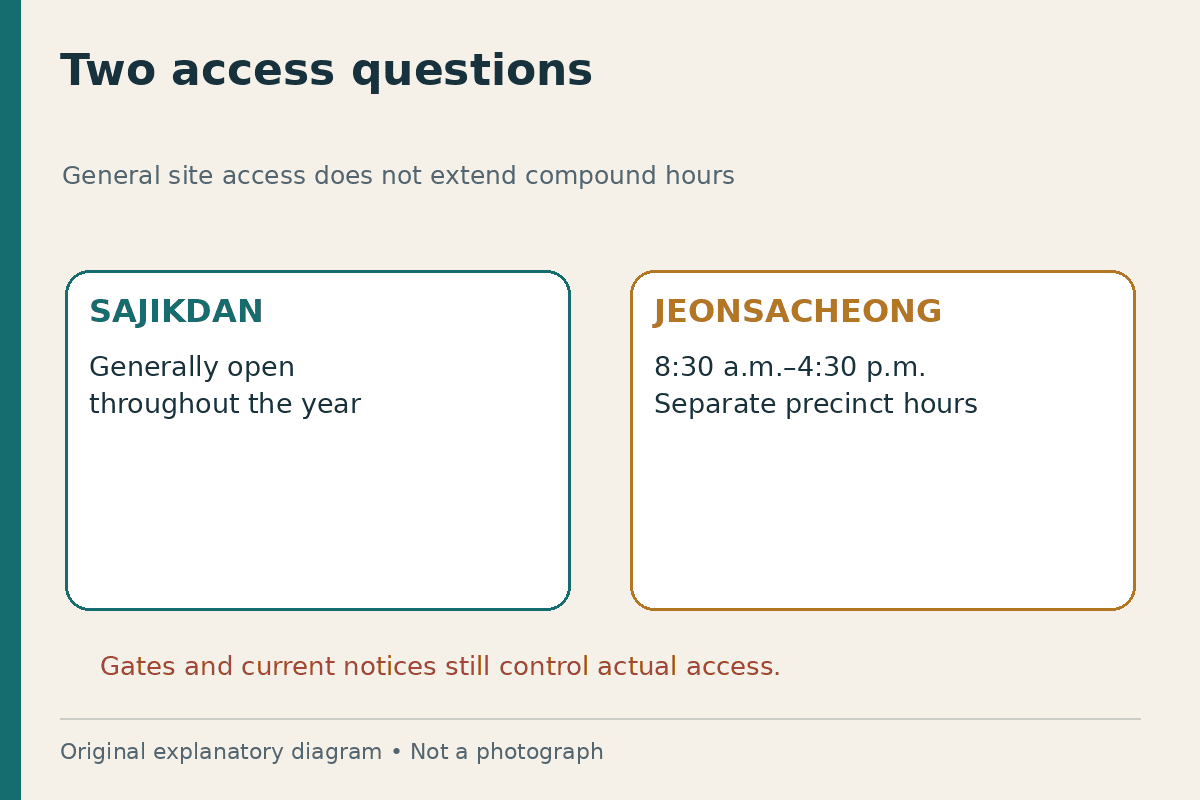
Visit Seoul’s Sajikdan listing identifies Gyeongbokgung Station, Line 3, Exit 1 as the subway approach. The surrounding Sajik Park is listed as free to enter. Park access should still be kept separate from permission to enter a fenced ritual area.
For planning, set aside roughly 40–60 minutes in daylight, plus your approach and onward travel. This is an editorial allowance for reading the plan, understanding the altar pair and visiting the preparation precinct if open. It is not a measured route or a promise of step-free access.
Annual rites are part of Sajikdan’s living significance, but they are not a daily visitor performance. Check a specific event notice if attending a ceremony is your aim. On a day without a ceremony, the site plan, altar pair and preparation buildings still give you plenty to explore.
If you want a meal afterward, the Seochon and Tongin lunch walk offers a separate plan for the surrounding neighbourhood. Finish the time-limited Jeonsacheong visit first rather than assuming it will still be open after lunch.