
Bukchon Hanok Village is one of the most beautiful places to walk in Seoul. Many travelers visit this neighborhood for its narrow alleys, traditional Korean houses, tiled roofs, and views of modern Seoul behind old hanok rooftops.
But Bukchon is not just a photo spot. It is a real residential neighborhood where people still live. That is why the best way to visit Bukchon is to follow a quiet, respectful walking course instead of rushing through the streets only for pictures.
Bukchon sits between Gyeongbokgung Palace and Changdeokgung Palace, two major royal palaces of the Joseon Dynasty. It is also near Jongmyo Shrine, Insadong, Samcheong-dong, and several cultural museums. This makes it a perfect area for a half-day Seoul history and culture trip.
In this guide, I will introduce three easy Bukchon Hanok Village walking courses. Each course has a different theme: a classic history route, a K-drama-style photo route, and a slow hanok cafe route.
Before you go, remember one important rule. The Bukchon-ro 11-gil area has visitor restrictions because it is a residential zone. According to Seoul Metropolitan Government, tourist visits to the Red Zone are restricted from 5:00 p.m. to 10:00 a.m. the following day, with fines from March 1, 2025. Visit Korea also lists 10:00 a.m. to 5:00 p.m. as the operating hours for the road along Bukchon-ro 11-gil.
Before You Start: How to Visit Bukchon Respectfully
Bukchon Hanok Village is beautiful because it is still alive. This is not a folk village built only for tourists. It is a historic neighborhood with private homes, local residents, small workshops, cafes, galleries, and cultural facilities.
Because of this, visitors should walk quietly. Do not shout, play music, block narrow alleys, or take photos through windows and gates. A hanok may look like a beautiful travel background, but it may also be someone’s home.
The best time to visit is during the day, ideally between 10:00 a.m. and 4:00 p.m. Weekdays are usually better than weekends because the streets are less crowded. Comfortable shoes are important because many alleys are sloped.
Also, do not try to follow private celebrity routes. It is better and safer to enjoy public filming areas, well-known cultural streets, and official visitor routes. Bukchon has appeared in Korean dramas and travel content, but the best experience comes from respecting the neighborhood, not invading privacy.
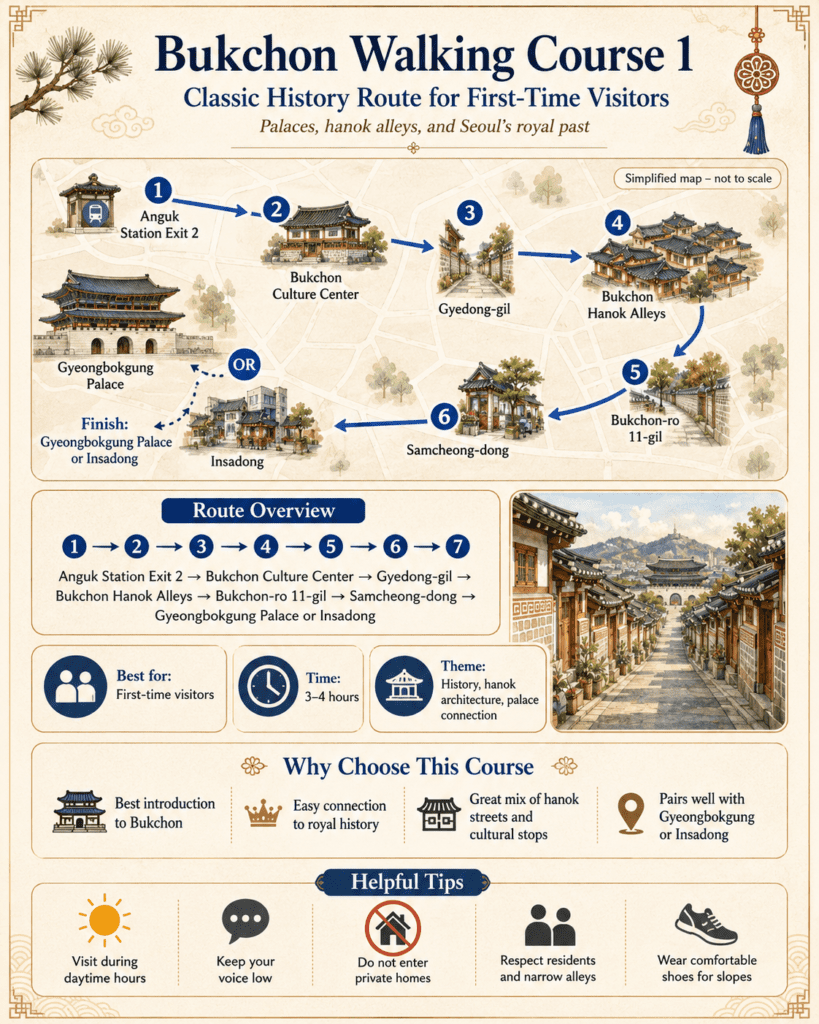
Recommended for: First-time visitors, history lovers, palace travelers
Estimated time: 3 to 4 hours
Best time: 10:00 a.m. to 2:00 p.m.
Main theme: Royal history, hanok houses, traditional Seoul
Route
Anguk Station Exit 2
↓
Bukchon Culture Center area
↓
Gyedong-gil
↓
Bukchon Hanok alleys
↓
Bukchon-ro 11-gil area during allowed daytime hours
↓
Samcheong-dong
↓
Gyeongbokgung Palace or Insadong
Course Overview
This is the best course for travelers visiting Bukchon for the first time. It gives you a balanced experience of history, architecture, and local atmosphere.
Start from Anguk Station Exit 2. This is one of the easiest ways to enter the Bukchon area. From here, walk toward the Bukchon Culture Center and Gyedong-gil. This part of the neighborhood feels calmer than the most famous photo spots, so it is a good place to begin slowly.
As you walk, look at the roofs, walls, wooden doors, and small gates. A hanok is a traditional Korean house, usually built with wooden frames, tiled roofs, and a layout designed to work with sunlight, wind, and the surrounding landscape. In Bukchon, many hanok are compact urban houses, not large countryside homes.
This course is especially meaningful because Bukchon is located between royal palaces. Gyeongbokgung Palace was the main royal palace of the Joseon Dynasty, while Changdeokgung Palace was another important royal palace known for its harmony with nature. Bukchon developed near these centers of power, so it has long been connected with Seoul’s historic heart.
After walking through the hanok alleys, continue toward Samcheong-dong. This area has cafes, small shops, and galleries. It is a good place to rest after walking through the slopes of Bukchon.
You can finish the course at Gyeongbokgung Palace if you want a stronger history-focused day. Or you can walk toward Insadong if you want traditional tea, souvenirs, crafts, and a more relaxed cultural shopping experience.
Why This Course Works
This course is easy to understand for first-time visitors. It connects Bukchon with Seoul’s royal history instead of treating it only as a pretty street.
It also works well for blog readers because the route has a natural flow. You begin at a subway station, walk through historic hanok streets, rest in Samcheong-dong, and finish at either a palace or Insadong.
For foreign travelers, this course answers a simple question: “Why is Bukchon here?” The answer is that Bukchon was shaped by its location near the royal palaces and the old center of Seoul.
Good Travel Tip
Do not spend all your time looking for one famous photo angle. Some of Bukchon’s best moments are found in small details: a wooden gate, a quiet courtyard, a tiled roof line, or the view of modern buildings behind old hanok houses.
Course 2: Bukchon K-Drama Mood Walking Course
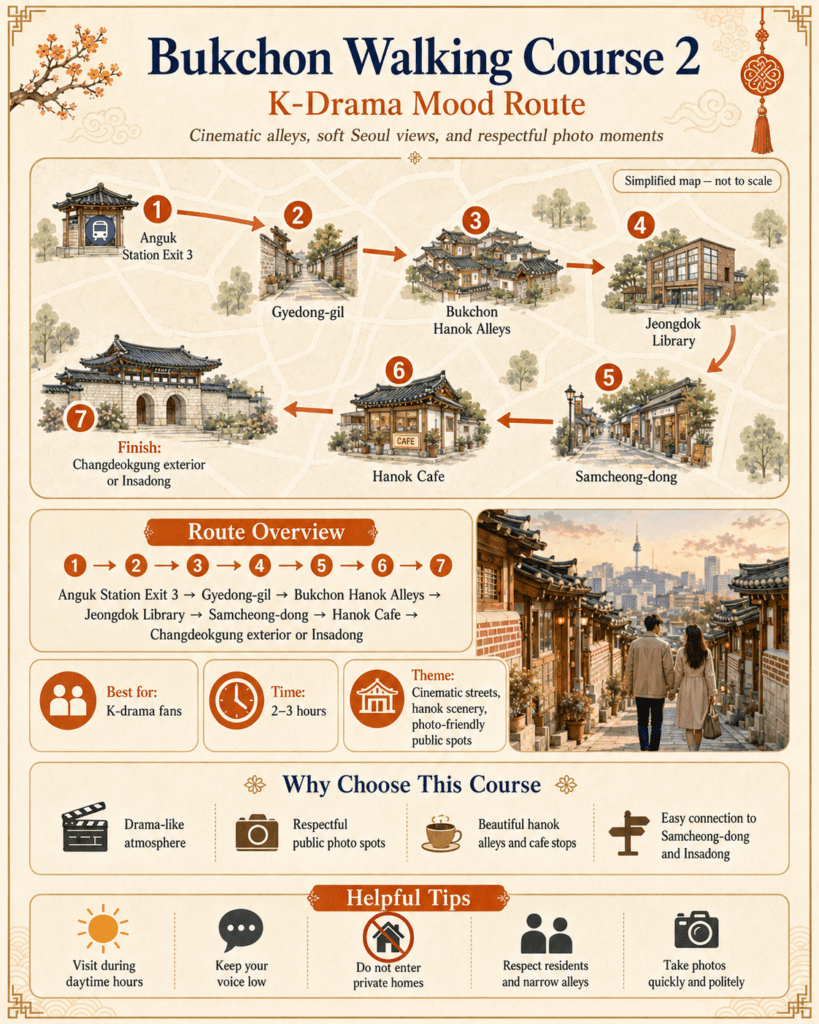
Recommended for: K-drama fans, photo lovers, first-time Seoul travelers
Estimated time: 2 to 3 hours
Best time: 10:30 a.m. to 3:00 p.m.
Main theme: Drama-like scenery, public filming atmosphere, respectful photo spots
Route
Anguk Station Exit 3
↓
Gyedong-gil
↓
Bukchon Hanok alleys
↓
Jeongdok Library area
↓
Samcheong-dong streets
↓
Hanok cafe or traditional tea house
↓
Changdeokgung Palace exterior or Insadong
Course Overview
This course is designed for travelers who want to feel the atmosphere of a Korean drama without following private celebrity locations. It is inspired by the kind of scenery often seen in K-dramas: quiet alleys, traditional rooftops, school-like streets, small cafes, and soft Seoul light.
Visit Korea notes that much of the drama “True Beauty” was filmed in the Bukchon Hanok Village area. This makes Bukchon an attractive place for K-drama fans who want to experience a familiar Seoul atmosphere in real life.
Start from Anguk Station Exit 3 and walk toward Gyedong-gil. This street has a nice local rhythm, with small shops, cafes, and traditional buildings nearby. It feels less staged than a famous tourist photo spot, which makes it better for travelers who want natural Seoul scenery.
From there, move toward the hanok alleys. These narrow streets are the main visual highlight of Bukchon. The curved tiled roofs, wooden doors, and sloping paths create a scene that feels cinematic even without a camera crew.
Continue toward the Jeongdok Library area. This part of the route is good for a quieter walk and can connect naturally to Samcheong-dong. Samcheong-dong has a softer, more modern feel, with cafes, galleries, and small boutiques. It is a good place to rest and take lifestyle-style photos.
End the route at a hanok cafe or traditional tea house. Instead of taking too many photos in residential alleys, it is better to spend time in a public space that welcomes visitors. This lets you enjoy the hanok atmosphere more comfortably and respectfully.
Why This Course Works
This course is good for K-drama fans because it focuses on mood, not gossip. It avoids private celebrity information and uses public streets and officially known filming-area references.
For English blog readers, this approach feels safe and trustworthy. Many fans want to visit drama-like places, but they also want to know how to do it respectfully.
You can describe this route as a “K-drama mood course” rather than a “celebrity route.” That makes the article more ethical and better for long-term SEO.
Photo Tips for This Course
Take photos quickly and quietly. Do not stand in front of private gates for too long. Avoid photographing residents, open windows, laundry, delivery items, or anything that clearly belongs to a private home.
The best photos usually come from wider street views, roof lines, and walking shots taken from behind. These feel natural and do not invade anyone’s privacy.
Suggested Blog Phrase
“This route is not about following celebrities’ private lives. It is about walking through the kind of Seoul scenery that makes Korean dramas feel so warm and memorable.”
Course 3: Slow Bukchon Hanok Cafe and Local Culture Course
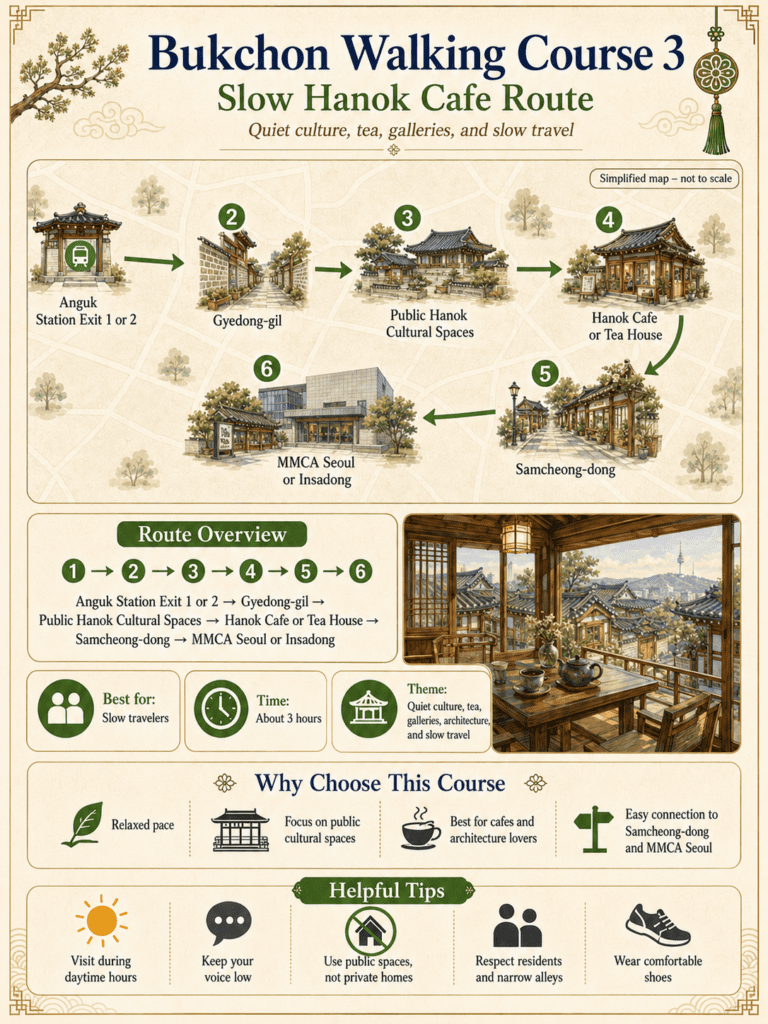
Recommended for: Slow travelers, cafe lovers, architecture fans, cultural travelers
Estimated time: About 3 hours
Best time: 11:00 a.m. to 4:00 p.m.
Main theme: Hanok cafes, galleries, workshops, quiet local culture
Route
Anguk Station Exit 1 or 2
↓
Gyedong-gil
↓
Public hanok cultural facilities or small galleries
↓
Hanok cafe or tea house
↓
Samcheong-dong
↓
National Museum of Modern and Contemporary Art Seoul or Insadong
Course Overview
This course is for travelers who prefer atmosphere over a busy checklist. It is not about seeing every famous spot. It is about slowing down and understanding Bukchon as living heritage.
Start from Anguk Station and walk toward Gyedong-gil. Instead of heading straight to the most crowded photo alley, take time to notice the neighborhood’s rhythm. You may see small shops, restored hanok buildings, local signs, and quiet side streets.
Bukchon has several public hanok facilities, workshops, and cultural spaces. Seoul Hanok lists public hanok facilities and workshops in the Bukchon area, including cultural spaces and craft-related places with their own operating hours. These are better places to explore than private residential alleys because they are meant to receive visitors.
After that, visit a hanok cafe or traditional tea house. This is one of the best ways to experience hanok architecture from the inside. Sitting inside a hanok allows you to notice the wooden structure, low roof lines, windows, courtyard feeling, and calm atmosphere.
Then continue toward Samcheong-dong. This area blends traditional Seoul with modern design. You can find cafes, galleries, independent shops, and small restaurants. It is a good bridge between old Bukchon and contemporary Seoul.
If you want to extend the course, walk to the National Museum of Modern and Contemporary Art Seoul. This is a strong finish for travelers who enjoy architecture, design, and culture. Another option is Insadong, which is better for traditional souvenirs, tea, and crafts.
Why This Course Works
This course is ideal for travelers who do not want to rush. It also reduces pressure on residential streets because it focuses more on public spaces, cafes, galleries, and cultural facilities.
It is also a good course for older travelers, couples, solo travelers, and visitors who prefer meaningful experiences over crowded viewpoints.
From a blog perspective, this route can be framed around “responsible travel” and “living heritage.” Those ideas are important because Bukchon’s popularity has created real concerns for residents.
Good Travel Tip
Choose one cafe or cultural space in advance, but leave enough time for wandering. Bukchon is best when you do not over-plan every minute.
Also, check opening hours before visiting workshops or cultural facilities. Small places may close on certain weekdays, holidays, or during private events.
Which Bukchon Course Should You Choose?
Choose Course 1 if this is your first time in Bukchon. It gives you the clearest understanding of the area’s history and location.
Choose Course 2 if you love K-dramas and want beautiful photos. It gives you the feeling of a Korean drama scene without crossing privacy boundaries.
Choose Course 3 if you prefer quiet travel, cafes, galleries, and slow walking. It is the best option for travelers who want to enjoy Bukchon without feeling rushed.
Here is a simple comparison.
| Course | Best For | Time Needed | Main Experience |
|---|---|---|---|
| Course 1 | First-time visitors | 3–4 hours | History, hanok alleys, palace connection |
| Course 2 | K-drama fans | 2–3 hours | Drama-like streets, photos, Samcheong-dong |
| Course 3 | Slow travelers | 3 hours | Hanok cafes, galleries, quiet local culture |
Best Time to Visit Bukchon Hanok Village
The safest and most respectful time to visit Bukchon is during the official daytime visitor window. For Bukchon-ro 11-gil, Visit Korea lists 10:00 a.m. to 5:00 p.m. as the operating hours, and Seoul’s official notice restricts tourist visits in the Red Zone from 5:00 p.m. to 10:00 a.m. the next day.
For a better experience, visit on a weekday. Weekends can be crowded, especially near the most famous hanok alleys.
Late morning is usually a good choice. The light is nice, shops and cafes are open, and you can avoid disturbing residents early in the morning.
Simple Etiquette Rules for Bukchon
Bukchon is one of Seoul’s most famous travel spots, but it is also a neighborhood. A respectful visit makes the experience better for everyone.
Keep your voice low. Do not enter private homes. Do not take photos through windows or gates. Do not block alleys. Do not fly drones. Do not leave trash. Avoid large group behavior.
When taking photos, choose public street views. Avoid close-up images of private doors, nameplates, windows, or personal belongings.
A good rule is simple: enjoy Bukchon as if you were walking through someone’s neighborhood, not an outdoor photo studio.
Frequently Asked Questions
Q. How long do I need for Bukchon Hanok Village?
A. Most visitors need about two to three hours for Bukchon. If you combine it with Gyeongbokgung Palace, Changdeokgung Palace, Insadong, or a hanok cafe, you can easily make it a half-day trip.
Q. Is Bukchon Hanok Village free to visit?
A. Yes, Bukchon Hanok Village itself is free to visit. However, cafes, workshops, museums, guesthouses, and cultural experiences may have separate fees.
Q. What is the best Bukchon course for first-time visitors?
A. Course 1 is the best option for first-time visitors. It connects Bukchon with palace history, hanok architecture, Samcheong-dong, and nearby cultural areas.
Q. Can K-drama fans enjoy Bukchon Hanok Village?
A. Yes, Bukchon is a great place for K-drama fans because it has the quiet, traditional Seoul atmosphere often seen in Korean dramas. Visit Korea also introduces the Bukchon area in connection with “True Beauty,” but visitors should focus on public places and avoid private homes.
Q. Are there visiting restrictions in Bukchon?
A. Yes. The Red Zone around Bukchon-ro 11-gil restricts tourist visits from 5:00 p.m. to 10:00 a.m. the next day. Visitors should check official information before going and visit during daytime hours.
Q. Can I wear hanbok in Bukchon?
A. Yes, many travelers wear hanbok when visiting Bukchon and nearby palaces. Just remember that Bukchon is a residential area, so you should avoid blocking alleys or taking photos too close to private homes.
Final Thoughts
Bukchon Hanok Village is one of the best places in Seoul to feel the connection between Korea’s past and present. It is beautiful, but its beauty is not only in the rooftops or photo spots. It comes from the fact that Bukchon is still a living neighborhood.
Each of the three courses in this guide gives you a different way to understand the area. The classic history course helps first-time visitors see Bukchon in relation to Seoul’s royal palaces. The K-drama mood course gives drama fans a safe and respectful way to enjoy cinematic streets. The slow hanok cafe course is perfect for travelers who want to experience traditional architecture, tea, galleries, and quiet local culture.
The most important advice is to slow down. Bukchon is not a place to rush through. Walk gently, look carefully, and remember that the houses around you are part of real people’s lives.
A good Bukchon trip should leave you with more than photos. It should help you understand how Seoul protects tradition inside a modern city, and how Korean heritage can still be found in everyday streets.
For a richer Seoul history itinerary, combine Bukchon with Gyeongbokgung Palace, Changdeokgung Palace, Jongmyo Shrine, Insadong, or Samcheong-dong. Together, these places show why Seoul is not only a modern capital, but also a city where history still quietly shapes daily life.