
Read the Full Guide: 3 Recommended Bukchon Routes
Many travelers visit Bukchon Hanok Village because they have seen its beautiful alleys on Instagram, YouTube, or a Korea travel vlog. The tiled roofs, narrow streets, and traditional wooden houses make it one of the most photogenic places in Seoul.
But Bukchon is more than a pretty photo spot. It is a living neighborhood where real people still live inside hanok, traditional Korean houses. It is also a historic area connected to the Joseon Dynasty, the Korean kingdom that ruled from 1392 to 1897.
Understanding Bukchon Hanok Village history makes your visit more meaningful. When you walk through Bukchon, you are not only looking at old houses. You are walking through a neighborhood shaped by royal palaces, aristocratic families, modern urban change, and today’s challenge of balancing tourism with local life.
Bukchon is located between Gyeongbokgung Palace, Changdeokgung Palace, and Jongmyo Shrine, three of Seoul’s most important royal and cultural heritage sites. Visit Korea describes Bukchon as an area with hundreds of hanok, traditional Korean houses, and explains that the name “Bukchon” means “northern village” because it lies north of Cheonggyecheon Stream and Jongno.
In this guide, you will learn what Bukchon is, why it matters, what a hanok means in Korean culture, what to see there, and how to visit respectfully.
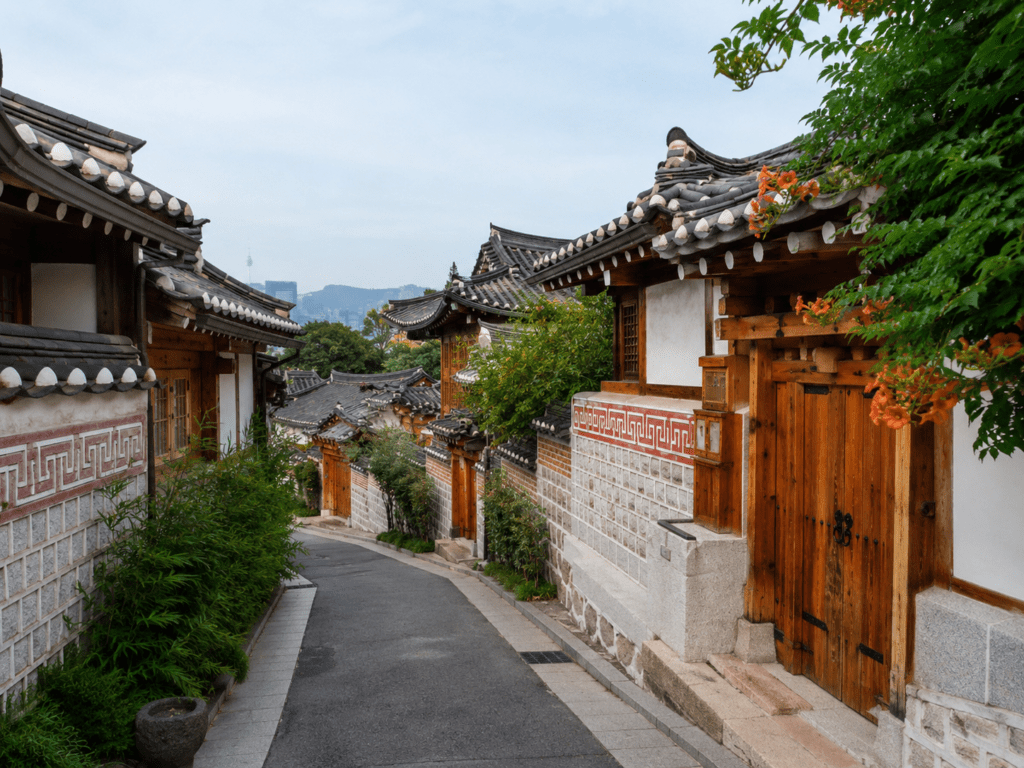
Why Bukchon Hanok Village Matters
Bukchon Hanok Village matters because it shows a different side of Seoul’s history. Many visitors understand Korean history through palaces, kings, and royal ceremonies. Bukchon shows how history also lived in residential streets, family homes, courtyards, and everyday architecture.
The village sits in a special location. To the west is Gyeongbokgung Palace, the main royal palace of the Joseon Dynasty. To the east is Changdeokgung Palace, famous for its natural layout and Secret Garden. Nearby is Jongmyo Shrine, the royal ancestral shrine where Joseon kings and queens were honored through Confucian rituals.
Because of this location, Bukchon was historically close to the political and cultural center of Seoul. Seoul Hanok, an official Seoul Metropolitan Government website, explains that Bukchon was traditionally a residential area of the nobility during the Joseon period.
This is one reason Bukchon feels different from a folk village or a recreated tourist attraction. It is not a theme park. It is part of the old urban fabric of Seoul.
For foreign travelers, Bukchon is a good place to understand how Korean history connects with daily life. Palaces show royal authority. Temples show religious culture. Bukchon shows how people lived near power, tradition, and community.
A Simple History of Bukchon Hanok Village
The word “Bukchon” means “northern village.” Historically, it referred to the area north of Cheonggyecheon Stream and Jongno, two important landmarks in central Seoul. Today, travelers usually use the name to describe the hanok neighborhood around Gahoe-dong, Gye-dong, Samcheong-dong, and nearby areas.
During the Joseon Dynasty, this area was known as a desirable residential district. It was close to the royal palaces and government offices, so many influential families, officials, and nobles lived here. In Korean history, these upper-class scholar-officials are often called yangban.
However, the Bukchon you see today is not simply a frozen image of the 1400s or 1500s. Its history is layered. According to Seoul Hanok, Bukchon did not change dramatically until the 1920s, but in the 1930s, Seoul’s urban structure changed and housing companies built groups of medium-sized hanok in the area.
This is important because many visitors imagine every house in Bukchon as a perfectly preserved Joseon-era mansion. In reality, many Bukchon hanok reflect both tradition and modernization. They kept key features of Korean architecture, but they were also adapted to a denser modern city.
That makes Bukchon especially interesting. It is not only a place of old Korea. It is a place where old Korea adjusted to modern Seoul.
What Is a Hanok?
A hanok is a traditional Korean house. The word is usually used to describe Korean-style homes built with traditional materials and architectural ideas.
A typical hanok uses a wooden framework with columns, beams, rafters, and connecting parts. Seoul Hanok explains that the structure of hanok includes wooden columns, crossbeams, purlins, rafters, and various supports, and that the details could vary depending on region, social status, and the purpose of the house.
For travelers, the most visible features are the curved tiled roof, wooden doors, stone walls, and small courtyards. Many hanok also include maru, a wooden-floored hall used for cooling and gathering, and ondol, the traditional Korean floor-heating system.
Hanok architecture is closely connected to nature. Korean traditional houses were often designed with attention to sunlight, wind, mountains, and water. This is why hanok can feel calm even inside a busy city.
In Bukchon, hanok are usually smaller and closer together than large countryside houses. Their beauty comes from the rhythm of rooftops, alleys, gates, and walls. When you look carefully, you can see how traditional design was compressed into an urban neighborhood.
Bukchon Hanok Village History and the Shape of Modern Seoul
One of the most interesting parts of Bukchon Hanok Village history is that the village reflects Seoul’s transformation. It is connected to the Joseon Dynasty, but it also tells a story of urban growth, population pressure, and preservation.
During the early 20th century, Seoul changed quickly. Large plots of land were divided into smaller housing lots, and new urban hanok were built to meet housing demand. Seoul Hanok explains that many of Bukchon’s present hanok residential areas, including parts of Gahoe-dong, Samcheong-dong, and Gye-dong, were established during this period.
These houses were not exactly the same as older aristocratic mansions. They were more compact and efficient. Some used newer materials such as glass doors or galvanized iron sheets while keeping traditional features.
This mixture is what makes Bukchon special. It is not only a preserved traditional village. It is also a record of how Koreans tried to keep familiar housing styles while adapting to a changing city.
When you walk through Bukchon today, you are seeing this layered history. Some homes feel old and quiet. Some have been turned into guesthouses, cafes, galleries, or cultural spaces. Others are still private homes where residents live normal lives.
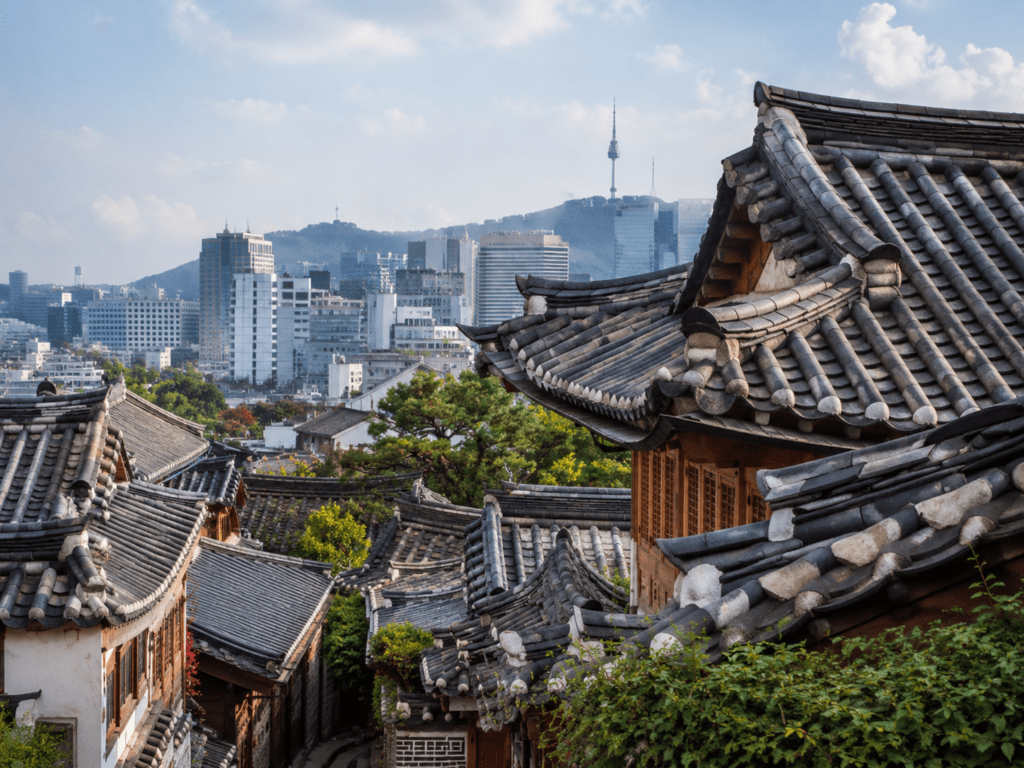
What Visitors Can See in Bukchon Today
The most famous part of Bukchon is its sloping alleys lined with hanok walls and tiled roofs. These streets are popular because they show a strong visual contrast between traditional architecture and modern Seoul.
But there is more to see than one photo spot. You can notice wooden gates, small courtyards, stone walls, roof-end tiles, and decorative details that reveal the character of hanok architecture. Some buildings are simple and quiet, while others have been carefully restored.
Many hanok in Bukchon are now used as cultural centers, guesthouses, restaurants, tea houses, and workshops. Visit Korea explains that some hanok in the village operate as cultural centers, guesthouses, restaurants, and tea houses where visitors can experience traditional Korean culture.
You may also find small galleries, craft studios, and local museums around the area. These spaces help visitors understand that Bukchon is not only about architecture. It is also connected to Korean crafts, design, tea culture, and contemporary creativity.
A good way to enjoy Bukchon is to walk slowly. Do not rush from one famous viewpoint to another. The details are small, and the atmosphere is quiet.
Bukchon Is a Living Neighborhood
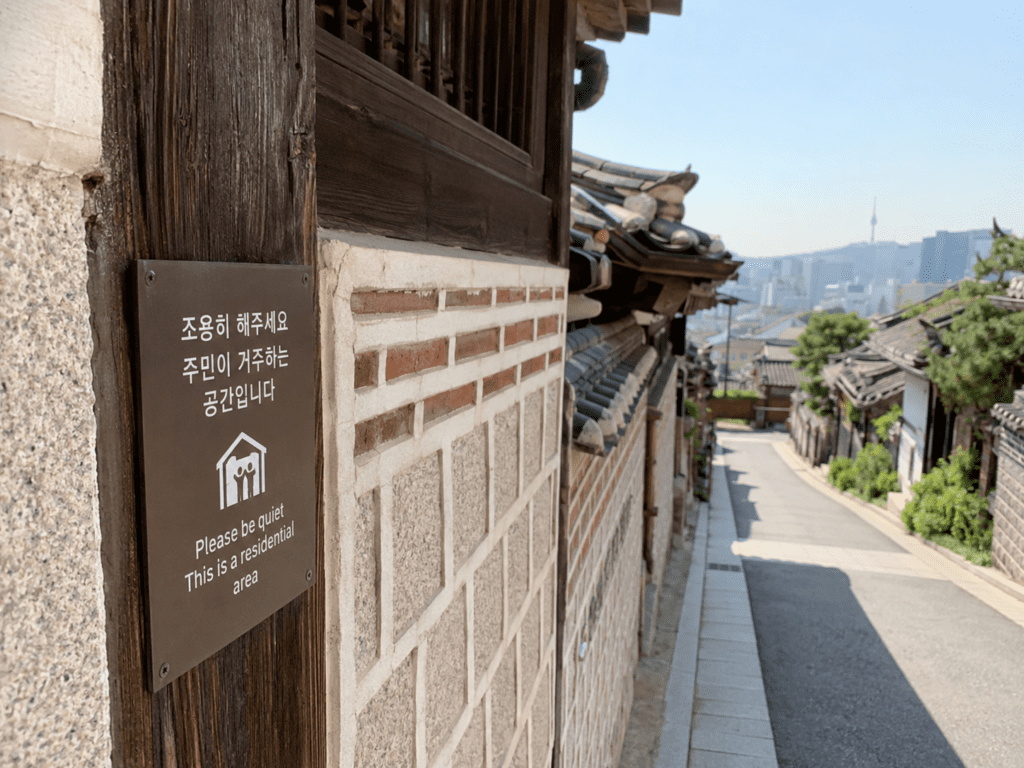
The most important thing to remember is simple: Bukchon is a residential area. People live here. Their homes are not backdrops for tourist photos.
This is why visitor etiquette matters more in Bukchon than in many other travel spots. Noise travels easily through narrow alleys. Camera lenses can accidentally point into private windows or courtyards. Large groups can block roads that residents use every day.
This does not mean travelers should avoid Bukchon. It means they should visit with respect. A quiet visitor can enjoy the beauty of the village without disturbing the people who keep the neighborhood alive.
From a Korean local perspective, Bukchon’s charm comes from this balance. It is beautiful because it still feels lived in. If it becomes only a photo zone, it loses the very thing that makes it meaningful.
Visitor Restrictions and Etiquette
As of 2026, visitors should check official information before going to Bukchon, especially around Bukchon-ro 11-gil. The Seoul Metropolitan Government announced visitor restrictions for the Bukchon Special Management Area Red Zone, with tourist visits restricted from 5:00 p.m. to 10:00 a.m. the following day. The fine for violations is KRW 100,000, with enforcement beginning on March 1, 2025.
Visit Korea also lists the operating hours as 10:00 to 17:00 for the road along Bukchon-ro 11-gil and notes that the area is free to visit.
Here are simple etiquette tips for foreign visitors:
Visit during official daytime hours. Keep your voice low. Do not enter private gates or courtyards. Avoid taking photos through windows. Do not use drones. Do not leave trash. Avoid large group behavior in narrow alleys.
It is also better not to visit too early in the morning or late in the evening. Even if a street looks quiet and beautiful, it may be someone’s home entrance.
If you want photos, take them quickly and respectfully. The best travel memory is not only a good picture. It is knowing that you experienced the place without harming it.
Best Way to Enjoy Bukchon Hanok Village
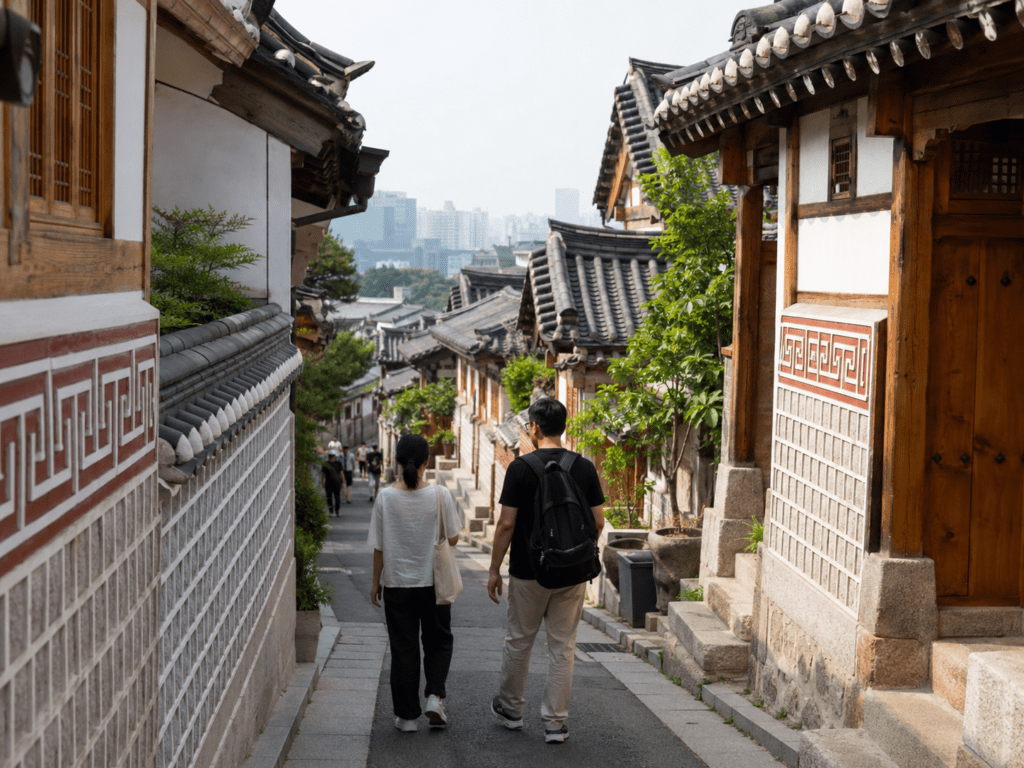
The best way to enjoy Bukchon is to combine history, architecture, and slow walking. Start near Anguk Station, then walk toward Gahoe-dong or Gyedong-gil. These areas give you a good sense of the neighborhood’s traditional houses and quiet slopes.
Try to visit on a weekday if possible. Weekends can feel crowded, especially in the most famous photo areas. Late morning or early afternoon is usually better than early morning or evening because it respects residents’ quiet hours.
You can also combine Bukchon with a palace visit. For example, you can visit Gyeongbokgung Palace in the morning, walk through Samcheong-dong, and then explore Bukchon during the day. Another good route is Changdeokgung Palace, Bukchon, and Insadong.
Wearing hanbok, traditional Korean clothing, can be a fun cultural experience, but remember that Bukchon is not a stage. Move carefully, respect private homes, and avoid blocking streets while taking photos.
If you like cafes, choose one inside a renovated hanok where visitors are welcome. Sitting inside a hanok cafe can help you feel the spatial beauty of Korean traditional houses in a more relaxed way.
Nearby Places to Visit
Bukchon is surrounded by some of Seoul’s best history and culture spots. This makes it easy to build a half-day or full-day itinerary.
Gyeongbokgung Palace is the most famous nearby palace. It was the main royal palace of the Joseon Dynasty and is a good place to understand royal authority, palace layout, and ceremonial architecture.
Changdeokgung Palace is also nearby. It is loved for its harmony with nature, especially the Secret Garden. If Gyeongbokgung feels grand and official, Changdeokgung often feels more intimate and natural.
Jongmyo Shrine is another important site close to Bukchon. It is quieter than the palaces and helps visitors understand Confucian royal rituals.
Insadong is a good place to visit after Bukchon. It has traditional craft shops, tea houses, souvenir stores, and galleries. Samcheong-dong is also nearby and is known for cafes, boutiques, and art spaces.
For a slower route, you can visit the National Museum of Modern and Contemporary Art Seoul. It connects well with the Bukchon and Samcheong-dong area, especially if you enjoy architecture and art.
Practical Travel Tips
Bukchon Hanok Village is free to enter, but some museums, workshops, guesthouses, and cultural experiences may have separate fees. Visit Korea lists Bukchon as free to visit and notes that parking is not available, so public transportation is usually the best option.
Anguk Station is the most convenient subway stop for many visitors. From there, you can walk to Bukchon, Insadong, Changdeokgung Palace, or Samcheong-dong.
Wear comfortable shoes. The alleys can be steep, narrow, and uneven in some places. In summer, bring water because the slopes can feel tiring. In winter, be careful because some streets may become slippery.
Do not plan your visit only around photos. Bukchon is best enjoyed when you slow down, read small signs, notice roof shapes, and think about how this neighborhood connects palace history with ordinary life.
Frequently Asked Questions
Q. Is Bukchon Hanok Village worth visiting?
A. Yes, Bukchon Hanok Village is worth visiting if you are interested in Korean traditional houses, Seoul history, and cultural neighborhoods. It becomes much more meaningful when you understand that it is a real residential area, not just a photo spot.
Q. What is Bukchon Hanok Village famous for?
A. Bukchon is famous for its hanok, traditional Korean houses with tiled roofs, wooden structures, and quiet alleys. It is also famous for its location between major royal heritage sites such as Gyeongbokgung Palace, Changdeokgung Palace, and Jongmyo Shrine.
Q. Do people still live in Bukchon Hanok Village?
A. Yes, people still live in Bukchon. This is why visitors should keep quiet, avoid entering private spaces, and follow official visiting rules.
Q. What are the visiting hours for Bukchon Hanok Village?
A. For the Red Zone around Bukchon-ro 11-gil, tourist visits are restricted from 5:00 p.m. to 10:00 a.m. the following day. Travelers should visit during daytime hours and check official updates before going.
Q. How long should I spend in Bukchon Hanok Village?
A. Most travelers spend one to two hours walking around Bukchon. If you also visit a hanok cafe, gallery, or nearby palace, you can easily make it part of a half-day itinerary.
Q. Can I wear hanbok in Bukchon Hanok Village?
A. Yes, many visitors wear hanbok when visiting Bukchon and nearby palaces. However, you should still respect residents, avoid blocking narrow alleys, and take photos without disturbing local life.
Final Thoughts
Bukchon Hanok Village history is not only about old houses. It is about how Seoul remembers its past while living in the present. That is what makes Bukchon so special for foreign travelers.
In one short walk, you can feel many layers of Korean history. You can see the influence of the Joseon Dynasty, the presence of royal palaces nearby, the beauty of hanok architecture, and the changes brought by modern city life. Bukchon helps travelers understand that Korean heritage is not limited to museum displays or palace halls. Sometimes, heritage survives in rooftops, alleys, courtyards, gates, and the daily routines of residents.
But this also means Bukchon needs respectful visitors. The village is beautiful because it is still alive. People wake up there, come home there, and live behind the doors that travelers often photograph. Visiting Bukchon well means walking quietly, following official visiting hours, protecting privacy, and remembering that culture is not only something to consume. It is something to respect.
For first-time visitors to Seoul, Bukchon is one of the best places to connect history with real urban life. I recommend visiting it together with Gyeongbokgung Palace, Changdeokgung Palace, or Jongmyo Shrine. The palaces will show you royal Korea. Bukchon will show you how traditional Korean life took shape around that royal world.
If you are planning a deeper Seoul history trip, continue with guides to Gyeongbokgung Palace, Changdeokgung Palace, Jongmyo Shrine, and Korean hanok architecture. Together, these places help you see Seoul not just as a modern capital, but as a city where history still quietly speaks through its streets.