Two hours is enough for a satisfying introduction to the National Museum of Korea if you decide what to leave for another visit. Choose the Room of Quiet Contemplation, one nearby gallery and a little time to pause. Trying to finish every floor turns a cultural stop into an endurance test.
This is a suggested short visit for independent travelers, not a guided tour or a promise that queues will fit the schedule. It works especially well when you need an indoor anchor for a Seoul day.
Start with the encounter you most want
The Room of Quiet Contemplation places two pensive bodhisattva statues together in a deliberately restrained setting. Both are designated National Treasures. The museum asks everyone, including guided groups, to remain silent.
Give your eyes time to adjust rather than rushing in with a camera raised. Look at the hands, posture and difference in ornament. You do not need to know Buddhist art history to notice that two related poses can create different impressions.
The room is on the second floor. Korea.net’s museum guide also introduces the large Gyeongcheonsa stone pagoda on the first floor, a useful second point of reference if you enjoy sculpture and scale.
A two-hour budget you can actually adjust
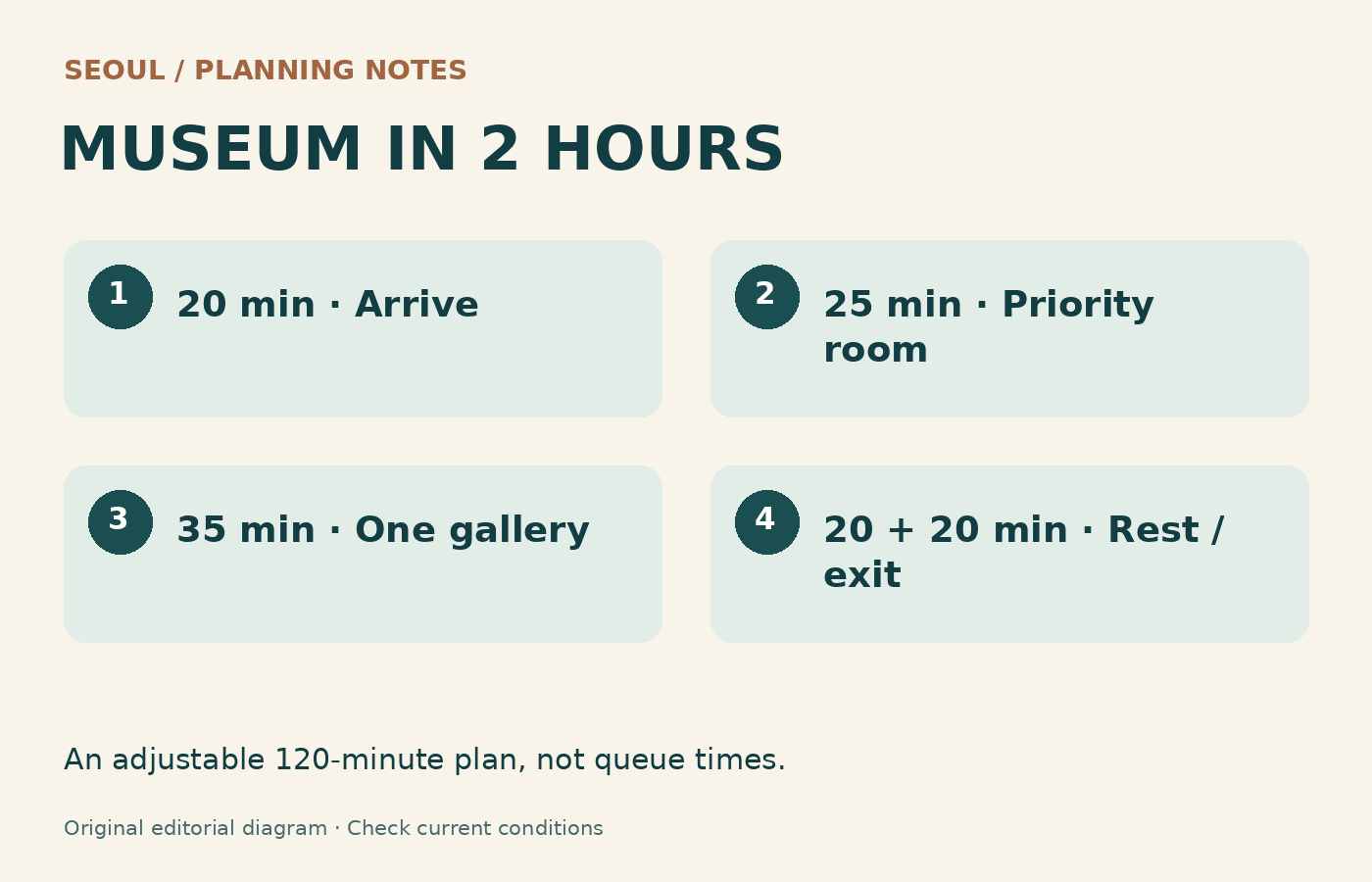
| Block | Suggested allowance | Purpose |
|---|---|---|
| Arrival, orientation and belongings | 20 minutes | Find the map, check restrictions and settle bags |
| Your priority room | 25 minutes | Spend attention on one main experience |
| One further gallery or collection | 35 minutes | Follow an interest rather than an entire floor |
| Pause and optional shop stop | 20 minutes | Rest without turning shopping into a requirement |
| Return for bags and departure | 20 minutes | Leave without a last-minute rush |
The blocks total 120 minutes. They exclude transport from your hotel and any special-exhibition queue. If entry takes longer, shorten the optional section first. Protect time for your main exhibit instead of squeezing every block.
Choose a second interest, not a second checklist
Use the current floor map to choose one collection that interests you: painting, ceramics or an earlier period of Korean history. Look for a relationship between two objects, read a label carefully, then move on when your attention starts to fade.
A firsthand Korean-language museum account describes conserving energy through the galleries and finding the Room of Quiet Contemplation crowded. The useful lesson is flexibility: a quiet design does not guarantee an empty room. It is not a forecast for your visit.
If your priority room is busy, ask staff about the current situation, visit your second choice and reconsider later if time allows. Do not build the day around an unsupported claim that a particular hour is always quiet.
Check hours before changing a rainy-day plan
The museum’s current visitor page lists 09:30–17:30 on Monday, Tuesday, Thursday, Friday and Sunday, and 09:30–21:00 on Wednesday and Saturday. Last admission is 30 minutes before closing. All times are Korea Standard Time.
Permanent exhibitions are free; paid special exhibitions have separate arrangements. The Children’s Museum uses timed reservations, so a general museum plan is not a substitute for its booking. Check the visitor page for holiday and quarterly gallery closures, as well as temporary room notices.
Backpacks should be stored in the first-floor lockers under the museum’s published visitor rules. Flash, tripods, selfie sticks and gimbals are prohibited. Follow gallery-specific photography notices and staff directions too.
Make the station-to-gallery transition easy
The museum’s directions name Ichon Station on Line 4 and the Gyeongui–Jungang Line. Follow museum signs, using its current elevator directions if needed. The destination address is 137 Seobinggo-ro, Yongsan-gu, Seoul.
An underground connection is listed, but that does not mean every part of your chosen approach is indoors or that its opening hours match the galleries. Keep a rain layer handy and leave time between the station arrival and the first exhibit.
Plan the station, transfer and exit before you leave →
At the end, ask yourself which object you would like to learn more about. That is a better reason for a second visit than a list of rooms you failed to finish. Keep the rest of the day light enough that the museum can be an experience rather than a task.