
If you are visiting Seoul for the first time, the subway map may look scary at first. There are many colored lines, long Korean station names, transfer points, and exit numbers. But once you understand the basic system, the Seoul subway becomes one of the easiest ways to travel around the city.
Many first-time visitors worry about three things: which line to take, where to transfer, and which exit to use. These are very normal questions. Even Koreans check map apps when going to an unfamiliar neighborhood.
The good news is that the Seoul subway is well-organized for travelers. Subway lines are color-coded, many signs include English, and major stations have clear transfer signs. Visit Seoul, the official travel guide to Seoul, explains that subway lines are color-coded and station signs are displayed in Korean, English, and Chinese.
In this guide, I will explain how to use the Seoul subway as a first-time visitor. You will learn how to read routes, make transfers, find the correct exit, and use a T-money Card without feeling lost.
What Is the Seoul Subway?
The Seoul subway is the main public transportation system in Seoul and the surrounding metropolitan area. It connects major tourist areas, local neighborhoods, shopping streets, universities, train stations, and airport transfer routes.
For visitors, the subway is usually more predictable than taking a taxi during busy traffic hours. Seoul roads can be crowded, especially during rush hour. The subway helps you avoid much of that traffic.
You can use the subway to reach places like Myeongdong, Hongdae, Gangnam, Dongdaemun, Gyeongbokgung Palace, Seoul Station, Jamsil, Itaewon, and many other popular areas. Once you learn the basic pattern, you can move around Seoul with much more confidence.
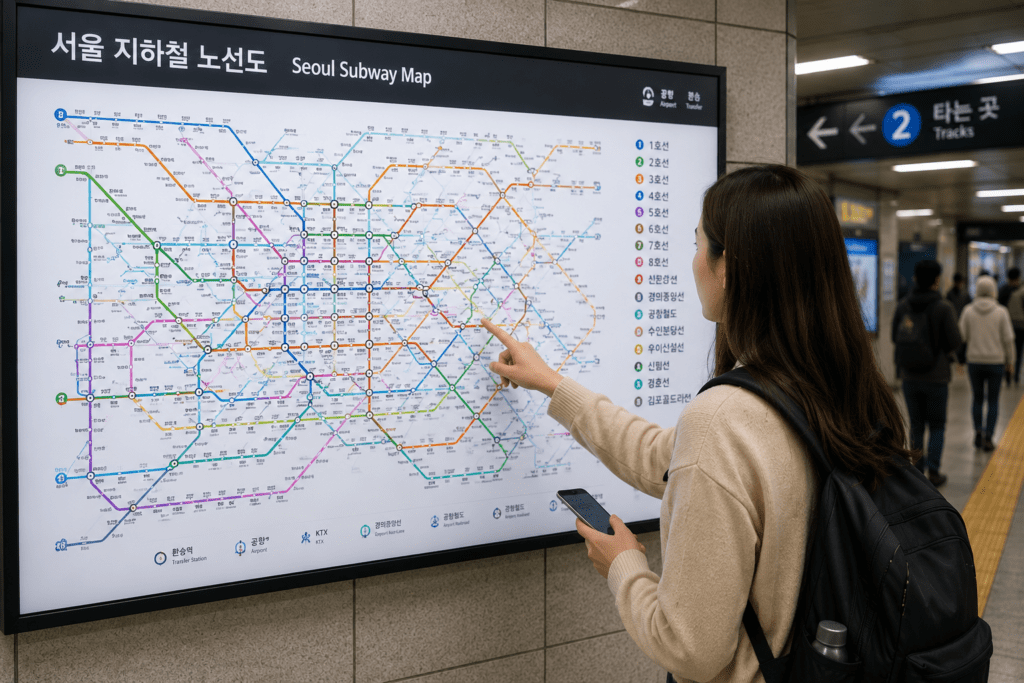
Why the Seoul Subway Matters for First-Time Visitors
The Seoul subway matters because it solves one of the biggest travel problems: moving around a large city without depending too much on taxis. Seoul is big, and many famous places are spread across different districts. The subway makes those areas easier to reach.
It is also useful because stations are usually located near important streets, attractions, markets, and shopping areas. In many cases, the subway exit number is just as important as the station name. Choosing the right exit can save you a long walk.
For example, if you go to Myeongdong Station but use the wrong exit, you may still reach the area, but you might need to cross large streets or walk several extra minutes. In Seoul, local people often say, “Which exit?” before meeting someone at a subway station. This is because exits can lead to very different sides of the neighborhood.
Understanding Seoul Subway Lines
Each Seoul subway line has a number or name and a color. For example, Line 2 is green, Line 3 is orange, and Line 4 is blue. This color system makes it easier to follow signs inside stations.
When you plan a route, do not only check the line number. You also need to check the direction. Subway platforms are usually divided by the direction the train is going, often shown by the next major station or the final station on that line.
This is where many first-time visitors make a mistake. They find the correct line but enter the platform going in the opposite direction. Before you go down to the platform, check that the station names on the sign match the direction shown in your map app.
A simple way to think about it is this: line, direction, transfer, exit. If you check these four things, most subway rides in Seoul become much easier.
How to Plan Your Subway Route
The easiest way to plan your subway route is to use a Korean map app. Naver Map and Kakao Map are widely used in Korea. They can show subway routes, transfers, estimated travel time, walking directions, and exit numbers.
You can also use subway-specific apps if you prefer a simple route map. Seoul City has introduced subway information services for foreign residents and tourists, including subway line information and real-time timetable support.
When searching for your route, enter your starting point and destination. Then check the recommended subway line, transfer station, train direction, and exit number. Do not only look at the station name.
For first-time visitors, I recommend taking one extra minute before entering the gate. Look at your route again and confirm the line color, platform direction, and transfer station. This small habit can prevent many mistakes.
How to Use a T-money Card on the Seoul Subway
A T-money Card is a rechargeable transportation card used in Korea. You can use it on subways, buses, and some taxis. Seoul City explains that public transportation cards such as T-money and Cashbee can be purchased at convenience stores, subway stations, or through related official channels, and they can be reloaded after purchase.
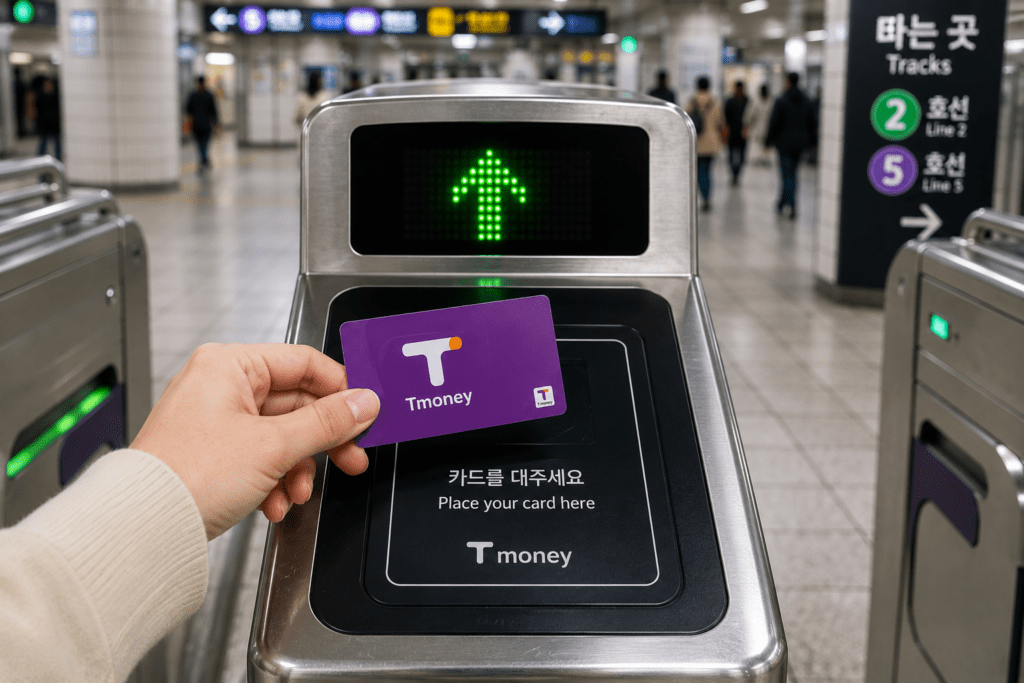
Using a T-money Card is simple. Tap the card on the card reader when you enter the subway gate. Then tap it again when you exit at your destination station.
Do not forget to tap out. The subway system needs to know where you entered and where you exited. If you do not tap correctly, you may have trouble leaving the station or using transfer discounts.
You can recharge a T-money Card at subway station machines and many convenience stores. Some machines offer English language options. However, payment methods can vary, so it is useful to keep some Korean cash ready for transportation card recharge.
Step-by-Step: How to Ride the Seoul Subway
First, search your destination in Naver Map, Kakao Map, or another reliable subway app. Check the recommended route. Pay attention to the subway line, direction, transfer station, and exit number.
Second, go to the subway station and find the correct line. Large stations may have several subway lines in one building. Follow the line color and number on the signs.
Third, tap your T-money Card at the gate. Wait for the gate to open and walk through. Keep your card easy to reach because you will need it again when you exit.
Fourth, go to the correct platform. Check the direction carefully before boarding. Look for station names on the sign and compare them with your app.
Fifth, get on the train after passengers exit. This is basic subway etiquette in Korea. Stand to the side of the doors and let people get off first.
Sixth, listen for station announcements and watch the screen inside the train. Many trains show the next station and transfer information. Major announcements are often made in Korean and English.
Seventh, transfer if your route requires it. Follow the signs for the next subway line. Some transfer walks are short, but others can take several minutes.
Finally, arrive at your destination station, follow the exit signs, and tap your T-money Card at the exit gate. Then follow the exit number recommended by your map app.
How Subway Transfers Work in Seoul
Transfers are very common in Seoul. Do not worry if your route includes one or two transfers. Many local people transfer every day.
Inside subway stations, transfer signs usually show line numbers, line colors, and arrows. Follow the signs for your next line. You may need to walk through tunnels, go up or down stairs, or pass moving walkways.
Some stations are large and complicated. For example, stations like Seoul Station, Express Bus Terminal, Gangnam, Jongno 3-ga, and Dongdaemun History & Culture Park can feel busy. If your transfer walk feels long, it does not always mean you are lost. Some transfers in Seoul simply take time.
If you use a T-money Card, transfer discounts may apply when transferring between subway and bus within the allowed time and conditions. T-money’s foreigner guide explains that transfer discounts are available within transfer time limits, but details can depend on route and time. Prices, transfer rules, and operating conditions can change, so it is always a good idea to check official information before your trip.
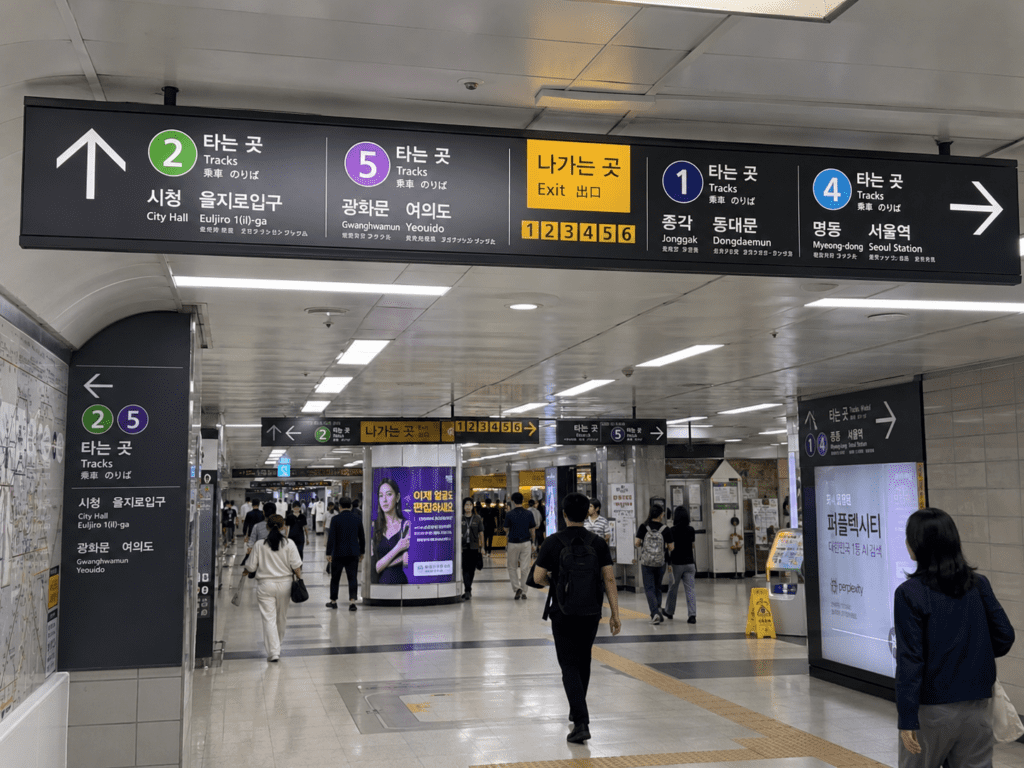
How to Find the Right Subway Exit
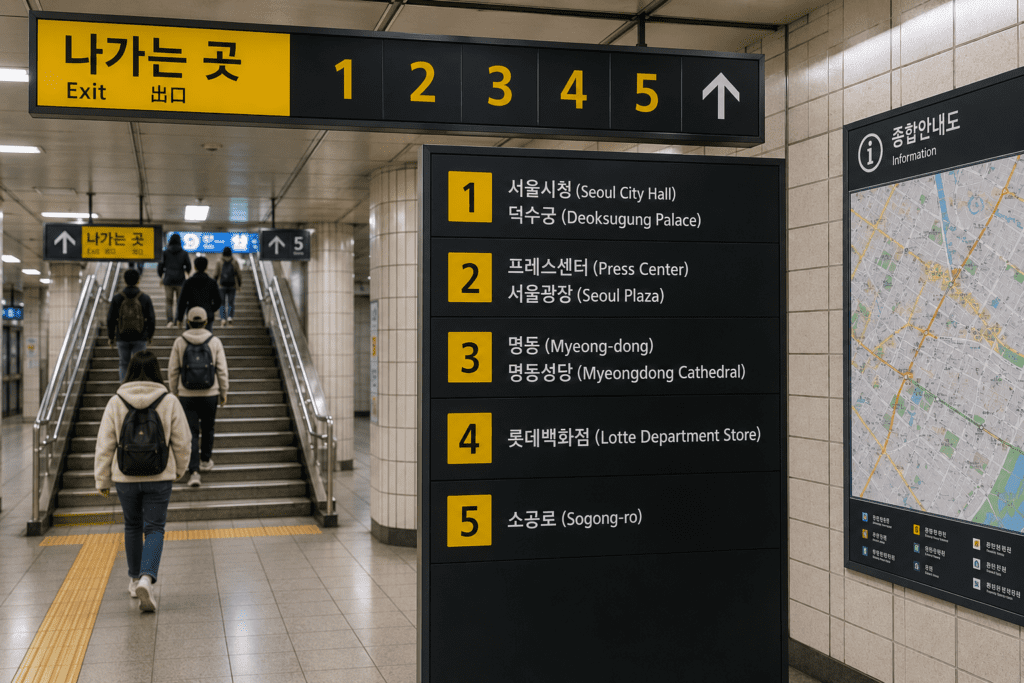
Finding the right exit is one of the most important subway skills in Seoul. Many stations have more than five exits. Some large stations have more than ten.
The exit number tells you where you will come out at street level. This matters because Seoul streets can be wide, and crossing to the other side may take time. If you choose the wrong exit, you may still be close to your destination, but the walk can become confusing.
Before you leave the station, check your map app for the recommended exit number. Then follow the yellow exit signs inside the station. Exit signs usually show numbers such as Exit 1, Exit 2, Exit 3, and so on.
A local tip is to search your exact destination, not just the nearest station. For example, search the cafe, hotel, museum, or palace gate you want to visit. The app will usually tell you which subway exit is best.
Common Mistakes First-Time Visitors Make
One common mistake is taking the right subway line in the wrong direction. This happens often, even to people who are careful. If it happens, do not panic. Get off at the next station, cross to the opposite platform if possible, and go back.
Another mistake is ignoring the exit number. Many visitors think arriving at the correct station is enough. In Seoul, the correct exit can make a big difference.
A third mistake is not keeping enough balance on the T-money Card. If your balance is too low, you may not be able to enter the gate. Recharge before long travel days, especially if you plan to use both subway and buses.
Some visitors also rely only on apps that do not work well for detailed walking directions in Korea. For subway and walking routes, Korean map apps are usually more practical.
Another mistake is standing too close to the train doors before people exit. In Korea, the polite way is to stand to the side and let passengers leave first. This helps everyone move faster.
Local Tips from a Korean Perspective
As a Korean local, my biggest advice is to slow down for the first ride. You do not need to move as quickly as commuters. Step aside, check your app, and follow the signs calmly.
During rush hour, subway trains can be very crowded. Rush hour is usually busy on weekday mornings and evenings. If you have large luggage, try to avoid the busiest times when possible.
On escalators and stairs, follow the local flow. In busy stations, people may walk quickly. If you need to stop and check your phone, move to the side first.
Inside the train, avoid loud phone calls and keep your backpack close to your body. If the train is crowded, take off your backpack and hold it in front of you. This is more comfortable for you and for people around you.
Priority seats are for elderly passengers, pregnant women, people with disabilities, and people who need extra care. Even if the train is not crowded, it is better to leave those seats open.
Things to Check Before Your First Subway Ride
Before your first subway ride, check your T-money Card balance. Make sure you have enough money for your trip. If you are not sure, recharge before entering the gate.
Check your subway line and direction. The line color helps, but the direction is just as important. Your map app should show the direction or final station.
Check your transfer station. If your route has a transfer, remember the name of that station before you board. This helps you stay calm during the ride.
Check your exit number. This is especially important when going to hotels, markets, museums, palaces, and meeting points. In Seoul, the wrong exit can turn a simple trip into a confusing walk.
Also check the last train time if you are going out late. Visit Seoul notes that the subway generally operates from around early morning until around midnight, but operating hours can vary by line, station, and day. Always check your app or the official website before traveling late at night.
Best Apps for Using the Seoul Subway
Naver Map is one of the most useful apps for traveling around Korea. It gives detailed walking routes, subway routes, bus routes, and exit information. Many Koreans use it in daily life.
Kakao Map is another popular Korean map app. It is also helpful for public transportation, walking directions, and checking nearby places. Some travelers prefer one app over the other, so it can be useful to try both.
Papago is not a map app, but it is very useful in Korea. It is a translation app that can help you understand Korean signs, menus, and short messages. If you see a subway notice that is only in Korean, Papago can help.
You do not need to use every app. For most first-time visitors, one good map app plus Papago is enough. Download them before your trip and test them once before your first busy travel day.
Frequently Asked Questions
Q. Is the Seoul subway easy for foreigners to use?
A. Yes, the Seoul subway is generally easy to use once you understand the basics. The map may look complicated at first, but color-coded lines, English signs, and map apps make it much easier.
Q. Can I use a T-money Card on the Seoul subway?
A. Yes, you can use a T-money Card on the Seoul subway. Tap the card when you enter and tap again when you exit.
Q. How do I know which subway direction to take?
A. Check the direction shown in your map app and compare it with the station signs on the platform. Do not only check the line number because the same line runs in two directions.
Q. What should I do if I take the wrong train?
A. Get off at the next station and check your route again. In most cases, you can cross to the opposite platform or follow signs to the other direction.
Q. Are Seoul subway signs written in English?
A. Many subway signs include English, especially station names, line numbers, and transfer signs. However, some notices may still be mostly in Korean, so a translation app like Papago can be helpful.
Q. Why are subway exits so important in Seoul?
A. Subway exits can lead to very different sides of a street or neighborhood. Choosing the right exit can save you time and make it easier to find your hotel, attraction, or meeting point.
Q. Should I use Naver Map or Kakao Map for the Seoul subway?
A. Both are useful in Korea. Many travelers use Naver Map for walking and public transportation, while others prefer Kakao Map. Try both and keep the one that feels easier for you.
Final Thoughts
Learning how to use the Seoul subway is one of the best things you can do before your first trip to Korea. At first, the subway map may look overwhelming. There are many lines, colors, transfers, and exits. But the system becomes much easier when you follow a simple order: check your route, confirm the line, check the direction, transfer if needed, and use the correct exit.
For first-time visitors, the most important tools are a T-money Card and a reliable Korean map app. The T-money Card makes subway and bus rides smoother because you do not need to buy a single ticket each time. A map app helps you choose the right route, transfer station, and exit number. These two things can remove a lot of stress from your Seoul trip.
My local advice is simple: do not rush too much on your first day. Seoul commuters move quickly, but you do not have to match their speed. Stand to the side, check your phone, and follow the signs step by step. If you take the wrong train or miss your stop, it is not a serious problem. You can usually correct the route easily.
The Seoul subway is not just transportation. It is part of everyday life in the city. Once you feel comfortable using it, Seoul becomes much more open and enjoyable. You can visit famous places, explore local neighborhoods, and move around the city with more freedom. For your next step, it is helpful to learn how to use a T-money Card in detail and which Korea travel apps are best for foreign visitors.
Suggested Internal Links
- How to Use a T-money Card in Korea
- Best Korea Travel Apps for Foreign Tourists
- How to Get from Incheon Airport to Seoul
- Korea Travel Checklist for First-Time Visitors
- What to Know Before Visiting Korea