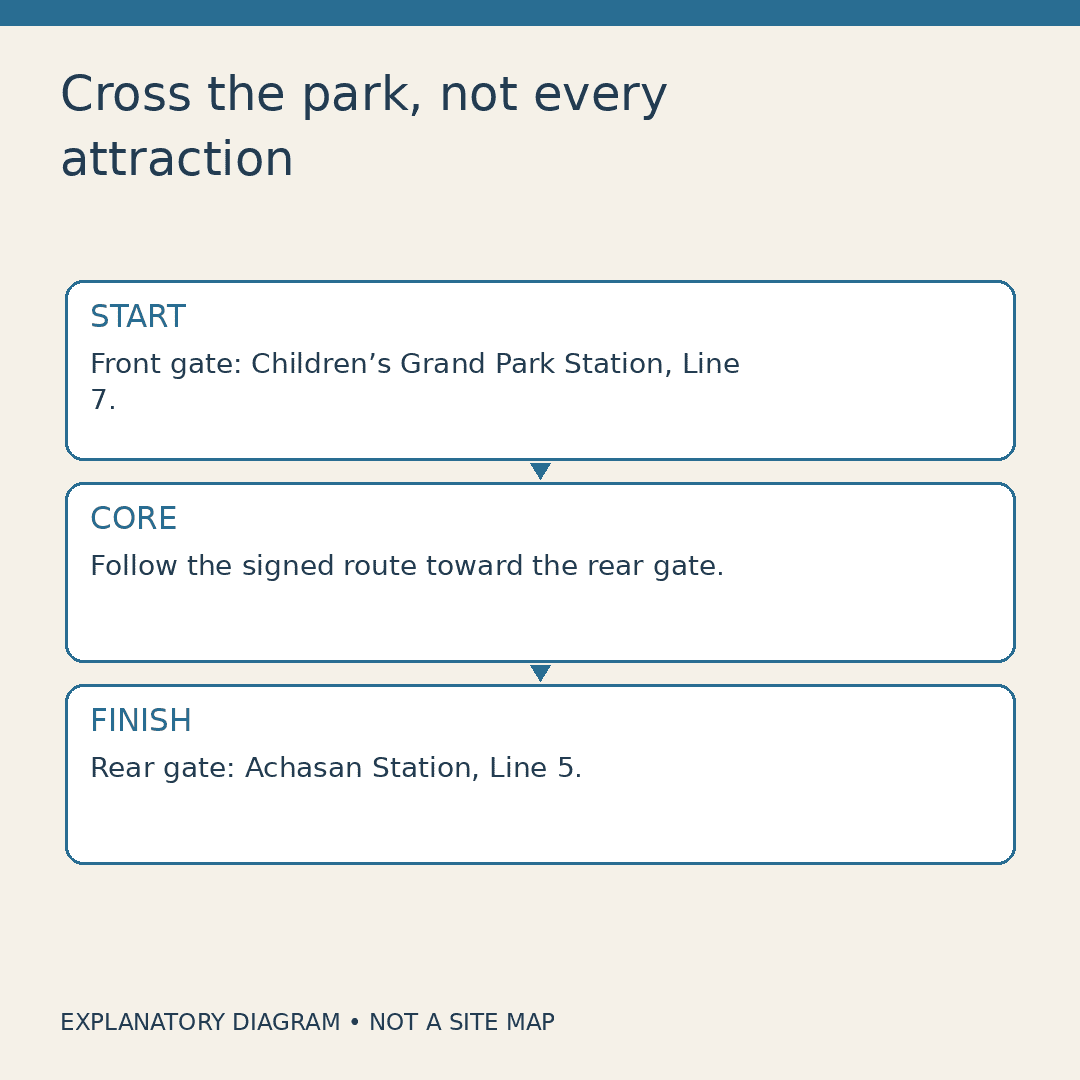
A short visit to Seoul Children’s Grand Park works better when you choose a way out before adding attractions. One useful backbone is a through-walk from the front gate near Children’s Grand Park Station to the rear gate near Achasan Station. That gives the outing two clear transport anchors instead of an expanding list of things to see.
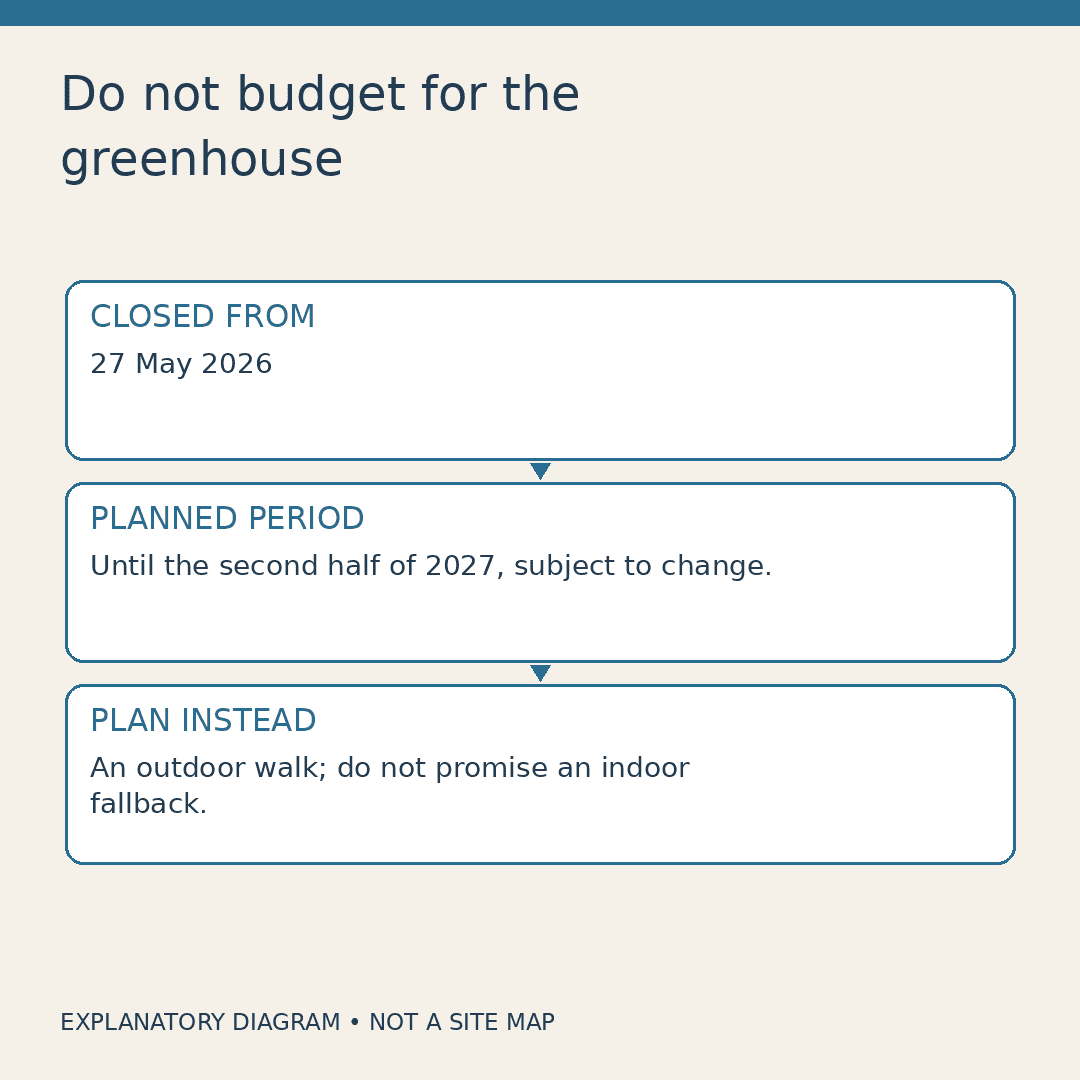
There is an important current limit: the botanical garden is closed for remodeling. This plan is an outdoor park walk, not an all-weather zoo-and-greenhouse circuit. It is desk-researched rather than a claim of a newly walked, measured or step-free route.
Save two stations and two gates
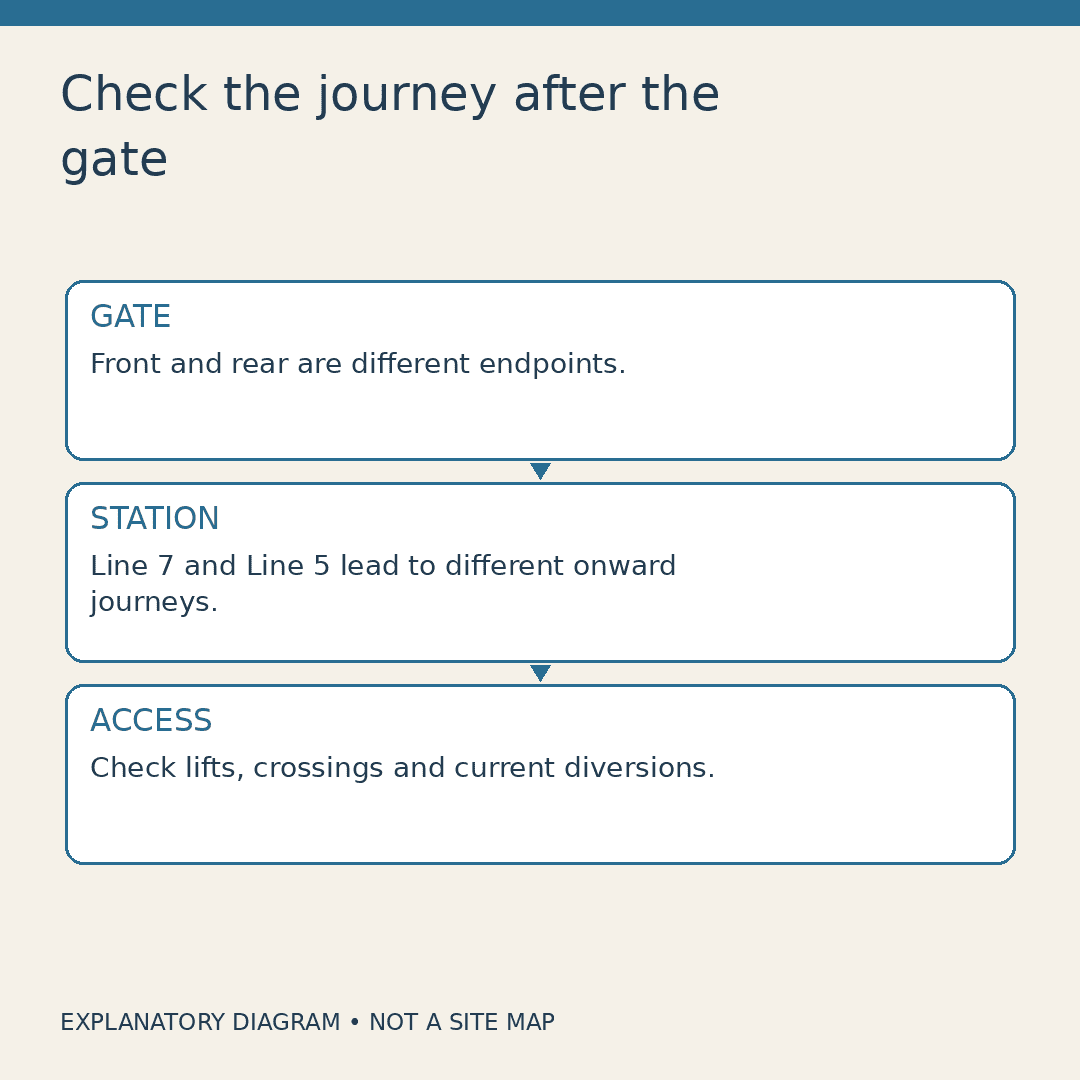
The operator’s directions page links the front gate to Children’s Grand Park Station, Line 7, exit 1, and the rear gate to Achasan Station, Line 5, exit 4. The park address is 216 Neungdong-ro, Gwangjin-gu, Seoul. This is 서울어린이대공원, not Seoul Grand Park in Gwacheon.
Compare your onward journey from both stations before choosing the direction. You can reverse the plan if Line 5 is the easier arrival and Line 7 the better finish. The important part is keeping the gate and station together in your saved notes; searching only the park name can send you to a different entrance.
Remove the greenhouse from old saved itineraries
The operator’s dated botanical-garden closure notice states that operation stopped on May 27, 2026, with the closure planned until the second half of 2027. That end period is a plan, not a confirmed reopening appointment.
If an older account recommends warming up in the greenhouse, do not carry that assumption into this visit. In heavy rain or uncomfortable cold, postpone the park walk or choose a separately verified indoor destination. A café symbol on a map is not a promise of an available seat, opening time or refuge for your whole group.
Use the main connection as a backbone, then choose one detour
At the entrance, read the current official park map and on-site notices. Identify your exit, a convenient toilet and one outdoor area that interests you. The map names gardens, ponds and play areas; select something near your permitted route rather than trying to connect every icon.
Follow the signed pedestrian connection toward the other gate, adapting to construction barriers or diversions. This article does not prescribe an unverified shortcut around the closed botanical garden. If the route you expected is unavailable, ask the information center or return by the open route you know.
Keep the detour modest: a pause to look at planting, a short rest or one play area if suitable for your group. A child becoming interested in a playground is a reason to use the available time there—not a reason to rush afterward to complete the original crossing.
Separate walking time from outing time
The official map gives about 20 minutes between the front and rear gates as a walking estimate. That is not a complete visitor itinerary. It does not account for your journey from the station, wayfinding, photographs, toilet stops, a slower companion or a temporary detour.
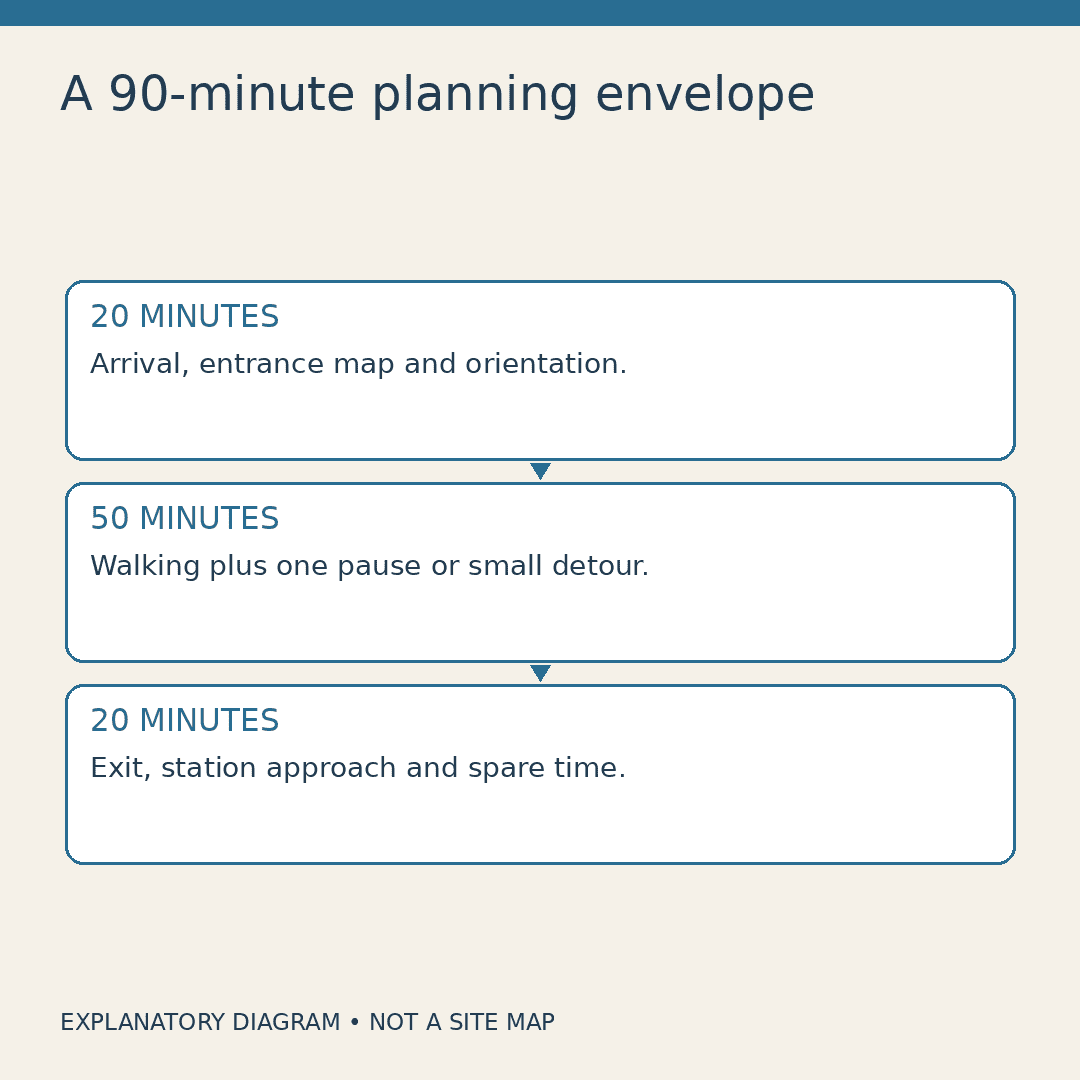
For a relaxed short outing, an editorial 90-minute envelope could allocate 20 minutes to arrival and orientation, 50 to walking and one pause, and 20 to leaving and spare time. These are planning allowances, not measured segments. If you add a substantial zoo visit or an indoor attraction, recalculate the outing instead of hiding it inside the same 90 minutes.
Keep facility hours and park hours apart
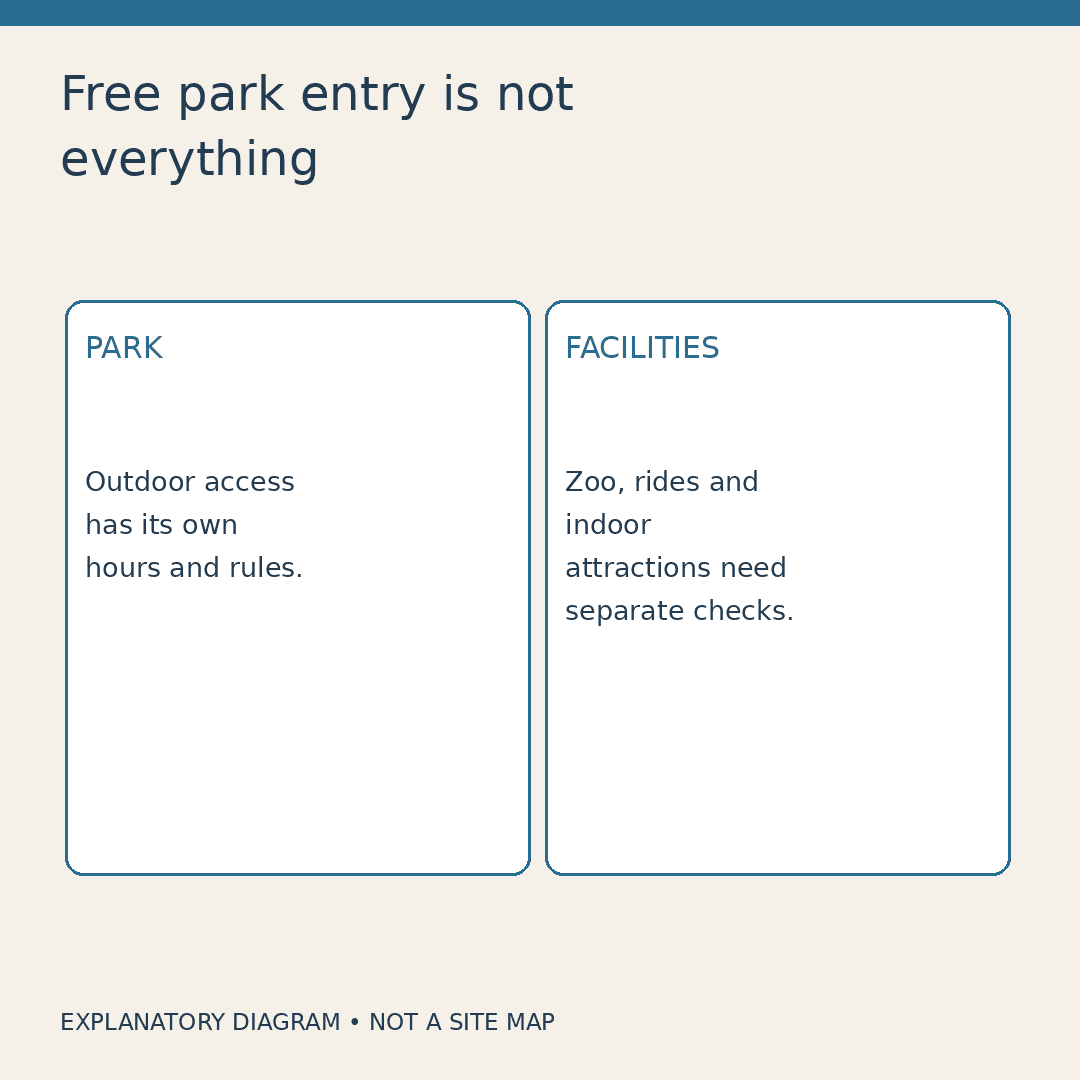
The operator’s hours and rules list free park admission and 05:00–22:00 opening for the main gates. The zoo has a separate 10:00–17:00 window that can vary with weather or animal-health measures. General park access does not establish that every ride, program or indoor facility is operating or included without charge.
This route deliberately does not depend on a fountain show, seasonal festival or a particular animal being visible. Check any extra you genuinely want separately. Follow the park’s rules, including no bicycles or kick scooters, no feeding animals and no picking plants. Do not assume that an activity shown in a visitor photo is permitted.
Finish at the gate that still suits the group
Before the final stretch, check the route to the station you actually intend to use. Exit numbers are orientation points, not accessibility certification. If you need a step-free journey, verify lifts and the complete street route rather than relying on the walking estimate. Our Seoul subway guide helps separate a station name from the right exit and onward direction.
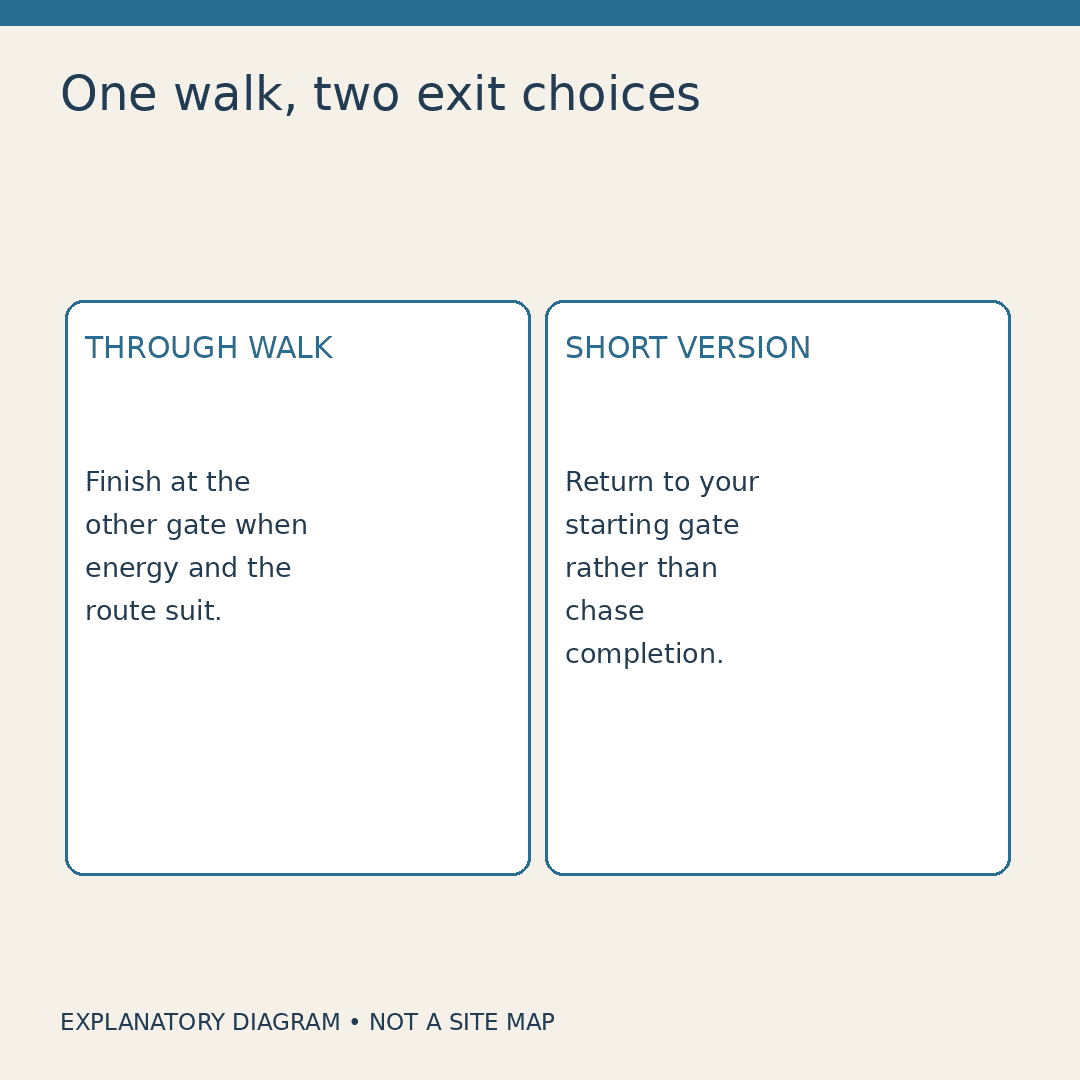
A through-walk can be satisfying, but it is not a completion challenge. Returning to the starting gate is a valid shorter version if the weather, diversions or somebody’s energy changes. Leave with one enjoyable park memory rather than a collection of facilities visited too quickly.
Official information checked 3 November 2026, Korea time. Recheck closures and access before visiting. The route diagram is conceptual; the 90-minute allocation is editorial, not an official tour.