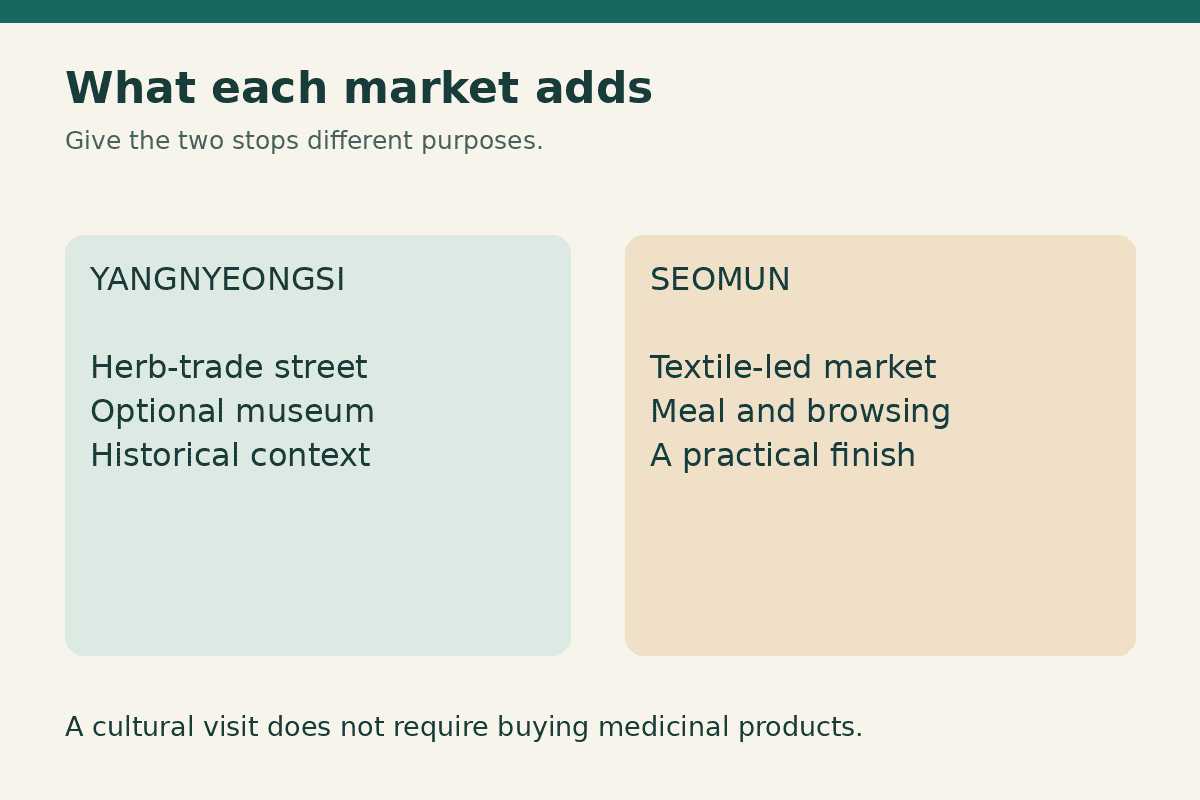
Daegu’s Yangnyeongsi and Seomun offer two different encounters with market life. Around Yangnyeongsi, the focus is the herb trade and its history. At Seomun, textile shopping and everyday goods share the visit with food. Pair them in daylight if you want more than a sequence of snack stalls.
Begin near Yangnyeongsi, add the museum if its current arrangements suit you, then continue to Seomun for lunch and browsing. Seomun’s weekend night market begins later, at 19:00. It is a separate evening choice, not something a midday market visit automatically includes.

Begin with the trade behind Yangnyeongsi
The Daegu market agency’s Yangnyeongsi listing identifies herbal materials and red ginseng as its main products. This is a working commercial district. Look at the shopfronts and signs, keep entrances clear and ask before photographing inside a business.
You do not need to purchase medicinal products to make the stop worthwhile. For a visitor unfamiliar with the trade, the nearby Daegu Yangnyeongsi Museum of Oriental Medicine can supply historical context before the street browse. Keep that cultural interest separate from decisions about taking a remedy or buying a product for a health condition.
The museum is at 49 Dalgubeol-daero 415-gil, Jung-gu. General admission is free; activities such as a footbath or workshop have separate arrangements. The Korea Tourism Organization’s museum guide describes multilingual graphics and animations, which can make the displays more approachable for international visitors.
Confirm the museum’s hours: KTO lists 09:00–18:00, while Daegu’s city tourism page lists 10:00–17:00. A proposed 10:30 visit falls within both published windows, but the discrepancy remains unresolved. Both describe Monday closure with a public-holiday exception. Check your date, particularly around January 1, Seollal and Chuseok; the city tourism page lists +82-53-253-4729, while KTO lists +82-53-253-3359. The differing listings are another reason to check directly before planning a museum-dependent visit.
A personal walking account published in June 2025 describes choosing only some of the city’s suggested stops and looking through the museum’s upper floors. It also mentions activities the writer did not try. Take the practical lesson: a display visit and a booked experience need different amounts of time. This route does not require adding a paid activity.
Continue to Seomun for the textile market as well as lunch
Use Banwoldang Station as the arrival anchor for Yangnyeongsi. The market agency lists it a short walk from the herb-market area and places Seomun about one kilometre away. Save both market destinations and use a current pedestrian route for the connection; a nearby-distance listing does not identify every crossing or entrance.
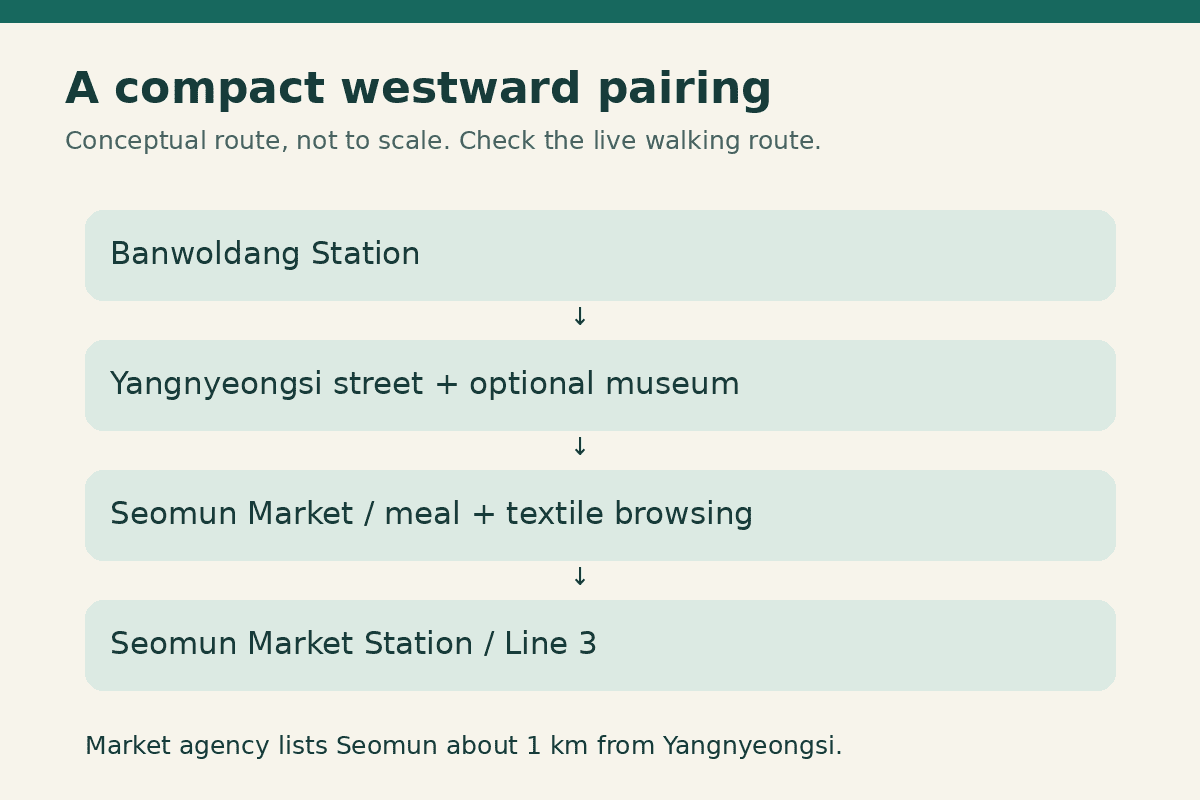
Seomun’s address is 45 Keunjang-ro 26-gil, Jung-gu. KTO’s Seomun introduction highlights textile-related goods alongside clothing, kitchen utensils, crafts and dried seafood. Even if you have no shopping list, seeing a little of that trade adds something a food-only visit misses.
For purchases, establish what the quoted price covers before agreeing: one item, a set or a quantity of material. Ask about a fabric’s composition rather than judging it solely by appearance. You can enjoy browsing without buying something bulky for the rest of your trip.
Choose lunch when you are ready for a proper pause. A November 2023 visitor account describes waiting for a seated meal in the District 2 basement and being unable to cover the whole market. That is a reason to allow a meal and some waiting time, not a current recommendation for the same vendor or its old prices.
Read today’s menu, confirm the total and ask about ingredients that matter to you. Payment arrangements can vary by stall. The guide to cards, cash and transit payments can help you prepare a backup without assuming one method works everywhere.
Keep the daytime and evening clocks separate
Published daytime hours for Seomun are 09:00–18:00, with closure on the first and third Sundays of the month and variation among shops. Yangnyeongsi’s general market listing gives 09:00–19:00, also with individual store closures. Check a particular business separately if it is your main reason for going.
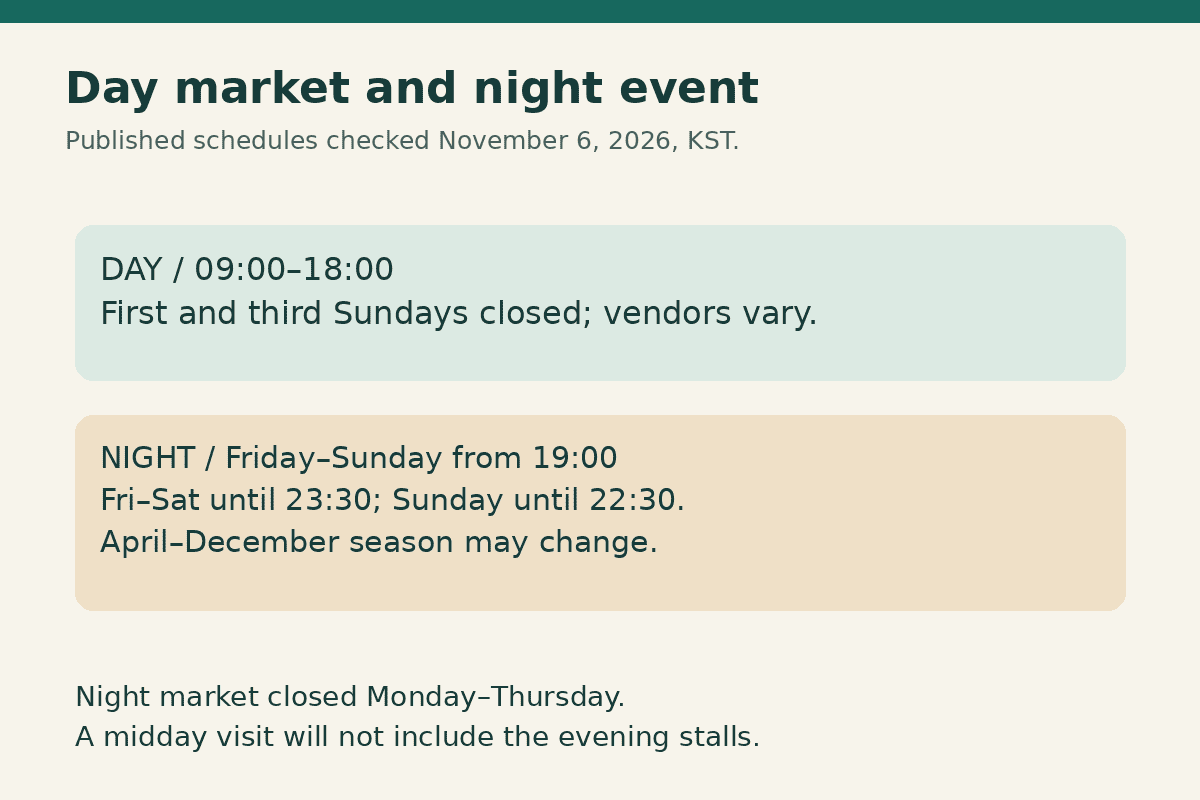
The night-market operator lists Friday and Saturday 19:00–23:30, Sunday 19:00–22:30, and Monday–Thursday closure. It gives an April–December season, subject to change. Recheck dated notices before arranging your evening around it.
If you finish the daytime route around 13:40, the published 19:00 opening is still five hours and twenty minutes away. Make a separate evening plan if the night stalls are important to you. Do not spend the afternoon waiting merely because both experiences use the Seomun name.
Give the outing room to breathe
This example is for an adult visitor on an ordinary Tuesday–Saturday in November, with no holiday or special closure, comfortable walking between the markets. All times are KST. Verify the specific date before travel; the museum remains optional.
As an editorial example, arrival at 10:15 and departure around 13:40 leave 205 minutes: 15 for arrival, 50 for an optional museum visit, 25 for the herb street, 25 for the transfer, 50 for lunch and waiting, 30 for browsing and 10 for reaching onward transport. These are planning allowances, not measured walking or service times.
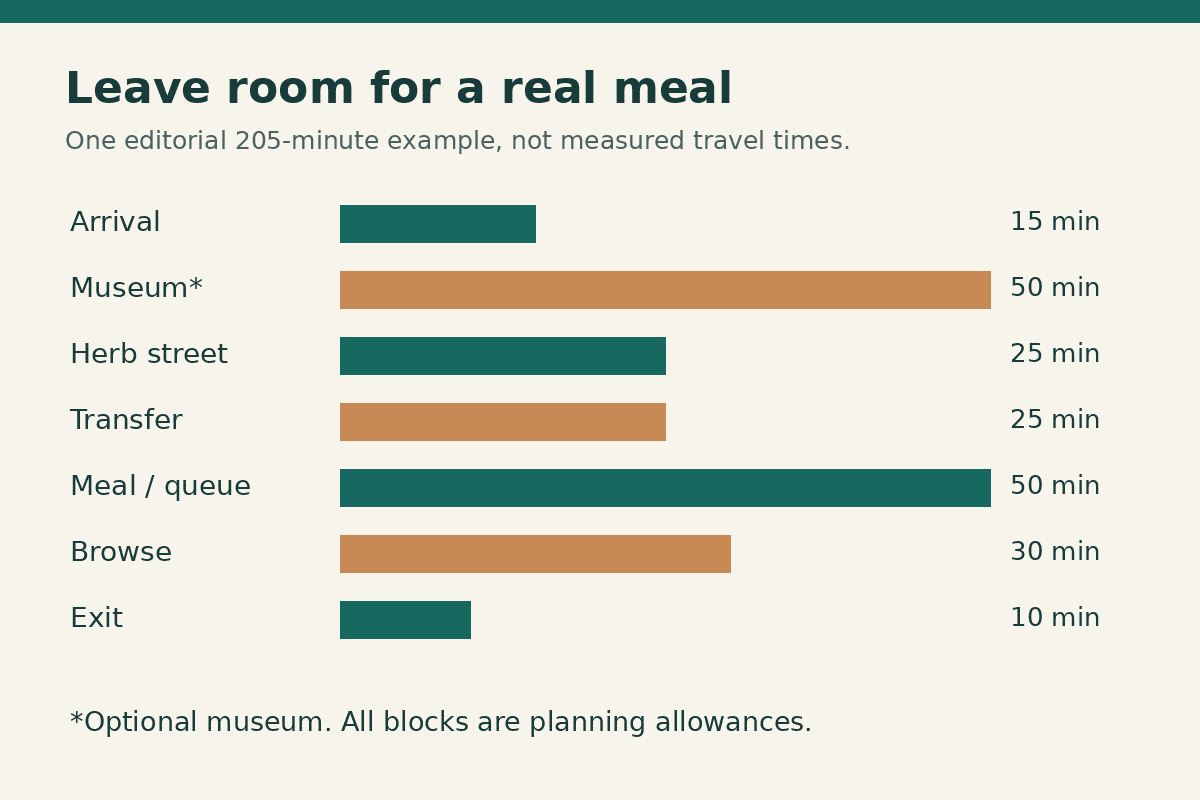
Finish toward Seomun Market Station on Line 3, checking your onward route before leaving the market. If the museum is closed, omit that segment rather than filling it with an unresearched attraction. For the complete daytime pairing, avoid Seomun’s regular closure Sundays.
The connecting streets are exposed to weather, and this is not a verified step-free route. In persistent rain or when the group is tired, choose one market and shorten the outing. Museum admission may be free, but transit, meals, shopping and optional experiences still belong in your budget. The roughly one-kilometre figure above concerns only the intermarket connection, not total walking distance, which has not been measured. No total per-person budget is quoted: transit, meals, shopping and optional activities are unpriced and excluded. The aim is to understand two sides of Daegu’s commerce, not to exhaust either market.
Research-based guide; official visitor information checked November 6, 2026, Korea time. Original diagrams are planning aids, not photographs or surveyed walking maps.