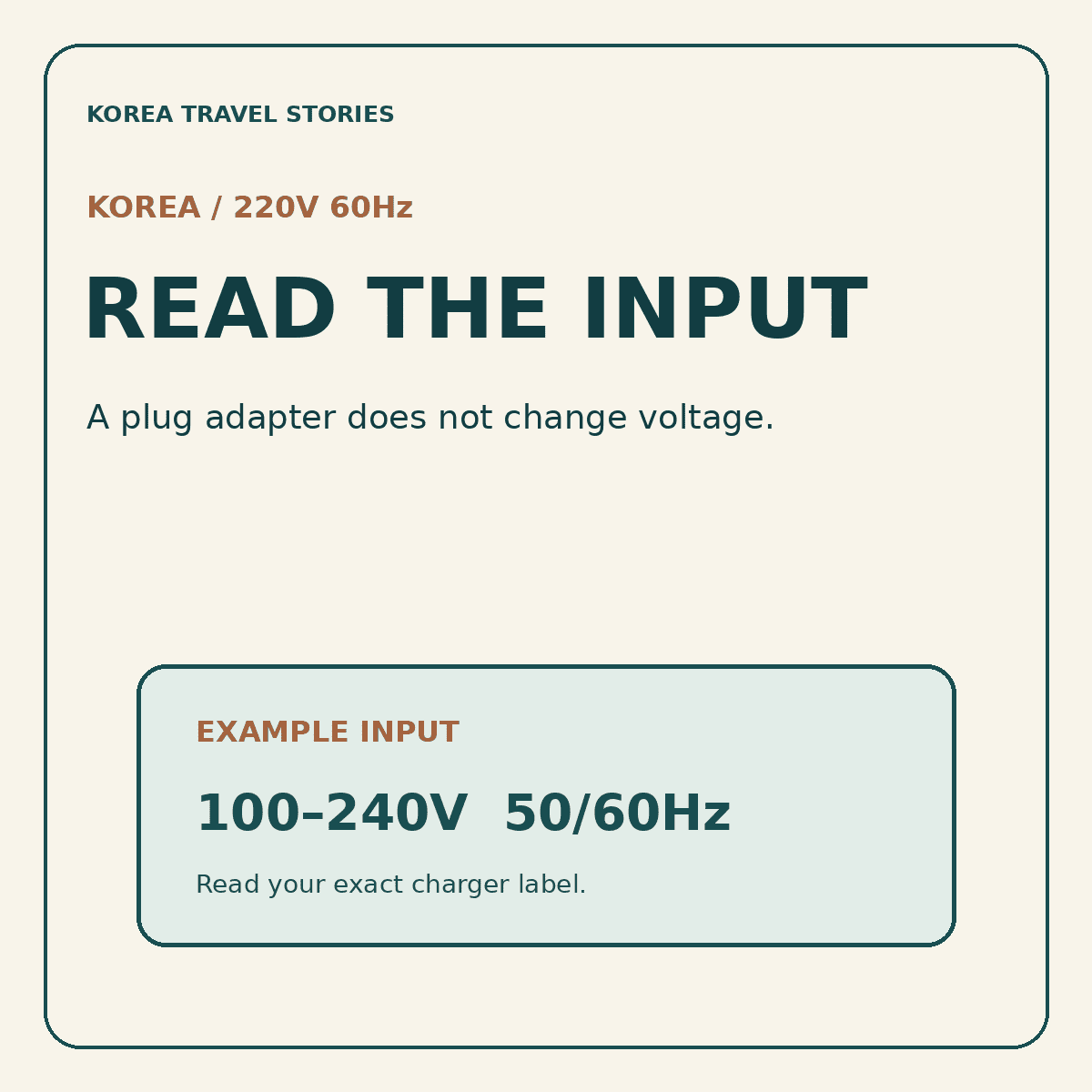
A plug that fits can still be the wrong electrical match. Before packing for Korea, read the small input label on your charger. That tells you more than a product title containing the word “universal.”
The Korea Tourism Organization lists Korea’s standard supply as 220 volts at 60 hertz, with outlets that have two round holes. Check both electrical compatibility and plug fit before connecting a device.
Use the input line, not the USB output line
A charger may show both “Input” and “Output.” Input describes the electricity the charger accepts from the wall. Output describes what it supplies to the connected device. A USB output such as 5V is not the value you compare with Korea’s mains supply.
For example, an input label reading 100–240V, 50/60Hz includes Korea’s 220V/60Hz supply. You still need a compatible, properly rated plug arrangement and must follow the manufacturer’s instructions. Do not infer compatibility from the phone’s brand alone.
Apple states that its USB power adapters accept 100–240V AC at 50–60Hz. That is a manufacturer-specific example, not proof that every charger or accessory in your luggage supports the same range.
Separate three different checks
| Check | Question | What not to assume |
|---|---|---|
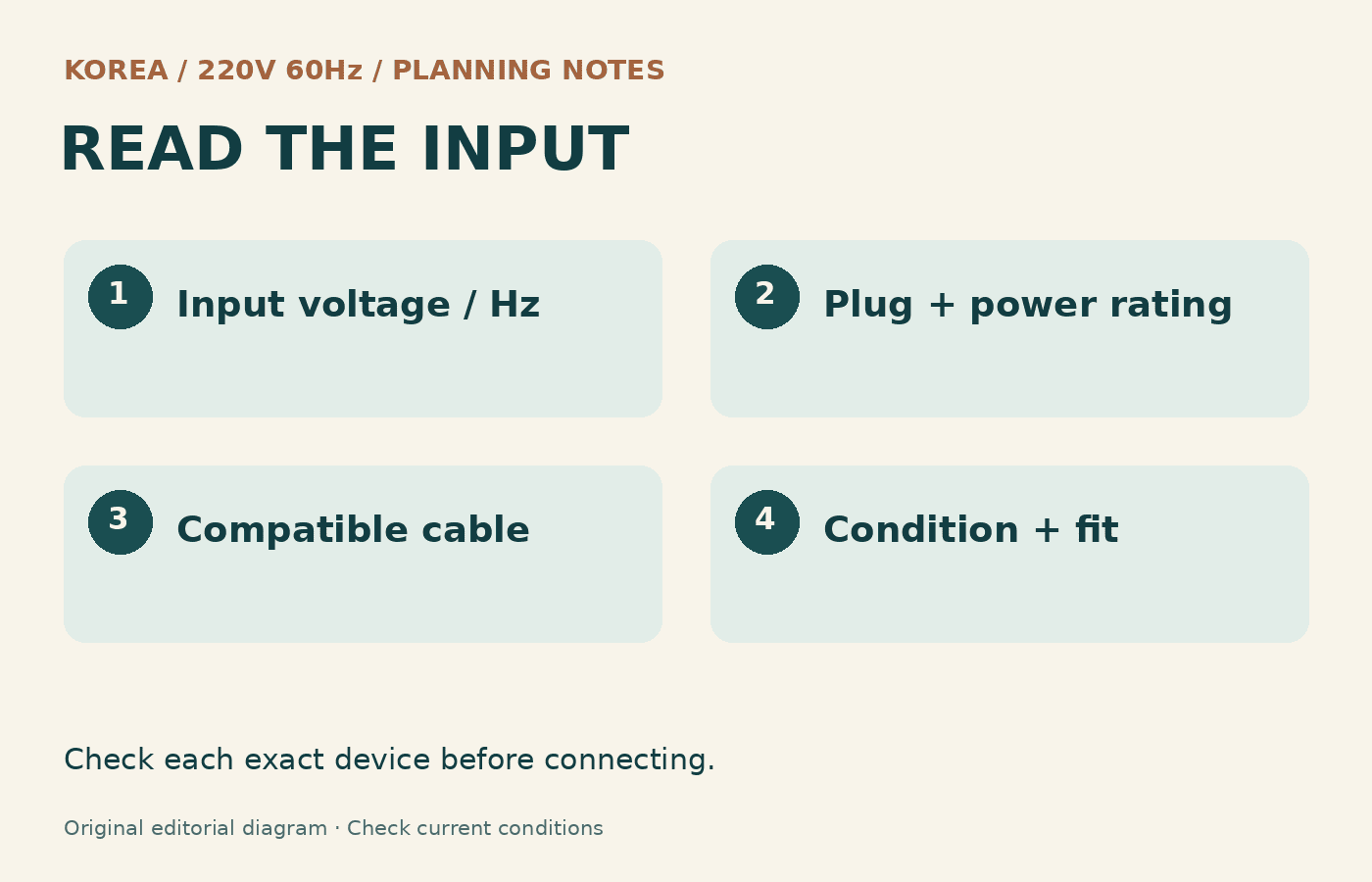
| Input voltage and frequency | Does the exact charger support 220V/60Hz? | A plug adapter changes the supply |
| Plug and grounding | Is the adapter suitable for this destination and device? | Any two-round-pin adapter is appropriate for every appliance |
| Device charging requirements | Are the cable and charger compatible with the device? | A fitting connector guarantees the desired charging speed |
SKROSS explains that its travel adapters do not convert voltage. They connect different plug and socket shapes. The manufacturer specifically advises checking the device’s nameplate.
If the label is missing, unreadable or shows only an incompatible voltage, do not try the device to see what happens. Ask its manufacturer about the exact model, or leave it behind.
Pack chargers differently from heating appliances
A phone charger and a hair dryer are different decisions. Do not extend the compatibility of your charger to a straightener, kettle or other appliance. Check every item separately, including power limits and any required grounding.
For a short stay, using an appliance supplied by the accommodation can be simpler than bringing one that needs electrical conversion. Confirm what is available directly; a room photograph does not establish that a particular device will be provided.
This guide does not select a voltage converter or provide a wiring method. If an appliance requires conversion, follow the appliance maker’s advice on an approved solution. A travel adapter alone is not a remedy for incompatible input voltage.
Make a small charging kit you understand
Pack the verified charger, a suitable adapter if needed and cables for the devices you actually use. Keep manufacturer information or a clear label photograph available offline. Avoid adding multiple unfamiliar adapters simply because they are small.
Before use, inspect for damage and make sure the connection is secure. Do not force a loose or incompatible fit, overload an adapter or improvise by chaining accessories. If equipment behaves abnormally, stop using it and get help from the accommodation or manufacturer.
KTO notes that some hotels may lend or sell adapters, and adapters are also sold at travel retail locations. Treat that as a possible fallback, not guaranteed stock or suitability for your appliance. Preparing before the flight is more dependable.
Once charging is sorted, prepare your Korea mobile connection →
The useful packing question is not “Have I bought a universal adapter?” It is “Have I checked this charger, this plug arrangement and this device?” Answer those separately and your first evening will require much less troubleshooting.