The easiest taxi journey starts before a car arrives. Save the Korean name and street address of your destination, choose a place where a driver can safely stop, and decide how you will pay. Those three checks prevent more confusion than memorizing a long list of taxi colors.
This guide is for a first ordinary city ride, with Seoul-specific rules clearly identified. It does not provide a guaranteed fare or assume that every app, overseas card, or vehicle type will work the same way throughout Korea.
Start with the destination, not just its English name
Open the destination’s official listing or your accommodation confirmation. Save its Korean name, road-name address, and map pin together. A hotel brand may have several branches, and a shopping district can cover a large area. For a station, airport, or large venue, identify the terminal or entrance you actually need.
Keep the information somewhere you can open without searching again. Before departure, show the address and check that the driver’s navigation destination matches it. A translated sentence such as 여기로 가 주세요 means “Please take me here,” but the address does the important work.
If your destination is on a narrow lane or pedestrian street, expect to confirm a suitable nearby drop-off rather than demanding a stop directly at the door. Leave time for the last short walk, especially with luggage.
Choose a taxi stand or an app that you can finish setting up
Korea Tourism Organization’s taxi guide describes street hailing and taxi stands as well as app booking. Stands are commonly found around major stations, terminals, and shopping areas. At an airport, follow official taxi signs and staff directions rather than arranging an improvised ride with someone approaching you inside the terminal.
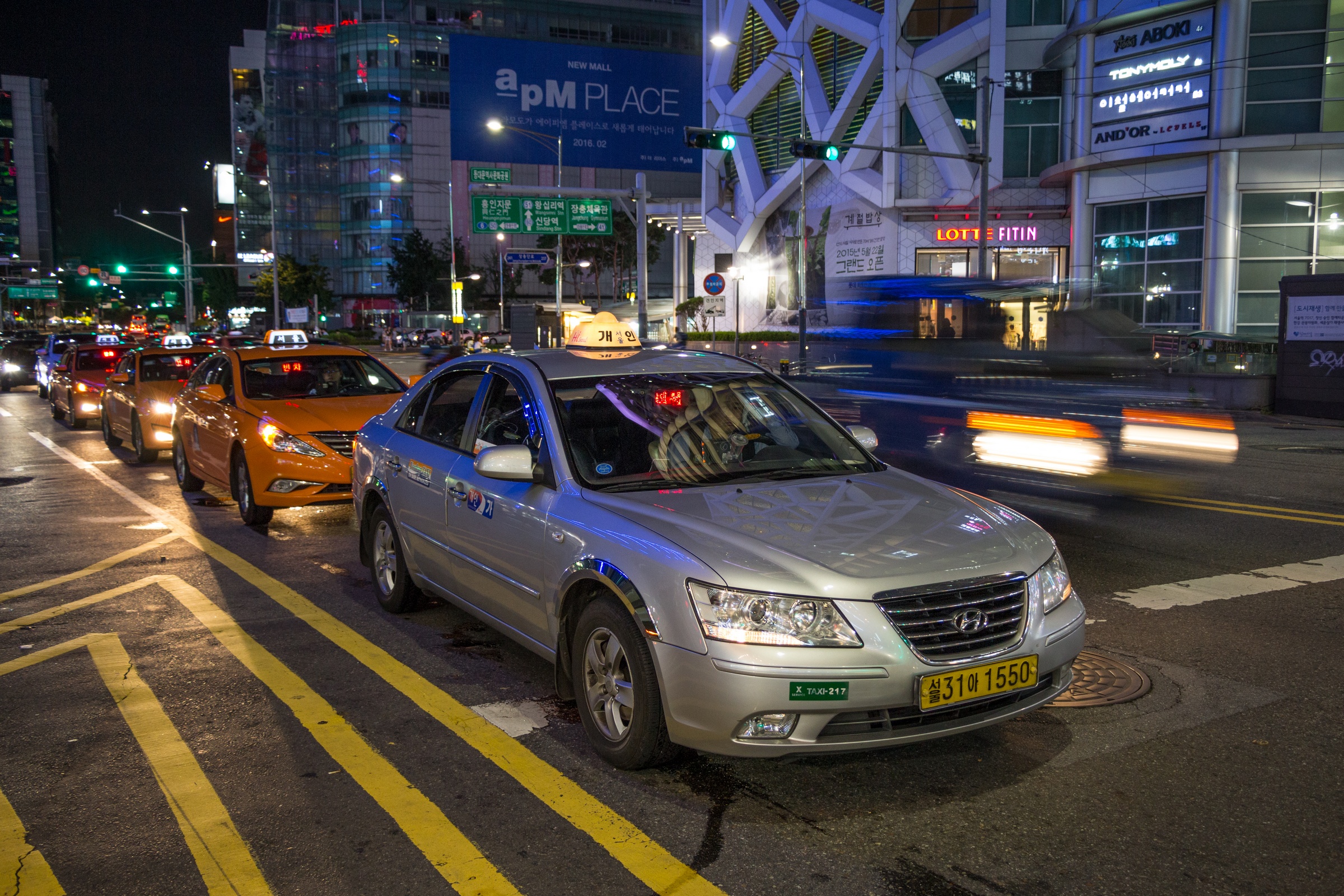
For visitors who prefer booking in an app, KTO lists k.ride as a foreigner-focused service that supports overseas card registration and Google or Apple sign-in. It also lists Uber Taxi. These are options to check, not a promise that your card will be accepted or a car will be available at the moment you need one.
Complete setup while you have a reliable connection. Check the selected car type, passenger capacity, luggage needs, payment method, and any booking or cancellation charges shown before requesting. If setup fails, a staffed taxi stand or help from your accommodation may be simpler than repeatedly trying while standing outside with bags.
The pickup pin deserves its own check
Look at the actual street, not only the blue dot on your phone. A pin can land on the wrong side of a divided road, behind a building, or inside a complex where a car cannot enter. Move to an appropriate signed pickup area and make the booking location match where you will wait.
Once a driver accepts, compare the displayed vehicle and registration number with the arriving car. Stay at the agreed point unless you coordinate a change through the app. Do not step into traffic to reach a car on the opposite side of the road. If the assignment disappears or is canceled, check the booking status before requesting a replacement.
Know what the estimate does and does not include
For an ordinary metered taxi, an app estimate is a planning aid, not automatically a fixed-price contract. Traffic, route, taxi category, and applicable charges can affect the total. A premium car or a reserved transfer may use different pricing, so read the specific offer you select.
Seoul’s official taxi fare page distinguishes taxi types, late-night and out-of-city surcharges, approved fixed-fare arrangements, and other charges. Do not apply Seoul’s fare table to every Korean city, or assume an airport transfer and a short city ride follow identical rules.
Before a long trip, ask whether the displayed price includes tolls and any booking charge. If someone offers an unfamiliar flat cash amount for an ordinary ride, clarify the service and price before starting. A high amount alone does not establish wrongdoing, but an unexplained charge should not be treated as self-explanatory either.
Pay once, then check the back seat
Keep a backup payment method. For a street-hailed taxi, confirm card acceptance before departure if you cannot pay in cash. For an app ride, check whether the booking uses automatic payment or payment to the driver. Do not pay again merely because an automatic charge has not yet appeared in your banking app. Ask the driver and check the trip’s payment status first.
Request and retain a receipt or the app trip record. Seoul’s January 2026 service update describes bilingual receipt information and clearer surcharge details. Your own receipt remains the evidence to check; do not assume every vehicle or service presents it identically.
Before leaving, gather your phone, wallet, bags, and anything placed beside you. If you need help later, the trip time, route, vehicle details, and receipt are more useful than a general description of the car. Use the app’s support route or Seoul’s official taxi guidance for the appropriate local complaint channel.
For a journey that is easy by rail, compare the Seoul subway guide before choosing a taxi. For the airport leg, use the separate Incheon Airport transfer comparison. The best choice is the one that fits the actual trip, not the one you feel obliged to use every day.
Official travel information checked October 20, 2026 (Korea time). Recheck the selected service’s current fare and payment conditions before booking.
“Taking a Taxi in Korea: Set the Destination, Check the Fare, Keep the Receipt”에 대한 1개의 생각