A power bank needs two separate checks before a Korean Air flight: whether the airline will carry it and where you must keep it once aboard. Under the policy effective April 20, 2026, each passenger may carry at most two power banks in total, subject to capacity limits and any required approval. Both belong in the cabin.
This guide covers Korean Air-operated flights, using the airline’s rules checked on November 5, 2026. For a codeshare, identify the operating airline on your booking. Connecting flights and departure-country rules can add restrictions, so check the entire journey before packing.
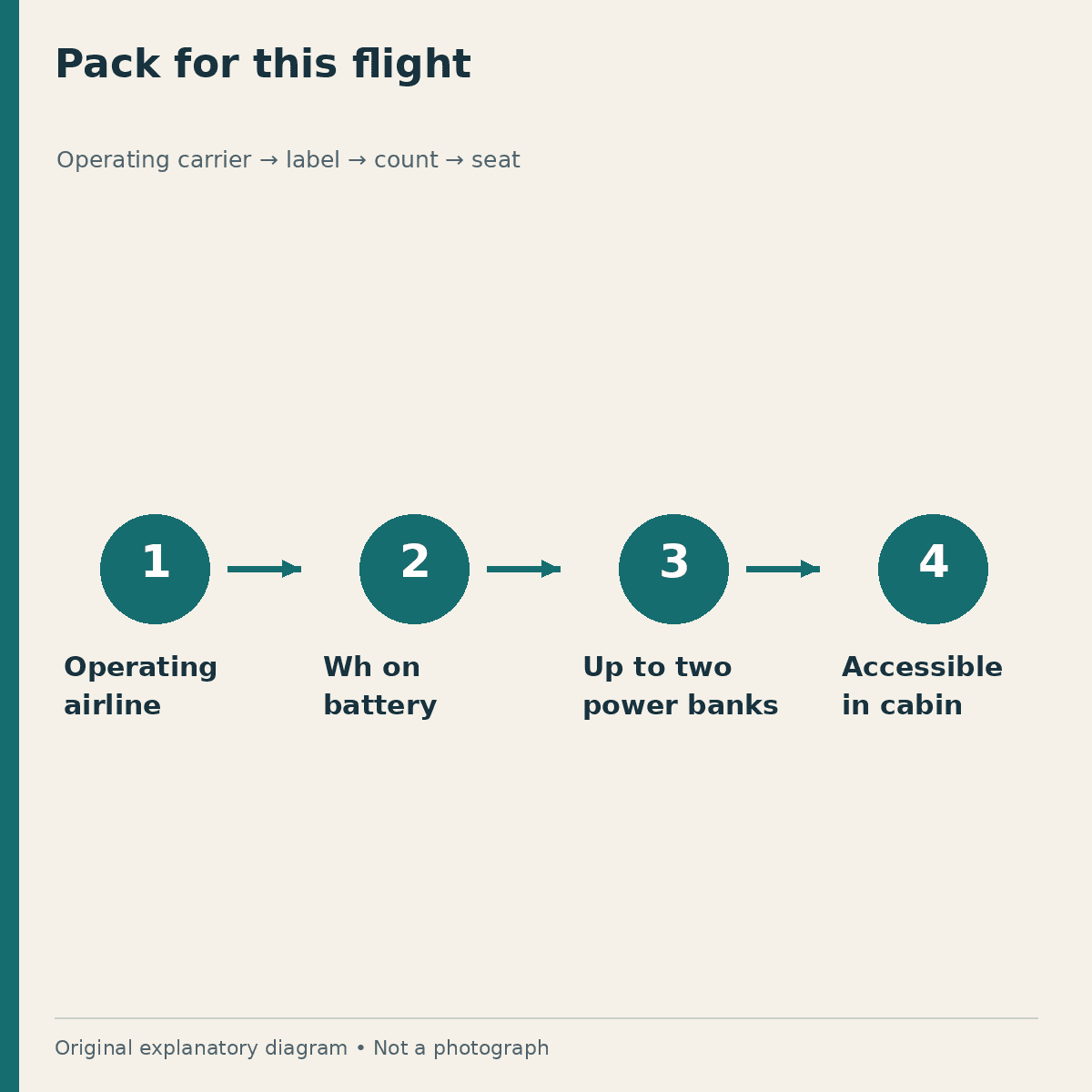
Start with the capacity printed on each bank
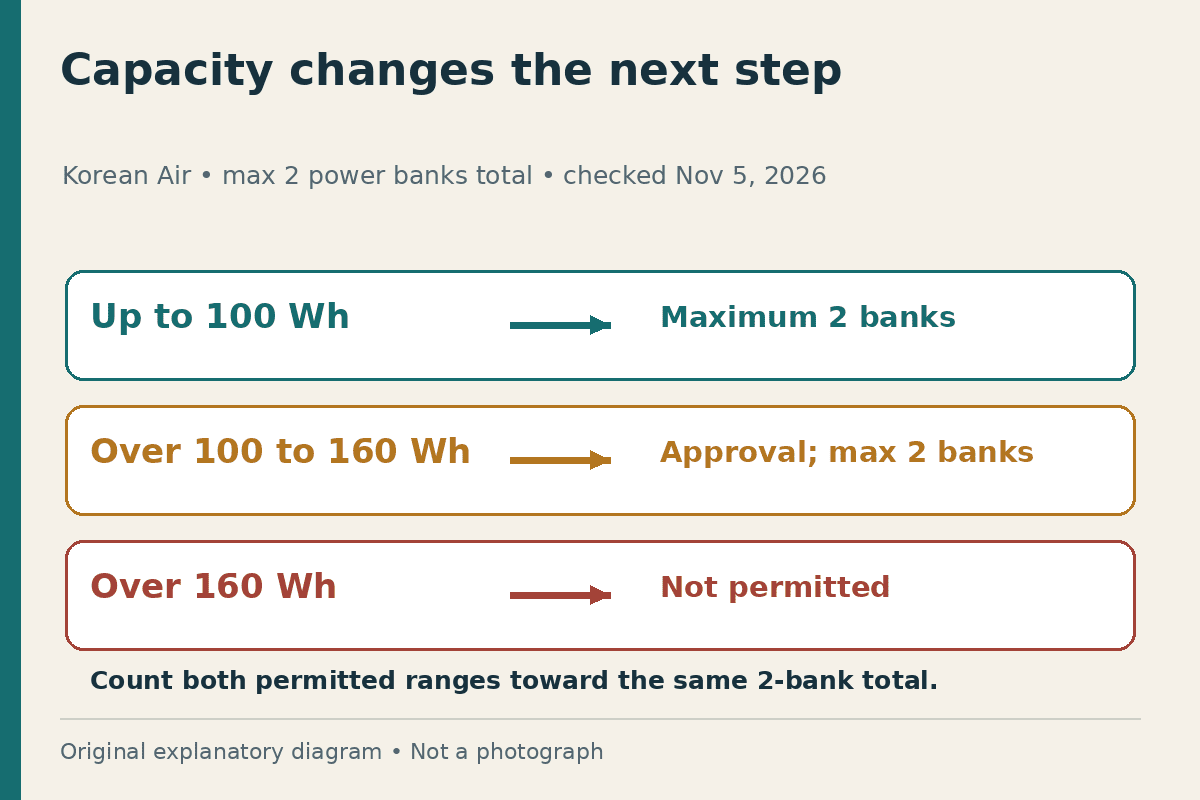
Find the watt-hour rating, written as Wh, on the device. Then use the applicable branch below. The airline’s restricted-items guide is the place to recheck acceptance conditions for your departure date.
| Power-bank capacity | Decision before departure |
|---|---|
| 100 Wh or less | Within the ordinary permitted capacity range. Count it toward the two-bank total. |
| More than 100 Wh, up to 160 Wh | Obtain airline approval in advance. It still counts toward the same two-bank total. |
| More than 160 Wh | Do not bring it as passenger baggage. |
The limit is two across the permitted ranges combined. One 74 Wh bank and one approved 120 Wh bank use the whole allowance. Two smaller banks plus an approved larger one would exceed it. If you also carry spare batteries in the higher-capacity range, check the airline’s combined limit for those batteries and power banks.
A familiar brand or a small case does not establish capacity. An unreadable rating, damage, swelling or signs of overheating can prevent acceptance. Resolve an unclear label with the manufacturer and airline before travelling. Do not replace the manufacturer’s marking with a home-made label or pack a damaged bank in the hope that it will pass inspection.
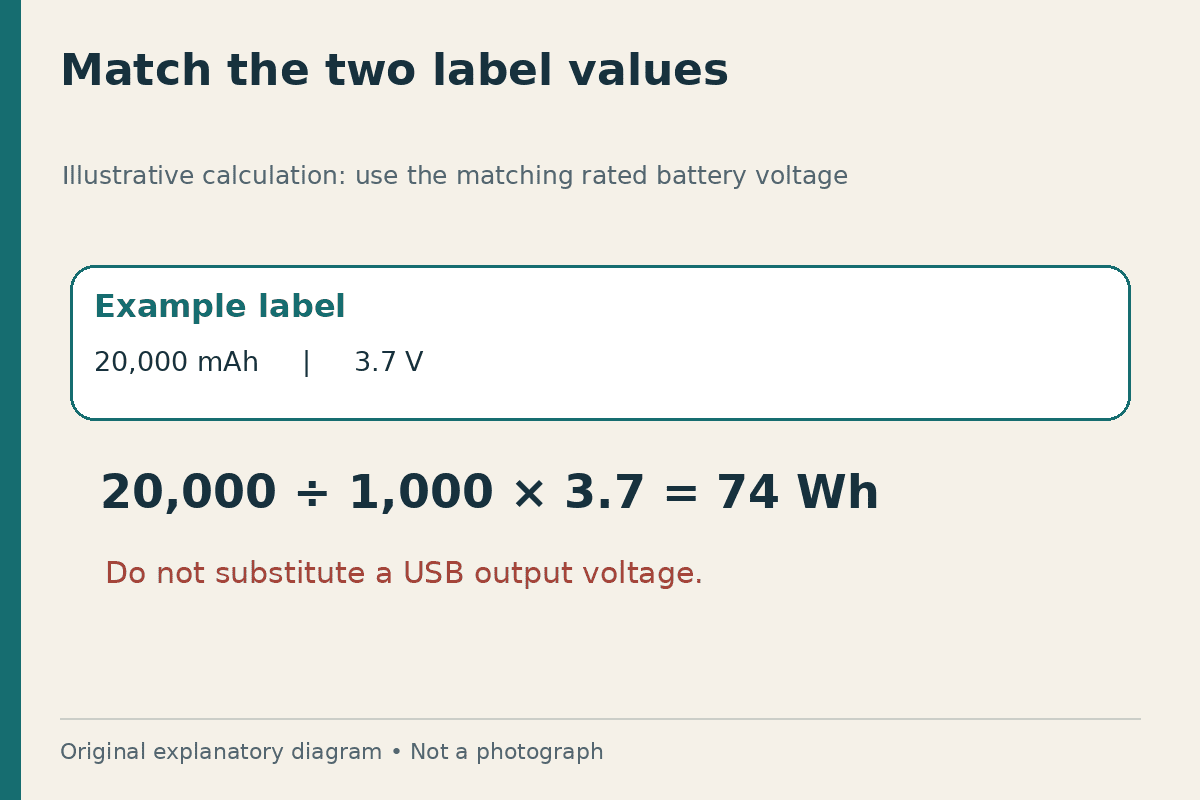
Use battery voltage when checking a calculation
When the relevant specifications are available, the conversion is Wh = mAh ÷ 1,000 × nominal battery voltage. As a hypothetical example, 20,000 mAh at 3.7 V equals 74 Wh.
The USB output values printed beside a charging port, such as 5 V, 9 V or 12 V, describe charging output. They are not automatically the nominal battery voltage needed for this calculation. Also distinguish W, a power rating, from Wh, the energy capacity used for the airline limit. A correct arithmetic result does not replace an acceptable manufacturer label or airline approval.
A wall charger is a different item with a different label. If you are sorting both devices at once, the Korea charger input-label guide explains the mains-power check separately.
Pack for the moment your main bag leaves your hands
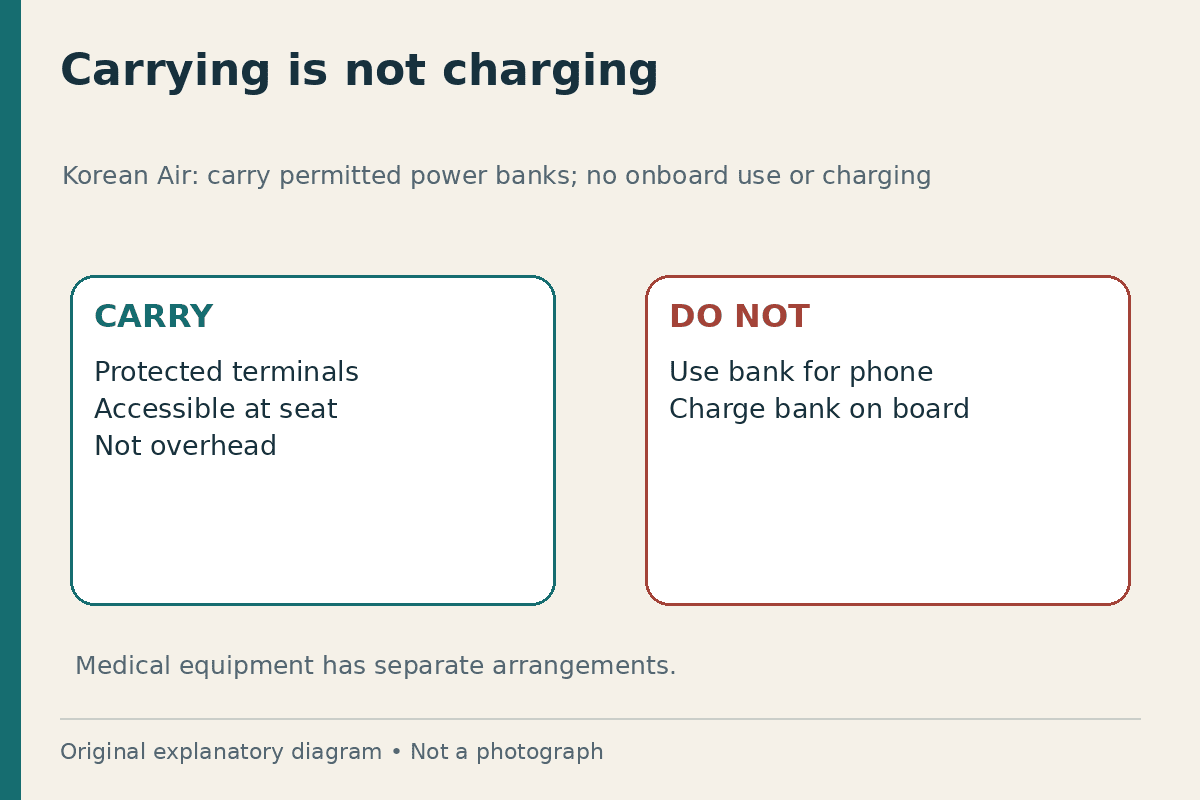
Protect each accepted power bank against short circuits using a method allowed by Korean Air: insulate its terminals, put it in its own transparent resealable bag, or use an individual protective pouch. Keep it accessible in the cabin bag you will retain.
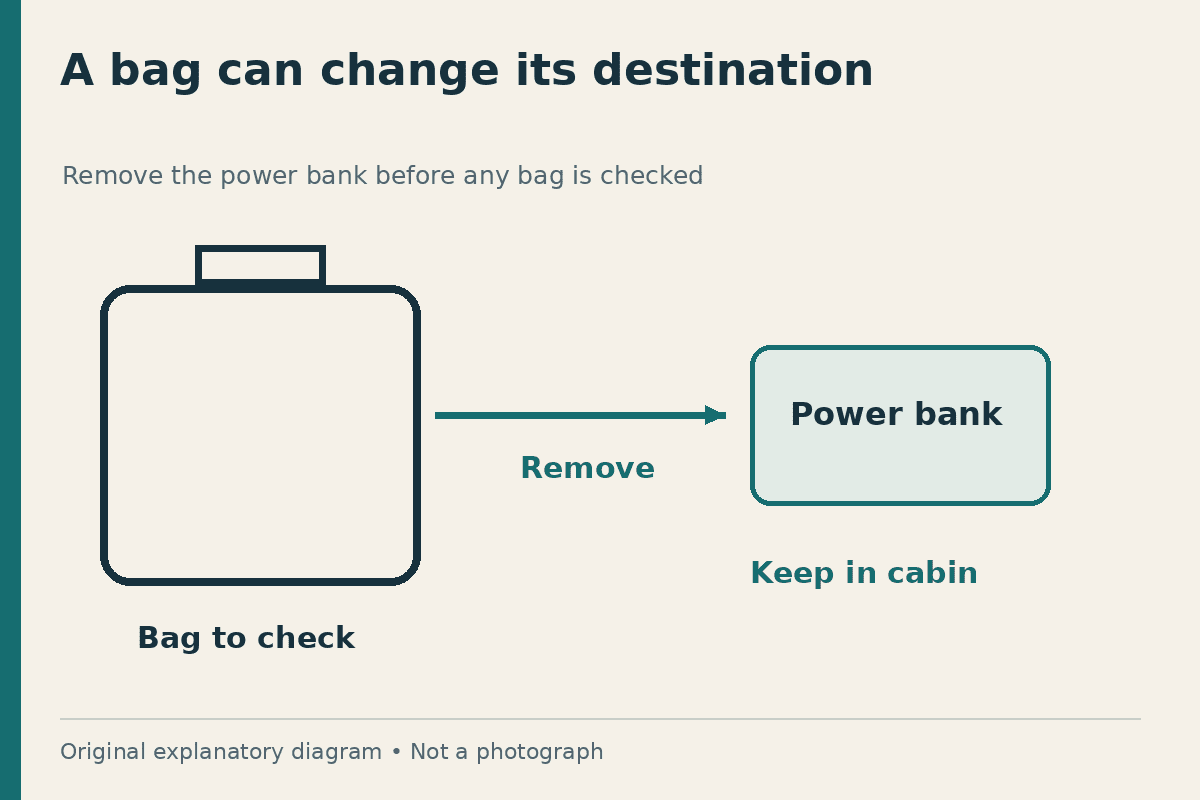
- Before checking a suitcase: remove every power bank and keep it in your cabin baggage.
- If a cabin bag is taken at the gate: take the power banks out before handing the bag over. A change from cabin baggage to checked baggage changes where those devices may travel.
- Before stowing your bag aboard: separate the power banks from anything you plan to place in an overhead bin.
- At your seat: follow the crew’s directions and keep the devices on your person or in the seat pocket in front of you, as the airline specifies.
It is easier to make these separations at home than in an aircraft aisle. A small, clearly accessible pouch can keep the devices together while still protecting each one individually. Your boarding preparation can then focus on the remaining Incheon departure and terminal checks.
Carriage permission does not include onboard charging
Korean Air’s April 2026 power-bank notice prohibits onboard use and charging of power banks and keeps them out of overhead bins. Charge your phone before boarding, and do not connect it to a power bank during the flight. Do not recharge the bank from an aircraft outlet either.
If a device becomes unusually hot, smells abnormal or emits smoke, tell the cabin crew immediately. If it slips into an electrically operated seat, alert the crew before moving the seat mechanism.
The airline describes a medical-use exception for equipment such as a portable oxygen concentrator or CPAP. Arrange that directly with Korean Air before travel, including the device and battery requirements. A general packing guide cannot establish approval for an individual medical setup.
Finish with three items ready to show: the device’s readable capacity, any required airline approval, and your plan to retain and protect it in the cabin. Recheck the operating carrier’s current rules shortly before departure, especially if an older packing article says that five power banks are allowed.