The white tower above Jeongdong-gil marks an unusual moment in Korean royal history: a king sought safety in a foreign diplomatic compound and continued making decisions there. The former Russian Legation is worth visiting for that political story, even though little of the original complex survives.
Understanding the move makes this small outdoor stop more revealing. Why did Gojong leave his palace? What changed when royal government operated from the legation? And how much of that episode can the building in front of you actually explain?
Why the king left the palace
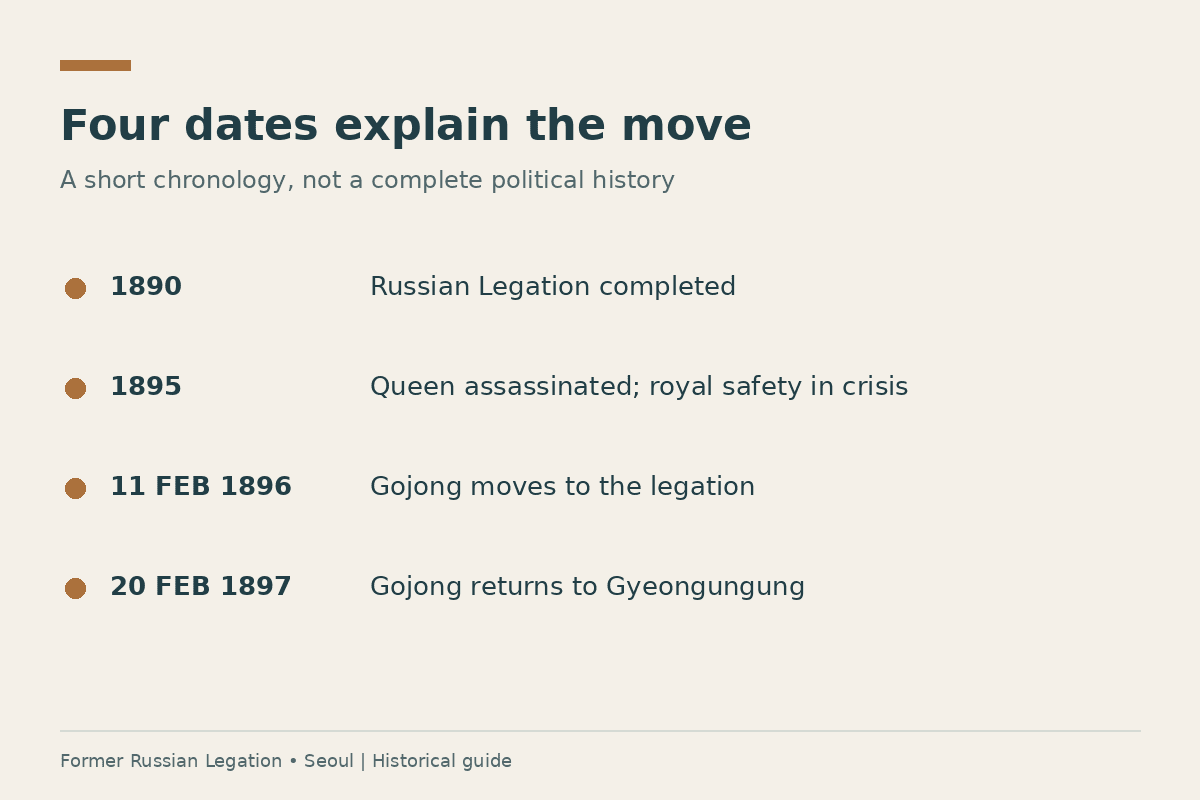
After the queen’s assassination in 1895, Gojong faced a serious crisis of personal security. On 11 February 1896, he moved from Gyeongbokgung to the Russian Legation. The episode is known as Agwan Pacheon, the royal refuge at the Russian legation.
The move provided protection while changing the setting in which the king exercised authority. On arrival, Gojong ordered the dismissal of Kim Hong-jip’s cabinet and established a new cabinet. The change of residence thus immediately changed who held government office. The National Institute of Korean History’s account of the refuge provides the historical context and chronology.
For a visitor, the important tension is between safety and independence. A protected residence could give a threatened ruler room to act, while placing the court inside another country’s diplomatic premises.
The return was to Gyeongungung
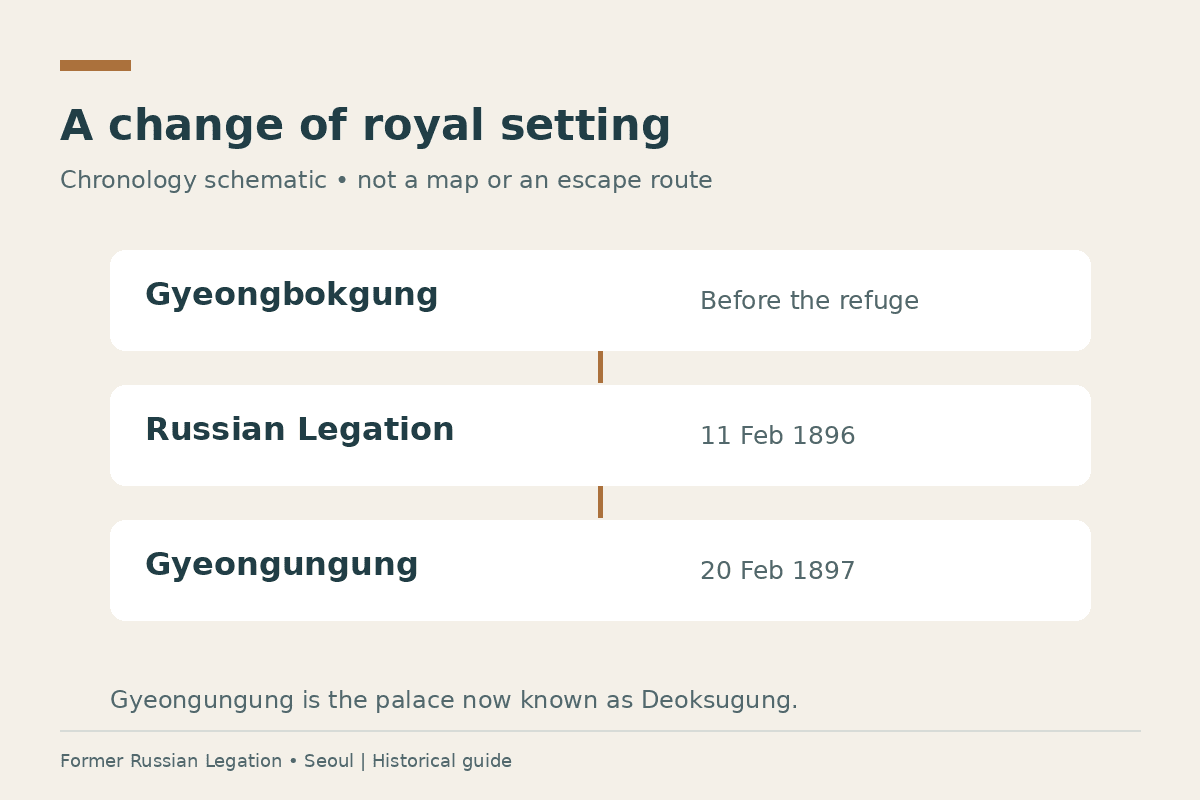
Gojong left the legation on 20 February 1897, returning to Gyeongungung, the palace now known as Deoksugung. That destination matters: the story does not end with a simple return to the same palace he had left.
Use the three places as a mental sequence when exploring central Seoul. Gyeongbokgung supplies the starting point, the Russian Legation marks the refuge, and Gyeongungung supplies the return. This is a way to organize the history, not a suggestion to trace an exact escape route through today’s streets.
What the surviving tower can tell you
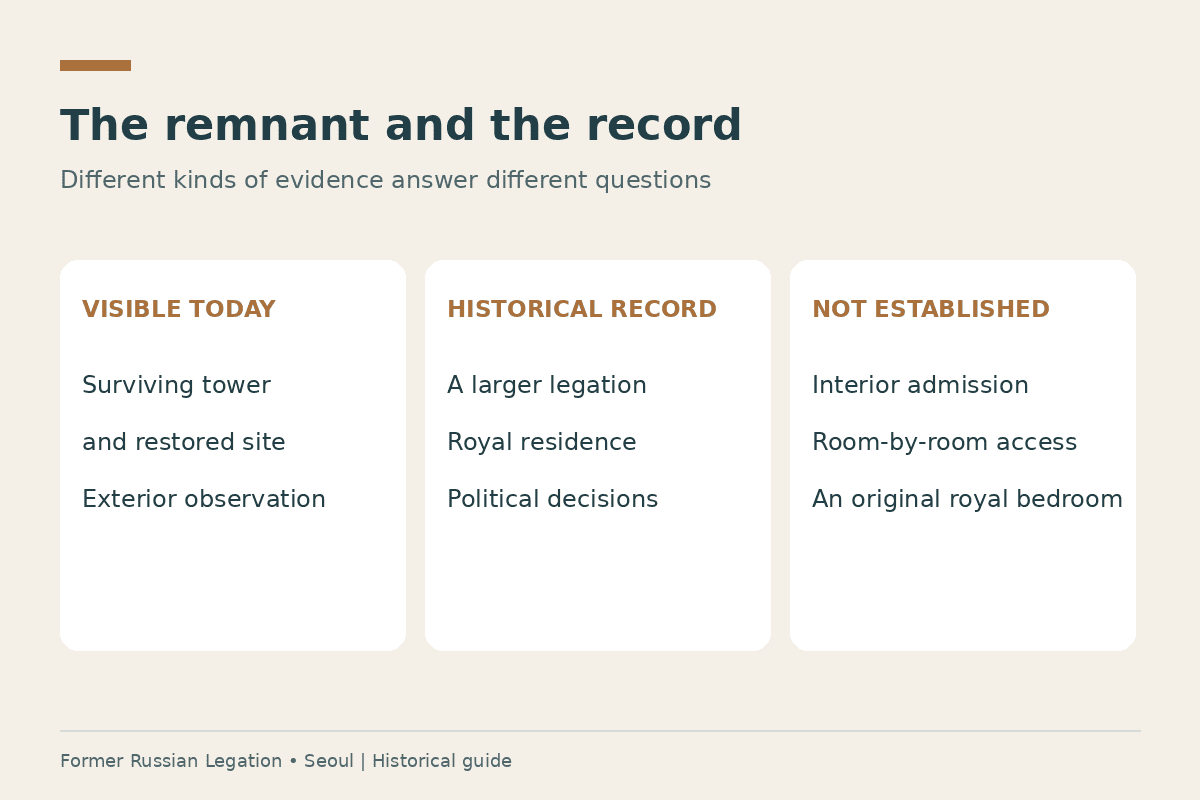
The legation was completed in 1890 to a design by Sabatine. Much of the building was destroyed during the Korean War, leaving the tower and basement. Restoration followed in 1973, and the grounds became a public park, according to the Korea Tourism Organization’s site history.
The visible remnant is therefore only part of the place where these events unfolded. Its small present footprint should not become your mental picture of the entire diplomatic compound. Nor does a surviving structure, by itself, identify the room in which a particular royal decision was made.
Pause with two separate questions. What can you observe about the remaining structure and its hilltop setting? What requires a historical account to explain?
Make the uphill stop in daylight
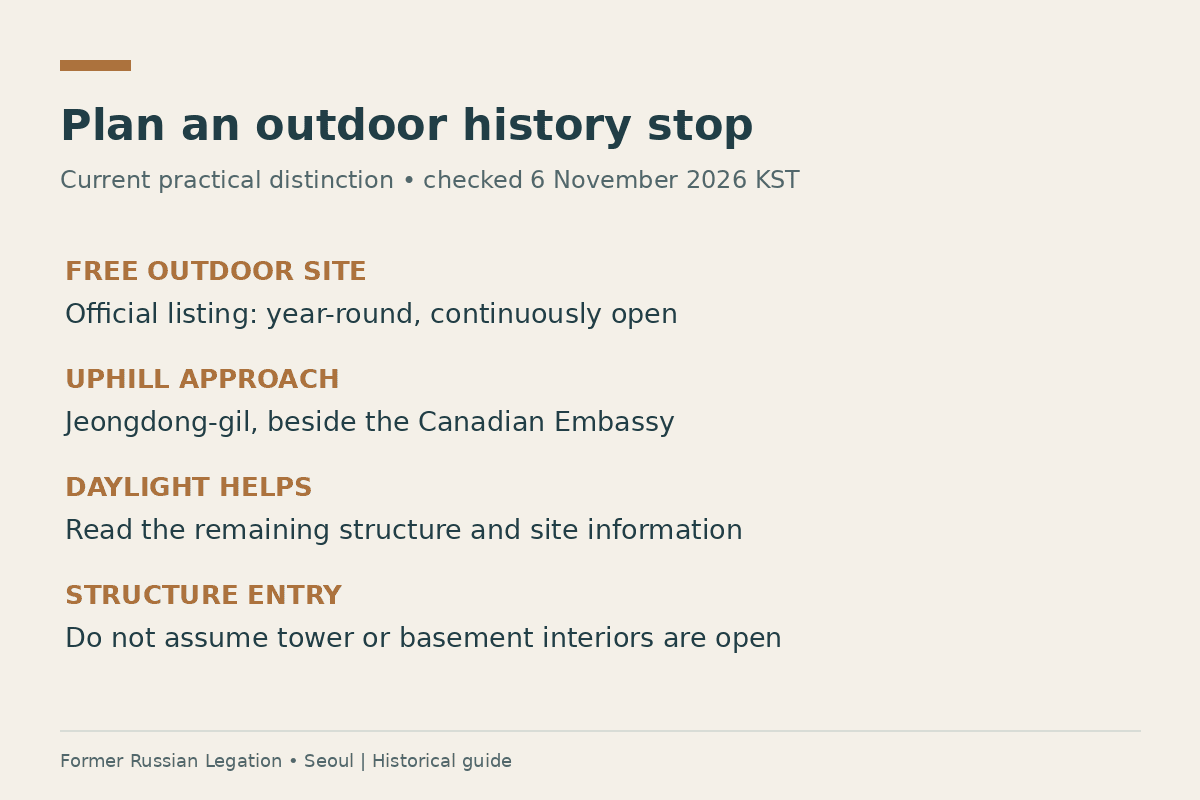
Search for Former Russian Legation (구 러시아 공사관) at 21-18 Jeongdong-gil, Jung-gu, Seoul. Use the historic site name rather than searching only for the current Russian Embassy.
City Hall Station is a useful starting area for Jeongdong. Seoul Tourism describes the final approach as an uphill path beside the Canadian Embassy on Jeongdong-gil in its guide to Seoul’s streetside architecture. Check your walking directions to the historic site before leaving the main street, and allow for the climb rather than assuming a level extension of the palace-wall walk.
KTO lists admission as free. Its accessible-tourism listing describes year-round, continuous access to the outdoor site. Plan for exterior viewing; this does not establish admission to the tower or basement. Follow barriers and notices on arrival. Although the listing describes threshold-free grounds, it does not guarantee a step-free journey from the subway. Visitors with specific mobility needs can ask the accessible-tourism listing’s contact, +82-2-3396-5844, about the approach; the English destination listing gives a different contact, +82-2-3396-5882.
Korea Travel Tips
도봉산고양이’s Korean-language Jeongdong walking account also describes the uphill detour and viewing the remnant from outside. The useful planning lesson is modest: leave room for the approach and a pause, rather than treating the tower as something you will necessarily see while passing along Jeongdong-gil. Daylight is the better choice for looking at details, and wet weather may be a reason to postpone the climb or choose an indoor stop.
If you are continuing through the neighborhood, the Deoksugung stonewall street and palace guide explains how to keep the public street walk separate from a palace visit. Neither needs to be added merely to make the legation stop longer.
Leave with the political question
The tower’s significance comes from the situation it helps locate: royal power continued to operate, but from the shelter of a foreign legation. Holding that tension in mind gives this quiet remnant a place in the larger history of Seoul, without requiring it to offer a complete palace or museum experience.
Visitor information checked on 6 November 2026, Korea Standard Time. Temporary restrictions and on-site access arrangements can change.