Imagine starting your first Seoul Bike ride at 10 a.m., returning it at 10:40, then taking another bike at 2 p.m. With a one-hour daily pass, those can be two separate short rentals within the same pass. Keeping the first bike until 2 p.m. would exceed the one-hour allowance and incur excess charges.
A daily pass has a validity window; each rental has its own time allowance. This guide explains both for adult visitors using Seoul’s public bicycles, called Ttareungi (따릉이). It covers the repeat-use daily products, not every membership or promotional pass.
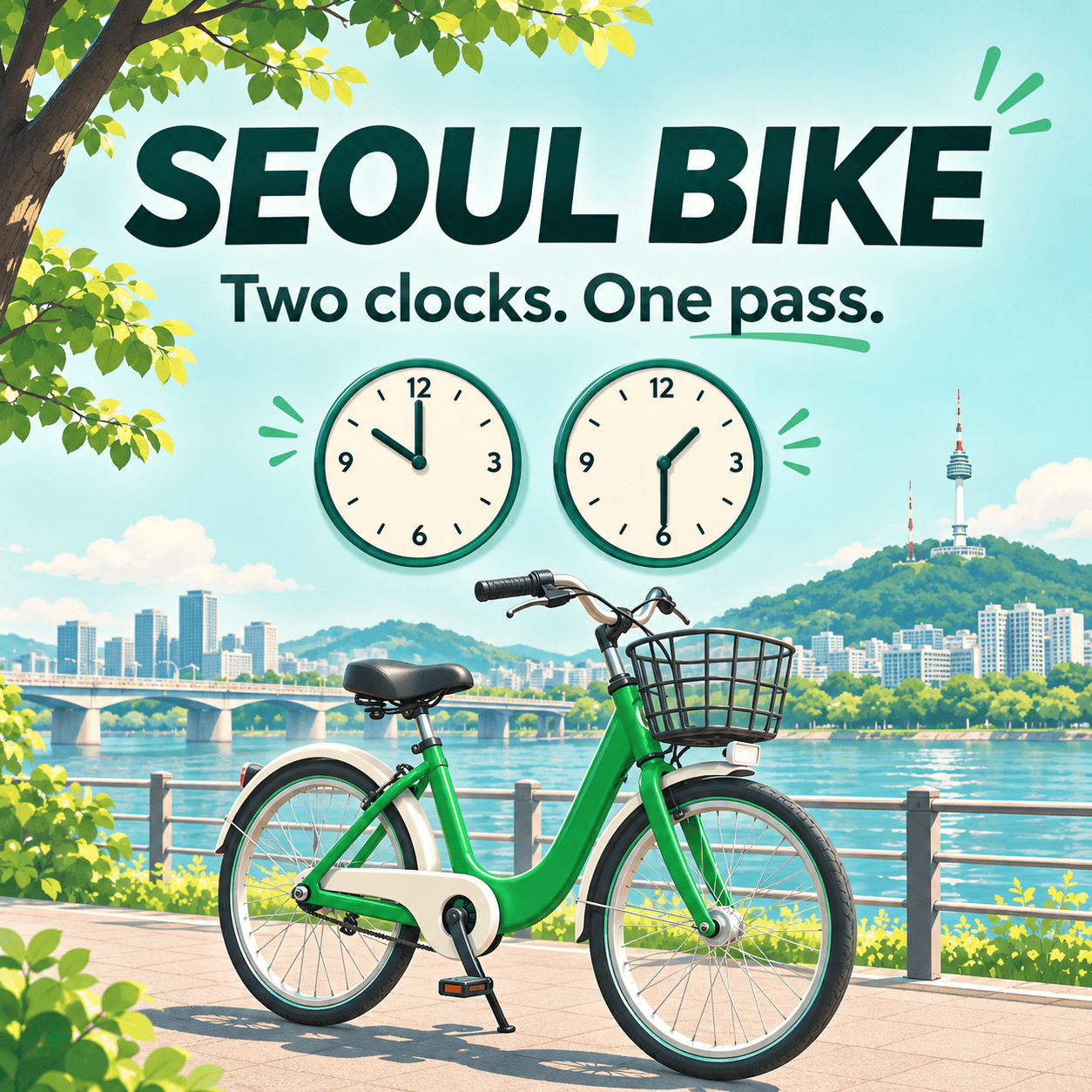
All example times below are Korea Standard Time (KST).
Follow one pass through two completed rides
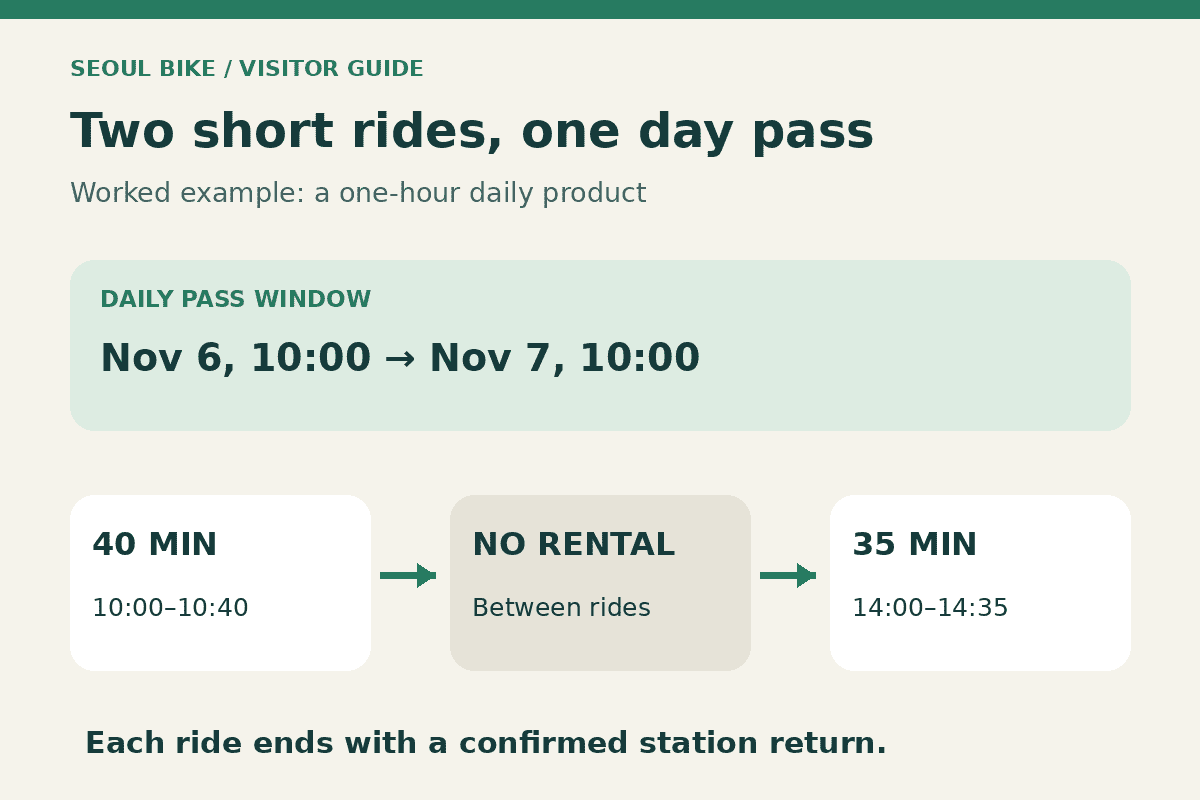
Seoul’s official pass explanation starts the daily validity period at the first rental. In our hypothetical example, a first rental at 10 a.m. on day one starts a pass window lasting until 10 a.m. on day two. Buying the pass earlier does not turn its use window into a midnight-to-midnight calendar day.
- 10:00–10:40: ride for 40 minutes, then complete the return at a designated station.
- 10:40–14:00: no bicycle is rented. The daily pass window continues.
- 14:00–14:35: rent another available bike and complete a second return after 35 minutes.
Each ride fits a one-hour allowance. The combined 75 minutes is not one continuous rental, so it does not require a two-hour product merely because the daily total exceeds an hour. Conversely, a café stop with the bicycle still rented counts toward that rental’s allowance.
Choose the allowance for each ride
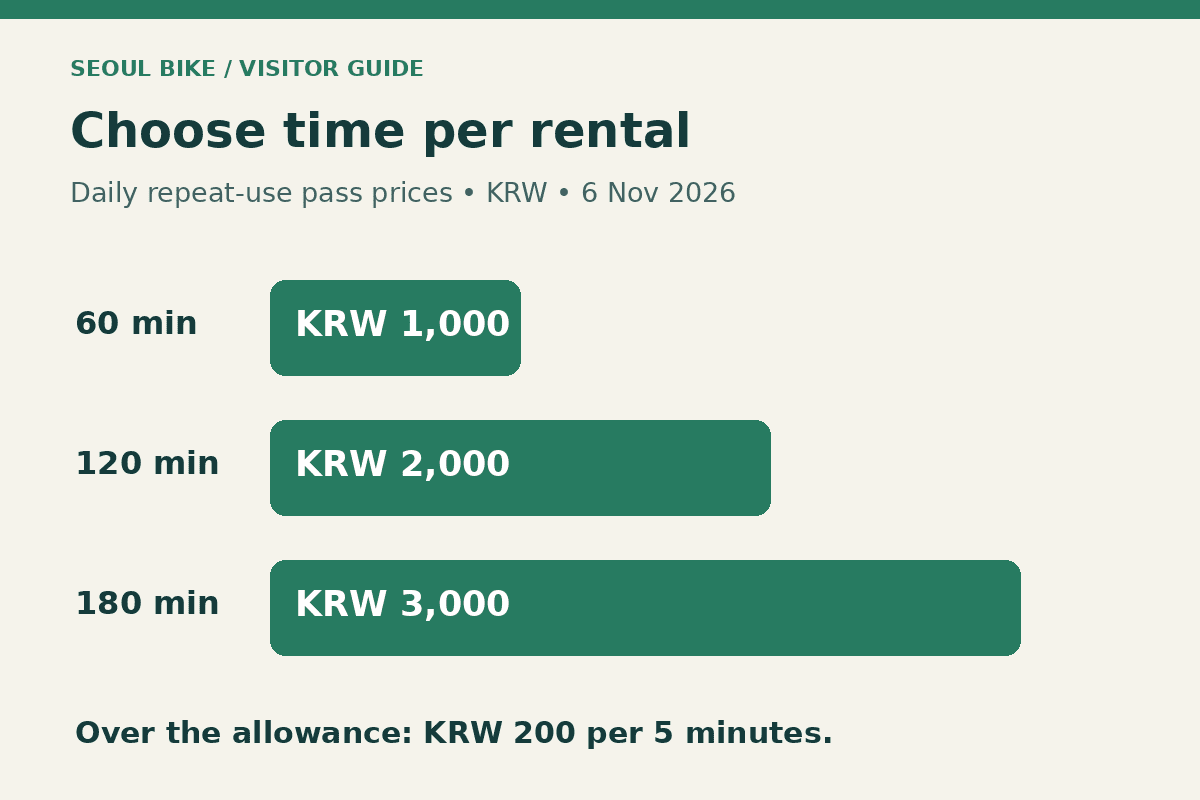
The Seoul Facilities Corporation service guide, checked November 6, 2026, lists these daily repeat-use products. Prices are in Korean won per pass.
| Daily product | Allowance per rental | Pass price |
|---|---|---|
| One-hour | 60 minutes | KRW 1,000 |
| Two-hour | 120 minutes | KRW 2,000 |
| Three-hour | 180 minutes | KRW 3,000 |
The operator lists an excess charge of KRW 200 per five minutes beyond the chosen rental allowance. Return before the limit rather than trying to use the last possible minute. A longer allowance buys more time for each rental; it does not remove the need to return the bike.
Read the exact product offered before paying. Tourism pages may also describe other products, including continuous-use options, whose conditions differ. Seoul’s fare page says a used daily pass is nonrefundable; check the purchase terms if cancellation matters to you.
Use the visitor purchase route
The operator’s foreigner instructions direct visitors to the app’s Foreigner option or the website’s English, Chinese or Japanese interface. They specify an overseas-issued credit card and one pass per card. Do not assume one purchase equips your whole group.
Have a charged phone, working data connection and your payment card ready before approaching a bicycle. Follow the visitor instructions rather than a resident’s membership tutorial. The city’s visitor guide also uses an email address for pass recovery, so enter one you can access and retain the purchase confirmation.
Use the app to find a current station and an available bicycle. Scan the bicycle’s QR code or enter its number, following the on-screen rental instructions. A station appearing on a map does not reserve a bicycle. If payment fails, check whether a charge or pass was created before trying again; another transport option is better than repeated uncertain payments.
Finish the rental, not just the ride
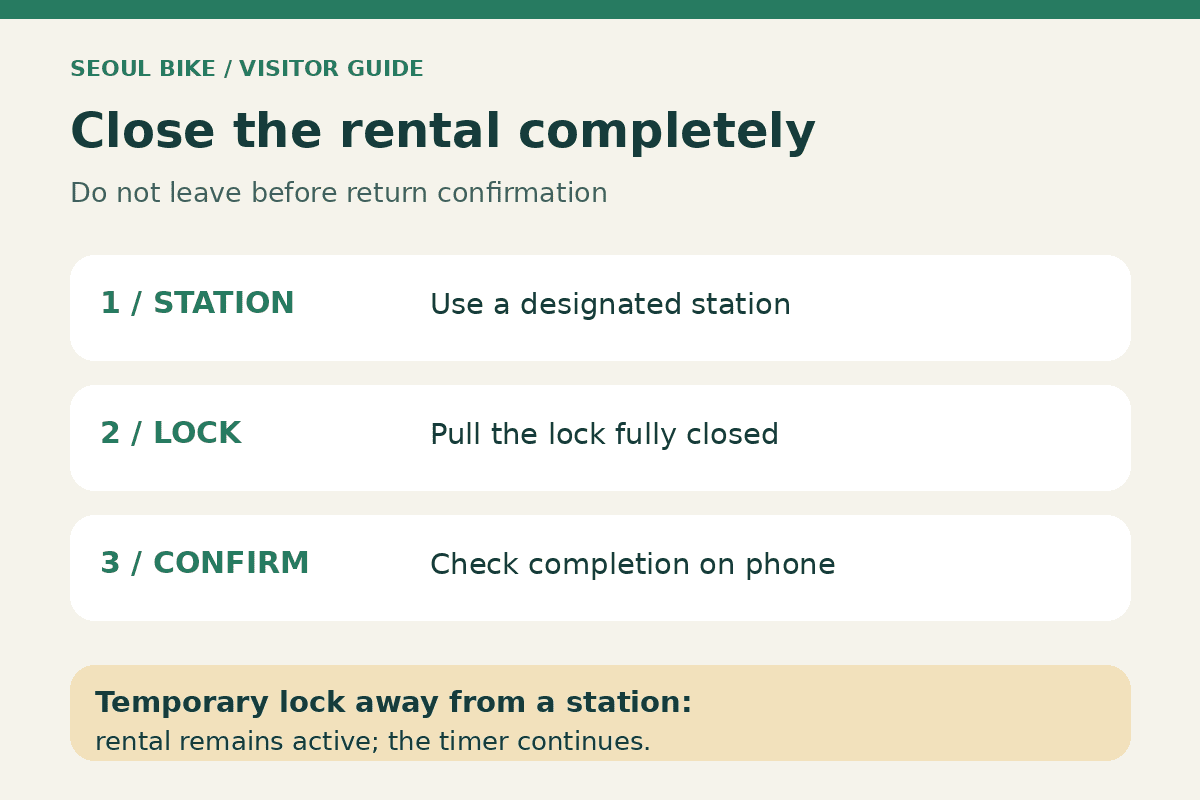
At a designated Ttareungi station, park as instructed, pull the rear-wheel lock fully into place and check the return-completion confirmation on your phone before leaving. Your next rental depends on the previous one being properly closed.
The operator’s temporary-lock FAQ makes the distinction clear: locking a bike away from a station for a short stop leaves it in use. The clock keeps running, and an excess charge can accrue.
A September 2026 Korean-language rider account describes a delay between locking and the app showing a completed return. That is a useful reason to check the status, not evidence that every delay resolves by itself. This guide is based on published instructions and rider reports, not a rental test.
If the return is still unconfirmed
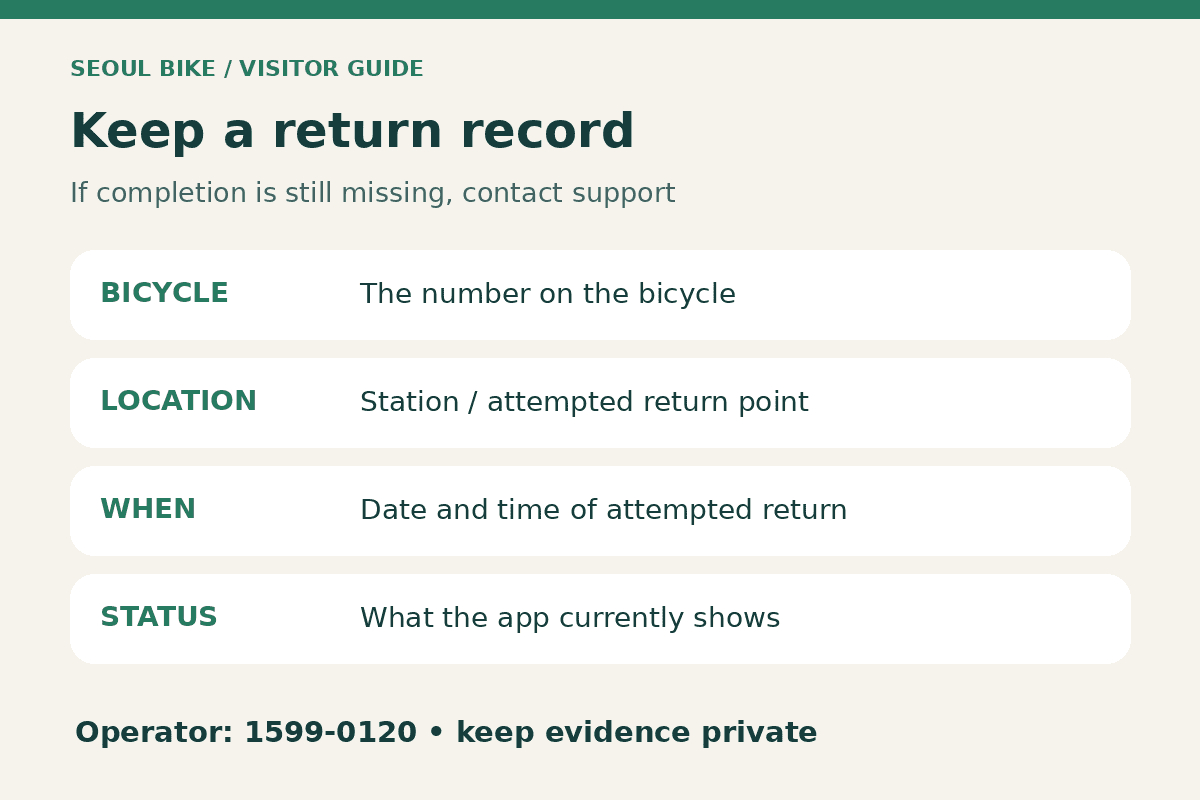
First check that the lock is fully closed and wait for the completion message. If it does not arrive, the operator’s return-help instructions say to contact 1599-0120. Record the bicycle number, station and time while you are still there.
If you cannot call, the same instructions direct users to leave the return location and date/time on the service’s inquiry/FAQ board. This is a support route, not an instant resolution or fee-waiver guarantee. Keep your purchase and return evidence private. English assistance and the ability to reach a domestic service number depend on the support channel and your phone service; a data-only SIM does not supply ordinary voice calling.
Make the first ride deliberately short
Choose a nearby return station before setting off. Check the tyres, brakes and chain, wear a helmet, and keep your phone put away while moving. Follow bicycle routes and signs; walk the bike across an ordinary pedestrian crossing. Do not ride after drinking.
Leave room for unfamiliar junctions, pedestrians and finding the return point. If conditions or confidence are poor, use the subway planning guide instead. A completed short rental teaches you more about the process than a long first ride under time pressure. Once the app confirms the return, you can decide whether another ride fits the remaining pass window.