Daejeon’s Expo area and Hanbat Arboretum can make a satisfying half day without turning into an endurance walk. Build the outing around a river crossing and one garden section. Treat an indoor attraction, a tower visit or a second garden as an addition only after you know what is open and how everyone feels.
The route below is a suggested sequence, not a timed tour or a promise of uninterrupted access. Check the weather and current local notices, then decide which end makes most sense for your arrival and onward journey.
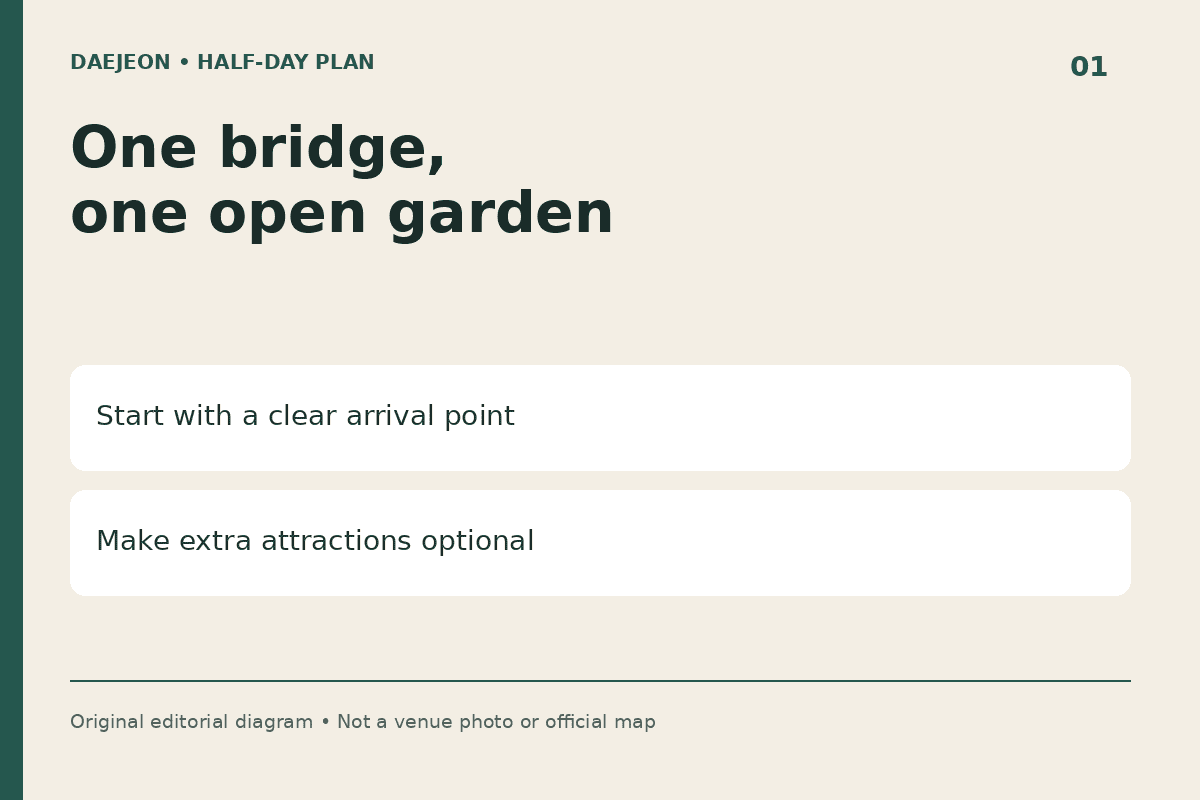
The route, with a decision at each stop
- Hanbit Tower area: use the exterior as an orientation point; enter only if current access and your interests justify it.
- Expo Bridge: cross toward the arboretum if weather and pedestrian access are suitable.
- Hanbat Arboretum: choose one garden that is open that day, then follow a modest loop.
- Finish: take a meal or rest break and leave enough time to reach your onward transport.
For a shorter outing, omit the tower and start near the bridge. If the outdoor conditions are poor, postpone this route rather than treating it as a dependable rainy-day itinerary.
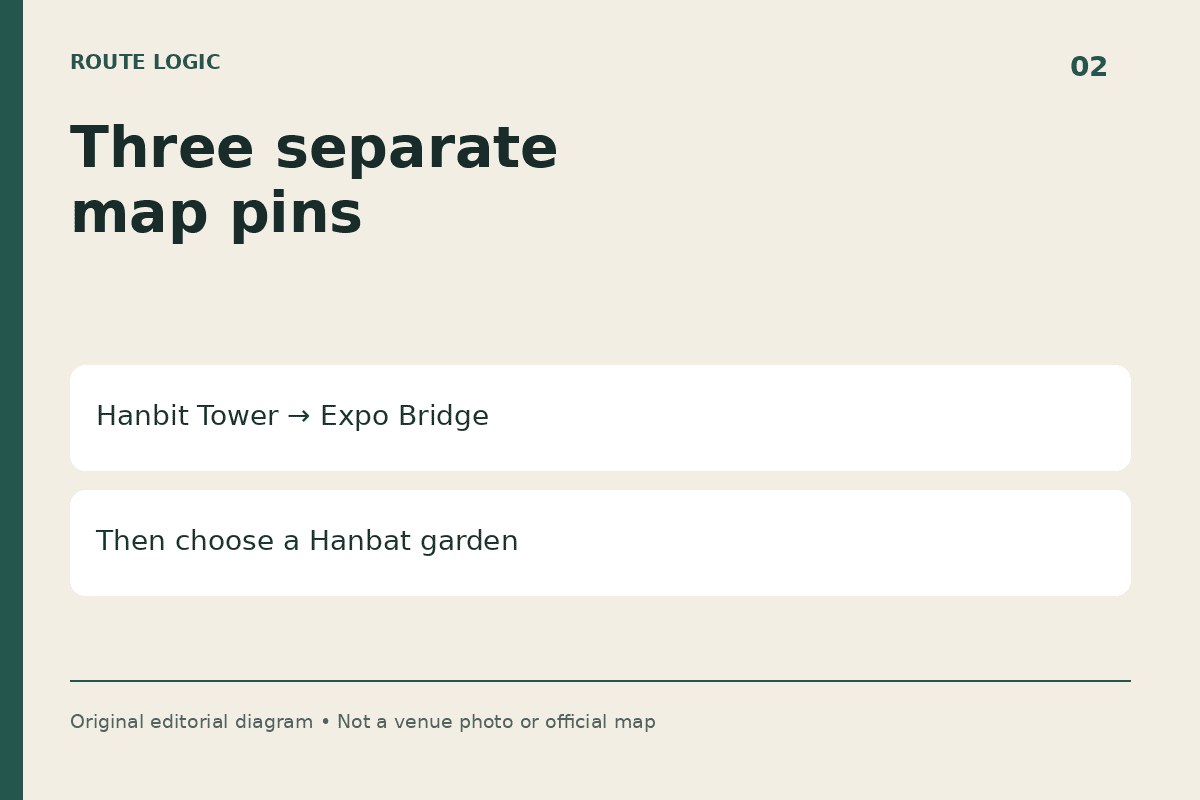
Save three separate places on your map
Mark Hanbit Tower, Expo Bridge and Hanbat Arboretum. Do not use “Expo” as a substitute for a specific arrival point: a broad district or park label may leave you at the wrong end for the walk you intended. Add your lunch or departure destination only after the core route is clear.
The Institute for Basic Science’s local-attractions guide explains the geographic connection: crossing the Gapcheon via Expo Bridge brings you toward the northern end of the arboretum. Use that as the basic relationship, then consult a current map for the paths and crossings available on the day. Do not assume that every line visible on a map is an open pedestrian entrance.
Begin with the Expo landmark, if it fits your arrival
The Korea Tourism Organization identifies Hanbit Tower as an Expo Science Park landmark commemorating the 1993 Daejeon Expo. You can use it as the first orientation point for the outing. Look at its relationship to the surrounding open space before deciding whether to go inside.
If the observatory is important to you, check its current operation and admission arrangements before committing to this order. A plan to photograph a landmark from outside is different from a plan to enter it. Do not make the entire afternoon depend on an indoor stop whose opening status you have not checked.
For a shorter version, begin near Expo Bridge instead. There is no need to visit the tower merely to make the route look complete. The best starting point is the one that preserves enough energy for the garden, particularly when you have arrived in Daejeon after another journey.
Make the river crossing a pause
Before entering the bridge, check the wayfinding and any temporary restrictions. Follow the pedestrian route and keep clear of other users when stopping for pictures. Choose a place to pause without spreading the group across the path. If the wind or rain makes the exposed section uncomfortable, shorten the outing rather than insisting on a full loop.
After crossing, take another look at the map before walking farther. The next decision is the garden entrance you want, not the farthest landmark you can reach. A brief check here can prevent an unnecessary detour around a closed or unsuitable entrance.
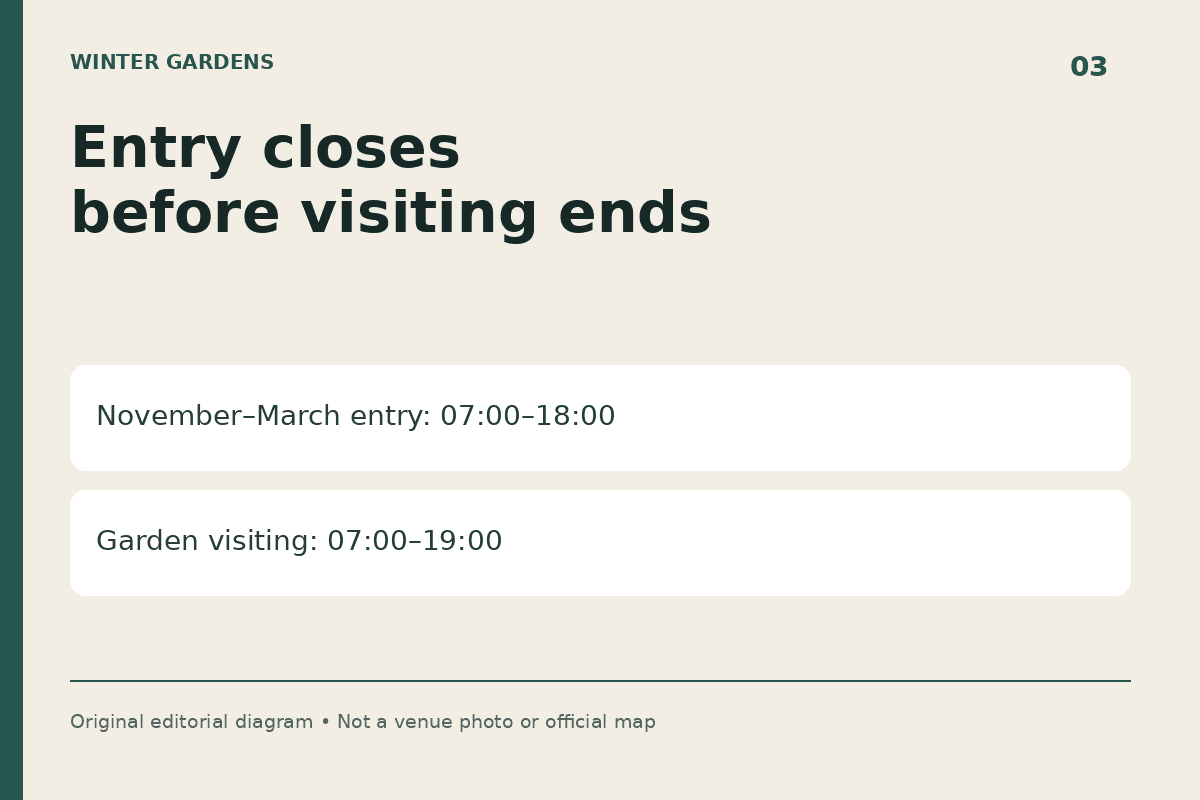
Choose one open garden at Hanbat
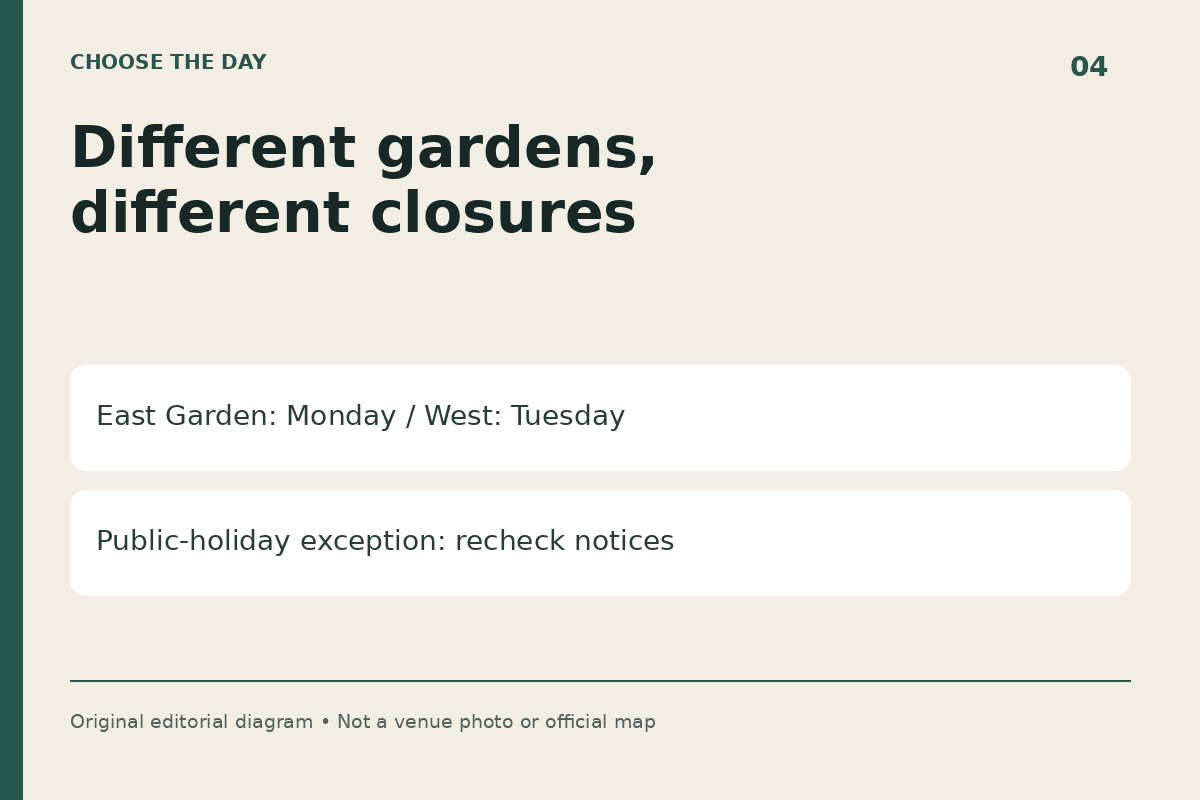
Hanbat Arboretum has different sections with different closing arrangements. The Hanbat Arboretum visitor information (Korean) publishes its seasonal visiting information, regular closure days and temporary notices. Read the date and scope of any notice: a past event affecting one garden should not be interpreted as a continuing closure of the whole arboretum.
The operator’s information checked on 17 November 2026 lists Monday as the East Garden’s regular closing day and Tuesday as the West Garden’s. It says those regular closures do not apply when the day is a public holiday. Check temporary notices as well, and use the entrance deadline rather than the later closing time when deciding whether you can still enter.
For a first visit, select one available garden section and look at its plan before entering. Pick a small loop with a clear return point instead of zigzagging toward every named feature. Let the actual season shape what you notice. Leaves, branches, planting arrangements and quiet corners can be worthwhile even when a flower display is not at its peak.
This is also a good point to agree on the group’s pace. Someone interested in plants may want to read labels, while another person may mainly want a relaxed walk. Choose a meeting point and keep the plan simple enough that nobody feels obliged to hurry through the part they enjoy.
Put food and rest before an extra attraction
Carry the essentials you normally need for an outdoor outing, and check where you can take a suitable break. Before making a meal stop, look up a specific place and its current opening status rather than assuming the nearest large building contains the food you want. Account for the walk back to your transport after lunch.
If you are still interested in another attraction, choose it for its own content and opening arrangements. An adjacent museum is not automatically a quick add-on. Leave enough time to enter, understand what is on display and return without rushing. Otherwise, finish after the garden and keep the museum for another visit.
Protect the onward journey
If Daejeon is a stop on a rail trip, plan the transfer back to the correct station separately from the walking route. Our KTX booking checklist helps keep station names, dates and tickets aligned. The weather-planning guide can help you decide whether the river section belongs at the beginning, at the end or outside today’s plan altogether.
End after the garden if the outing feels finished. A route that leaves you rested enough to enjoy the evening is more useful than an extra attraction reached only because it appeared nearby on the map.
About this guide
This is an AI-assisted planning guide based on the linked official visitor information, not a first-hand visit or a personal review. AI was used to draft and organize the information into practical questions and decisions for a trip. Operating details can change; use the linked operator pages to confirm arrangements for your date.